
You may have held a German residence permit for years, kept a stable job, and paid into the pension system. Even so, one missing certificate can stop a permanent residence application.
The Ausländerbehörde does not assess only time in Germany. It checks whether your residence history, livelihood, pension record, language proof, housing, employment, and civic knowledge form a complete file.
This matters most for non-EU professionals using the EU Blue Card route. The law can allow a faster path, but a shorter timeline does not excuse an incomplete application.
This guide explains the permanent residence Germany requirements by route. It also shows which documents cause delays and what applicants can do when the authority does not respond.
Table of contents
A Munich Blue Card Case That Says Everything
A Blue Card holder in Munich applied for permanent residence in early 2025. The authority responded quickly but identified one missing item, an A1 German certificate, and asked the applicant to withdraw the application.
The applicant passed the exam and filed again on 1 August 2025. The second application then stalled.
By June 2026, no decision had arrived, and the applicant sought legal advice. The case records show that the applicant chose the lawsuit route.
The key point is not whether the applicant eventually qualified. The key point is that one missing certificate turned a time-sensitive application into a prolonged administrative problem.
Many applicants treat the Niederlassungserlaubnis as a simple residence-clock exercise. German law does not work that way.
The authority evaluates several requirements together. A weakness in one category can stop the file, even if the residence period is sufficient.
Practical rule: Treat every requested document as a condition that can hold the entire file, not as an administrative formality.
Blue Card applicants should understand the link between their permit, qualifying employment, language evidence, pension documentation, and finances before filing. The accelerated framework described in the EU Blue Card residence guidance can help, but it still requires a legal assessment.
Preparation should start with the exact residence title and statutory route. The applicant must confirm four points before filing:
- Which residence periods count.
- Which language level applies.
- Whether the employment qualifies.
- Whether the pension record supports the application.
The authority may also ask for updated employment evidence if the file remains pending. A strong application is a complete evidentiary file, not just a form submission.
The sections below translate the legal requirements into practical checks. They also identify the documents that often arrive late and explain when prolonged silence may justify procedural action.
Need Legal Support
Have questions regarding visa, residence permit, citizenship, Blue card, etc?
We help you in all immigration topics.
What the Niederlassungserlaubnis Requires
The Niederlassungserlaubnis is Germany’s standard permanent residence title. Under Section 9 of the Residence Act, it grants residence without a fixed expiry date.
The legal requirements appear in the statutory rules on the Niederlassungserlaubnis. The standard route generally requires a residence permit held for five years and at least 60 months of compulsory or voluntary contributions to the statutory pension system, or equivalent provision.
These thresholds open the assessment. They do not settle it.
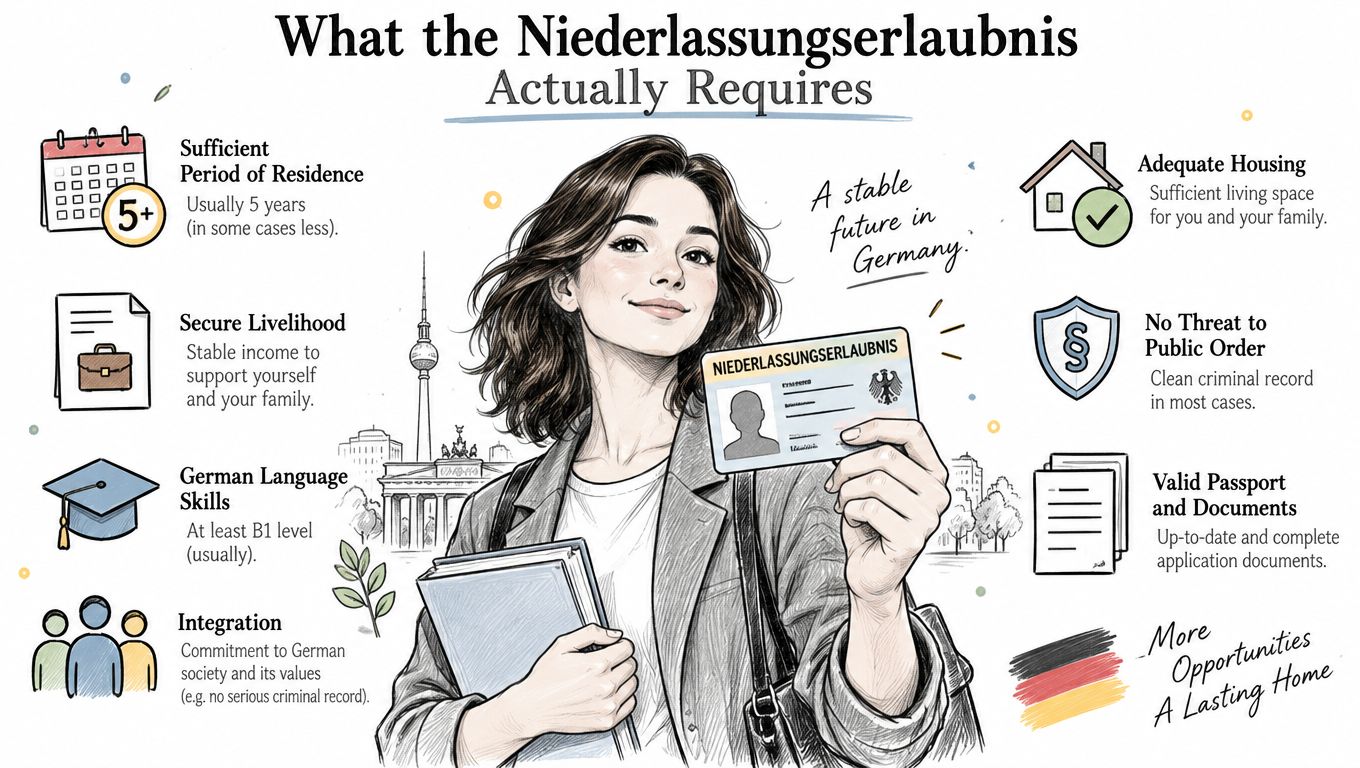
The core eligibility questions
A practical self-screen should answer these questions:
- Residence history: Has the applicant held a qualifying residence title for the required period, and do earlier titles count under the applicable rules?
- Pension provision: Does the pension insurance record show the required contributions or an accepted equivalent?
- Livelihood: Can the applicant support themselves without relying on disqualifying public funds?
- Employment authorization: Is the applicant permitted to work, and does the current job require additional professional authorization?
- Language: Can the applicant prove the German level required for the applicable route?
- Civic knowledge: Can the applicant demonstrate basic knowledge of Germany’s legal and social order and living conditions?
- Housing: Is the accommodation adequate for the applicant and household family members?
- Public order: Are there public-security or public-order concerns relevant to the application?
Residence calculations often reveal the first issue. Some earlier periods may count, while others may not, depending on the rule that applies.
Pension records also need review. Periods affected by childcare or caring for household members may be considered, so an incomplete statement can create avoidable questions.
Meeting the residence period alone does not establish eligibility. Permanent residence requires a cumulative assessment of status, contributions, livelihood, language, knowledge, housing, work authorization, and conduct.
Evidence must match the legal requirement. Stable income still needs current salary records and an employer statement.
Everyday German does not replace the certificate required for the route. In practice, pension records and current employment evidence often trigger follow-up requests because applicants assume the authority already has complete information.
For an initial file review, collect the residence title, pension record, employment documents, housing evidence, language certificate, civic-knowledge certificate, and insurance confirmation. A structured residence-permit review can identify the right route and document set before submission.
See the full residence permit overview.
Every Route to Permanent Residence at a Glance
The correct route depends on the applicant’s current residence title and employment history. The standard route under Section 9 generally uses a five-year residence period and 60 months of pension contributions or equivalent provision.
Qualified workers and EU Blue Card holders may qualify earlier under Section 18c of the Residence Act. They still need to satisfy the other applicable conditions.
For skilled workers, the accelerated route generally requires three years holding a qualifying skilled-worker residence title, continued eligible employment, pension provision, sufficient German, secure livelihood, and the relevant housing and civic requirements. The Section 18c provision governs these accelerated pathways.
EU Blue Card holders have two principal timing points. With basic German-language knowledge, the qualifying period can be 27 months of qualifying employment and corresponding pension contributions.
With sufficient German-language knowledge, it can fall to 21 months. Better German can therefore shorten the employment period by six months, but it does not remove the need to prove livelihood, pension coverage, housing, and the other statutory conditions.
| Route | Qualifying period | German required | Pension requirement |
|---|---|---|---|
| Standard Section 9 route | Five years of residence title possession | Sufficient German for the route | 60 months of contributions or equivalent provision |
| Qualified skilled-worker route under Section 18c | Three years holding a qualifying skilled-worker title | Sufficient German for the route | Contributions or equivalent provision required under the applicable conditions |
| EU Blue Card route with basic German | 27 months of qualifying employment | Basic German-language knowledge | Corresponding pension contributions or equivalent provision |
| EU Blue Card route with sufficient German | 21 months of qualifying employment | Sufficient German-language knowledge | Corresponding pension contributions or equivalent provision |
The table is not a substitute for checking permit history. A job title alone does not prove that the employment falls within the qualifying legal category.
Applicants should keep each Blue Card employment contract, payroll record, pension statement, residence document, and language certificate. Family circumstances can also affect the evidence needed for housing and household members.
Applicants handling related family residence questions can review the family reunification requirements in Germany. The permanent residence file should still stay focused on the applicant’s own statutory route.
The Documents That Decide Your File
A complete application usually requires more than the online form. The authority commonly examines the following:
- Identity
- Current status
- Residence registration
- Housing
- Employment
- Pension provision
- Language
- Civic knowledge
- Health insurance
Each document should be current enough to reflect the applicant’s position when the authority decides the case, not only when the application was uploaded.

Build the file around the legal route
A practical document set should normally be checked in groups:
- Identity and status: Passport, current residence permit, and biometric photograph.
- Residence and housing: Meldebescheinigung, rental contract, and evidence showing adequate living space for the household.
- Employment: Current employment contract, salary records, and the employer’s declaration on the employment relationship, known as the Erklärung zum Beschäftigungsverhältnis.
- Pension: The Rentenversicherungsverlauf or equivalent evidence of pension provision.
- Language and civic knowledge: The applicable language certificate and the Leben in Deutschland test certificate where required.
- Insurance and finances: Health insurance confirmation, tax records, and salary documentation.
The employer declaration deserves special attention
The most overlooked document in the reviewed files was the employer’s declaration. The employer should sign it before filing.
The applicant should also check that the employment contract runs well beyond the expected decision date. An application can become vulnerable if the contract expires while the authority is still reviewing the file.
Keep dated proof of every upload, email, appointment submission, and later document delivery. If the authority says a document was never received, the record can show what was submitted and when.
Route-specific preparation matters. A Blue Card applicant should confirm the qualifying employment category and keep the full employment history together.
A standard-route applicant should focus closely on the pension record and the residence-period calculation. An applicant with family members should check that household, registration, insurance, and residence records do not contradict each other.
The strongest filing is not the largest one. It is the file where every document answers a requirement, every date is consistent, and later updates can be supplied if processing continues.
How Long Permanent Residence Really Takes
Official eligibility periods and administrative processing times are different issues. The law may allow an application after the relevant qualifying period, but the Ausländerbehörde still needs to review documents, request missing evidence, verify employment, and issue a decision.
The practitioner caseload reviewed 14 Blue Card holders who approached with stalled files. Their median wait without a decision was about 11 months, with a range of roughly 8 to 20 months.
These figures are lower-bound indicators for delayed cases because people who seek help are more likely to have applications that have already become problematic.
Stuttgart was the slowest location in that group. Three applications filed in October and November 2024 were still undecided in June 2026.
That does not establish a universal citywide processing time. It does show why applicants should not plan around an assumed local average.
What the broader distribution suggests
A separate free-assessment dataset covered 41 permanent-residence applicants. Within that group:
- 27% had waited 0 to 6 months.
- 46% had waited 6 to 12 months.
- 27% had waited more than 12 months.
These figures are also biased toward delayed files. They should not be presented as a normal processing-time promise.
They do, however, support a practical planning approach. Applicants should keep employment, insurance, housing, and residence documents current throughout the waiting period.
The first three months should be treated as a procedural floor in ordinary delay cases. They should not be treated as a promise of a prompt decision.
Before that point, a follow-up may still be sensible, especially if the authority has identified a gap or requested an update. After that point, the applicant should assess whether the delay may be legally actionable.
A contract ending soon, a planned move, or an expiring language document can change the strategy. Applicants should update the authority before a key document becomes stale and keep proof that the application remains supported.
When Silence Becomes a Lawsuit
Section 75 of the Administrative Court Procedure Act, the VwGO, provides the basis for an Untätigkeitsklage, commonly called an administrative-delay lawsuit. In ordinary cases, legal action is generally permissible only after three months have passed from the application or objection, provided the authority has not decided and has no sufficient reason for the delay.
The statutory rule on administrative silence also allows an earlier lawsuit when special circumstances justify a shorter period.
A delay lawsuit is not the same as a challenge to a refusal. Its purpose is to address the authority’s failure to decide, not to persuade the court to grant the permanent residence title itself.
The court may require the authority to decide, set a further deadline, or suspend the proceedings if the authority shows a sufficient reason for the delay.
When filing becomes strategically sensible
A delay action deserves consideration when the applicant can show:
- A complete or substantially complete application was submitted.
- The relevant procedural period has passed, unless special circumstances support earlier action.
- The authority has not provided a sufficient explanation for the delay.
- The applicant’s evidence is organized, including submission confirmations and later correspondence.
- The applicant remains eligible, with current employment, insurance, housing, and residence documents.
The authority may issue the requested decision after proceedings begin. If it decides within a court-ordered period, the original dispute can become moot.
The court does not automatically turn an incomplete file into a successful permanent residence application. Applicants considering the Untätigkeitsklage filing process should assemble the application form, submission confirmation, document index, authority correspondence, reminders, current permit, employment evidence, and proof of any material consequences caused by the delay.
The typical time from lawsuit filing to decision at LegalWeg is about four months, based on site figures. This is a practice figure, not a statutory deadline or guarantee.
The right question is whether litigation creates a useful procedural path. It is not whether filing guarantees an immediate permit.
Free case assessment
Waiting months for a response on your application. You don’t have to.
Get your free case assessment to learn the best next steps for your situation.
What Actually Causes Refusals and Delays
Incomplete documentation was a recurring issue in the practitioner caseload. Of roughly 24 permanent-residence clients, about 10 reported that they had filed incomplete applications.
Among those applicants, three identified the employer’s declaration as the late document. Two identified the Leben in Deutschland certificate.
The remaining incomplete files each involved a different missing item, the A1 certificate, the pension insurance history, and city registration combined with health insurance. These are not interchangeable omissions.
Each one points to a separate checkpoint that should be completed before filing.

The Munich cascade
The Munich Blue Card case shows how a small gap can create two separate problems. The missing A1 certificate led the authority to ask for withdrawal, and the applicant then had to pass the exam and submit a new application.
The later silence meant that the lost time was not limited to the exam itself. Before filing, the applicant should confirm that every language document is present, legible, and attached to the correct application.
If a certificate is still pending, the safer course is usually to clarify the route and timing before submitting. It is better than assuming the authority will accept a later supplement.
Family files can fail through disconnected records
In another matter, the authority stated that a parent had no permanent residence permit on file. As a result, the child could not apply for citizenship on the expected basis.
The permit existed, but the authority did not have the relevant document in the file. Forwarding the permit resolved the document problem.
The lesson also applies to permanent residence applications involving dependants. Each family member’s file should contain the residence documents and civil-status evidence needed to connect the applications.
Applicants dealing with related family procedures can also review guidance on family-reunion visa delays in Germany.
A useful pre-filing check
- Employment: Employer declaration signed and contract dates checked.
- Language: Correct certificate uploaded for the chosen route.
- Pension: Insurance history obtained and reviewed for gaps.
- Civic knowledge: Leben in Deutschland evidence included where applicable.
- Registration and insurance: Meldebescheinigung and health insurance proof consistent.
- Submission trail: Every upload saved with its date and confirmation.
- Family records: Parent, child, and dependant documents cross-referenced.
Practical Next Steps and Common Questions
Self-filing can be reasonable when the route is clear, the documents are complete, and the authority is communicating. Structured legal support becomes more valuable when residence periods are disputed, the employment category is unclear, family files overlap, or the authority has stopped responding.
Can an applicant improve an income position that barely meets the threshold? The documented caseload does not establish a reliable income tactic or guaranteed improvement.
The practical focus should be accurate salary records, a complete employer declaration, stable contract evidence, and a careful calculation of household needs.
What processing time should applicants expect? Delayed Blue Card files in the reviewed caseload had a median wait of about 11 months.
That figure is biased toward applicants who sought help because their cases were stuck.
What causes the most avoidable problems? Missing employer declarations, civic-knowledge certificates, language evidence, pension histories, registration records, and insurance proof were recurring gaps.
When should someone consider an Untätigkeitsklage? After the ordinary three-month procedural floor, unless special circumstances justify earlier action, and only after checking that the file is sufficiently complete.
The next step is practical. Identify the statutory route, obtain the pension record, ask the employer to complete the declaration, verify language and civic certificates, and save dated proof of every submission.
If the authority has already been silent, collect the full correspondence before deciding whether a formal delay action is proportionate.
LegalWeg assesses German permanent residence eligibility, prepares and reviews application documents, communicates with immigration authorities, and handles administrative-delay lawsuits when a file remains undecided. Visit LegalWeg to request a case assessment and determine the most defensible next step for the application.