
An employer has found the right candidate. The contract is almost ready, but the visa appointment is close.
Then the applicant asks for a support letter. HR opens an old template and changes the name.
That approach creates risk. An employer support letter for immigration isn’t a character reference. It’s an evidence document. Authorities compare it with the contract, payroll setup, and official forms.
Every title must match. Every salary figure must match. Every date must match. A strong endorsement doesn’t fix a missing fact.
The letter should prove a real job exists. It should also prove the job fits the immigration route.
Table of contents
Letter Requirements by Immigration Route
The required evidence depends on the route. A German EU Blue Card application, for example, needs a qualifying job offer and salary evidence. A UK Skilled Worker application must align with sponsor records. The letter should reflect the applicable route, not reuse a generic template.
| Route | Letter must confirm | Salary benchmark | Supporting form or record |
|---|---|---|---|
| EU Blue Card, Germany | Job title, duties, qualification match, contract or binding offer of at least six months, work location, gross annual salary | €50,700 gross per year for most occupations; €45,934.20 for shortage occupations or qualifying recent graduates in 2026, according to European Commission EU Blue Card guidance for Germany | Declaration of Employment (Erklärung zum Beschäftigungsverhältnis) |
| Skilled worker, Germany | Intended employment, position details, working conditions comparable with domestic staff | Conditions comparable with domestic employees, assessed from the declaration | Declaration regarding a contract of employment (Erklärung zum Beschäftigungsverhältnis) |
| UK Skilled Worker | Sponsor licence status, occupation code, duties matching the actual role, salary, vacancy rationale | Salary stated on the Certificate of Sponsorship and compliant for the occupation code | Certificate of Sponsorship and payroll records |
Contact us for immigration support
Have a question about your visa, citizenship, or immigration case?
Contact our team, and we’ll get back to you directly.
Germany Needs Employment Facts, Not Praise
For the German EU Blue Card, the European Commission guidance specifies a valid employment contract or binding job offer for highly qualified work lasting at least six months. The salary must also meet the applicable national threshold. Because thresholds can change by year, a figure copied from an older letter may no longer be current when the application is decided.
The employer’s letter should make the employment terms easy to check against the contract and supporting records. Include:
- Employer identity: Legal company name and address.
- Job title: Exact title from the contract.
- Duties: Work the applicant will perform.
- Contract duration: Start date and term.
- Work location: Named place of work.
- Gross annual salary: Guaranteed pay only.
- Qualification match: Link between qualification and role.
For Germany’s skilled worker route, an informal letter does not replace the structured declaration. That form records employment details in a consistent format for the authorities.
Employers comparing routes can review the types of visas available in Germany. The chosen route determines which employment facts need to be documented.
The UK Route Depends on Sponsor Records
For UK sponsorship, the letter should agree with the sponsor’s records. The occupation code, duties, and salary must match the Certificate of Sponsorship. A polished letter cannot correct a coding error or describe duties that differ from the role as performed.
The Federal Employment Agency’s review of five years of the Skilled Immigration Act reports that employees subject to social-insurance contributions who received residence or settlement permits because of employment rose from just over 200,000 in 2020 to 420,000 by June 2025. Authorities assess employment documents as a set, so an inconsistency can delay the case.
Choose the route first, then document the facts it requires.
How to Draft the Letter Step by Step
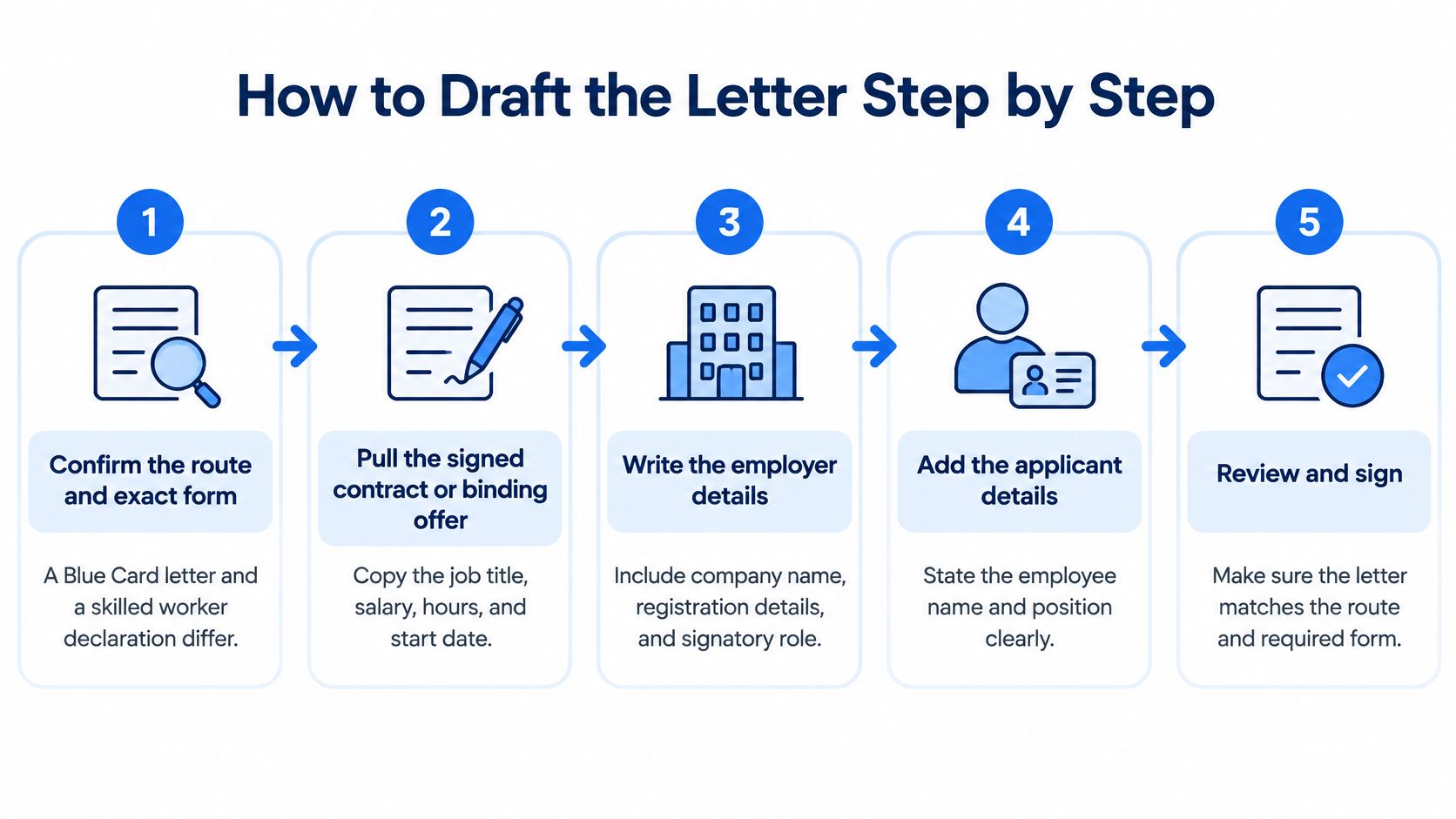
Steps 1 to 4 Build the Evidence Base
1. Confirm the immigration route and the required form. A Blue Card application and a skilled worker application may require different employment documents. For a German skilled worker application, the Federal Foreign Office’s skilled worker immigration guidance says applicants with a specific job offer should ask the employer to complete the “Declaration regarding a contract of employment.” Use the form for the selected route, since it sets out the employment details authorities will assess.
2. Use the signed contract or binding offer as the source document. The title, duties, and employment terms in the letter should match it. Authorities assess the duties alongside the title, so an impressive title cannot compensate for a description that misstates the actual work.
3. Check the salary against the threshold for the application year. Thresholds can change, which means an older template may no longer be accurate when the application is filed. For example, if the offer states a gross annual salary of €55,000 but the current payroll record and contract show €53,000, resolve the difference before signing. The letter, contract, and payroll records should report the same pay basis.
4. Link each factual statement to a record. HR records can support the title, department, and reporting line; the contract and payroll records can confirm salary, hours, duration, and location. For a sponsored UK application, check that the letter also matches the Certificate of Sponsorship.
Keep the records with the final signed version. This makes it easier to identify which documents support each statement if an authority asks for clarification.
Employers preparing documents for a German permit application can review the process for getting a residence permit in Germany.
Planning to settle permanently in Germany?
From checking whether you qualify to filing your application, we can help you apply for a permanent residence permit.
Tell us about your situation, and we’ll get back to you directly.
Steps 5 to 9 Complete the File
5. Explain how the applicant’s qualification relates to the role. Name the degree or certification and connect it to specific duties. For example, a degree in mechanical engineering may support duties involving the design of production components. A broad claim that the applicant is “highly qualified” adds little unless the letter explains the connection.
6. Confirm the location, start date, and contract duration against the latest records. These details can change while an application is being prepared. If the start date or workplace has changed since the first offer draft, update the letter before signing.
7. Put the letter on company letterhead and identify the signatory. Include the signatory’s printed name, role, and date of signature. The person signing should be authorised to make statements about the employment; the applicant should not sign on the employer’s behalf.
8. Keep a dated copy of the signed letter and its attachments. Record when and to whom the file was sent, along with the documents included. That record helps distinguish the submitted version from later revisions.
9. Describe an unsigned contract accurately. The German Declaration of Employment can confirm intended employment while the contract is being finalised. The foreigners authority (Ausländerbehörde) uses it to request any required approval from the Federal Employment Agency. State clearly that the contract is still being finalised, then provide the signed version when available.
Template Blocks to Fill In
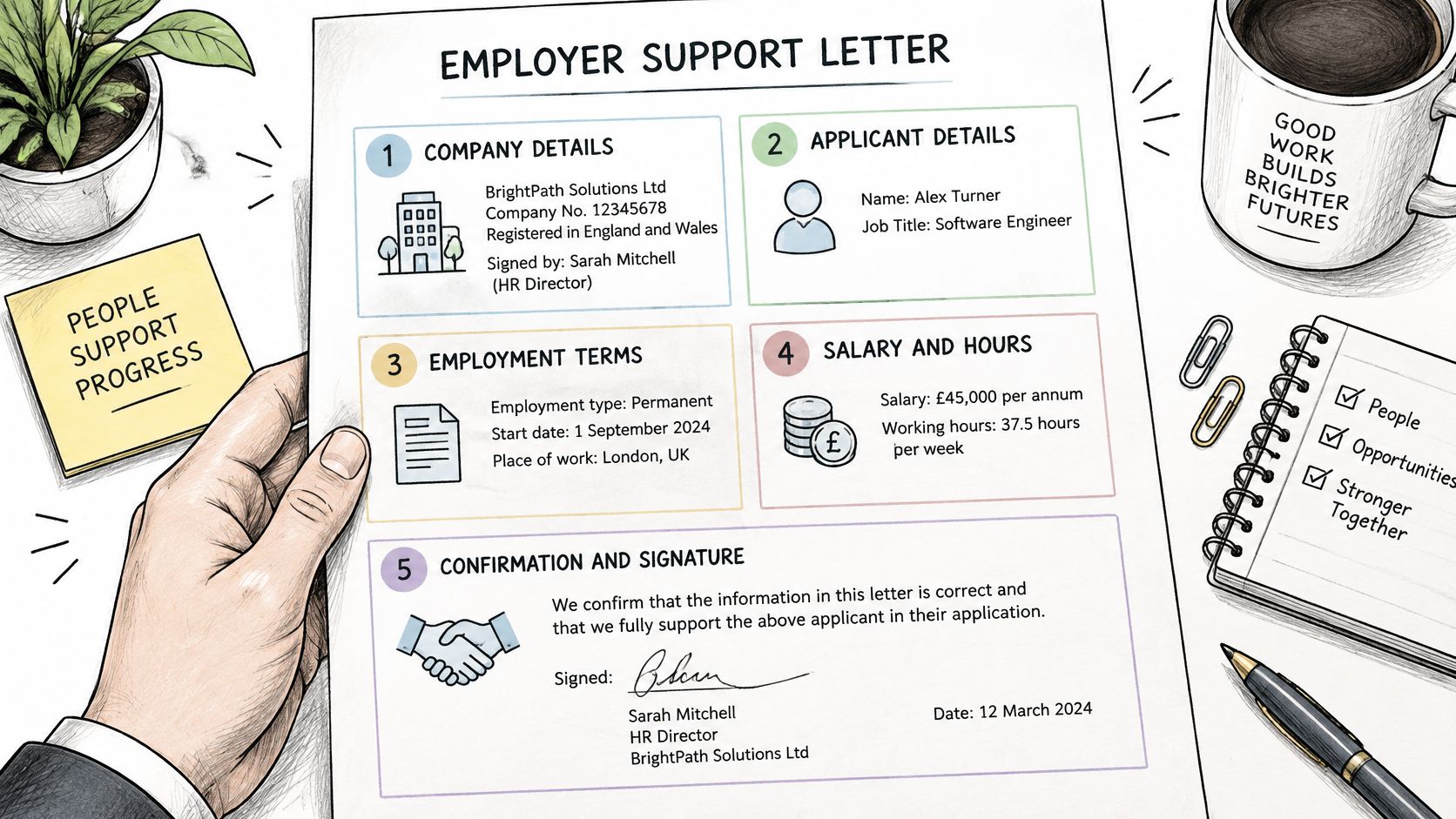
Five Blocks Keep the Draft Focused
Block one covers company identity. It states the legal name, registration details, address, and signatory role.
Example sentence: “ABC Engineering GmbH, registered in Munich, confirms the employment offer below through its Head of Human Resources.” That sentence identifies who’s making the statement.
Block two covers the actual position. It states title, duties, department, and reporting line.
Example sentence: “The applicant will work as a mechanical engineer, designing production components and reporting to the Engineering Manager.” Duties should read like the job in practice, not like a recruitment advertisement.
Block three covers employment terms. It states gross annual salary, contract type, duration, hours, and place of work.
Example sentence: “The role is full-time in Berlin under a permanent contract, with a guaranteed gross annual salary of €54,000.” A UK example should state guaranteed gross pay in pounds and match the sponsorship record.
For Blue Card cases, qualification fit isn’t decoration. The job must also be appropriate to the applicant’s qualification.
Block four explains that fit. It names the degree or certification and the duties it supports.
Example sentence: “The applicant holds a master’s degree in computer science, which directly supports backend software development and systems testing duties.” That wording gives the caseworker a checkable link.
Block five confirms genuineness and attachments. It states the employment is genuine and the contract or binding offer is attached.
Example sentence: “This vacancy is genuine, and the signed binding offer for the software developer role is attached.” The letter preserves evidence, but it doesn’t promise approval.
Authorities still examine qualifications and conditions. Employers shouldn’t write as if approval is guaranteed.
Longer-term planning also matters for some hires. Accurate early records can help later applications, including a settlement permit for skilled workers.
Copy Ready Checklist
- Block one checked: Company identity matches registration record.
- Block two checked: Title and duties match contract.
- Block three checked: Salary and hours match payroll setup.
- Block four checked: Qualification matches named duties.
- Block five checked: Attachments match the letter text.
Drafting rule: If a sentence can’t be ticked against a record, it shouldn’t stay in the letter.
Keep the Letter Valid When Salary Changes
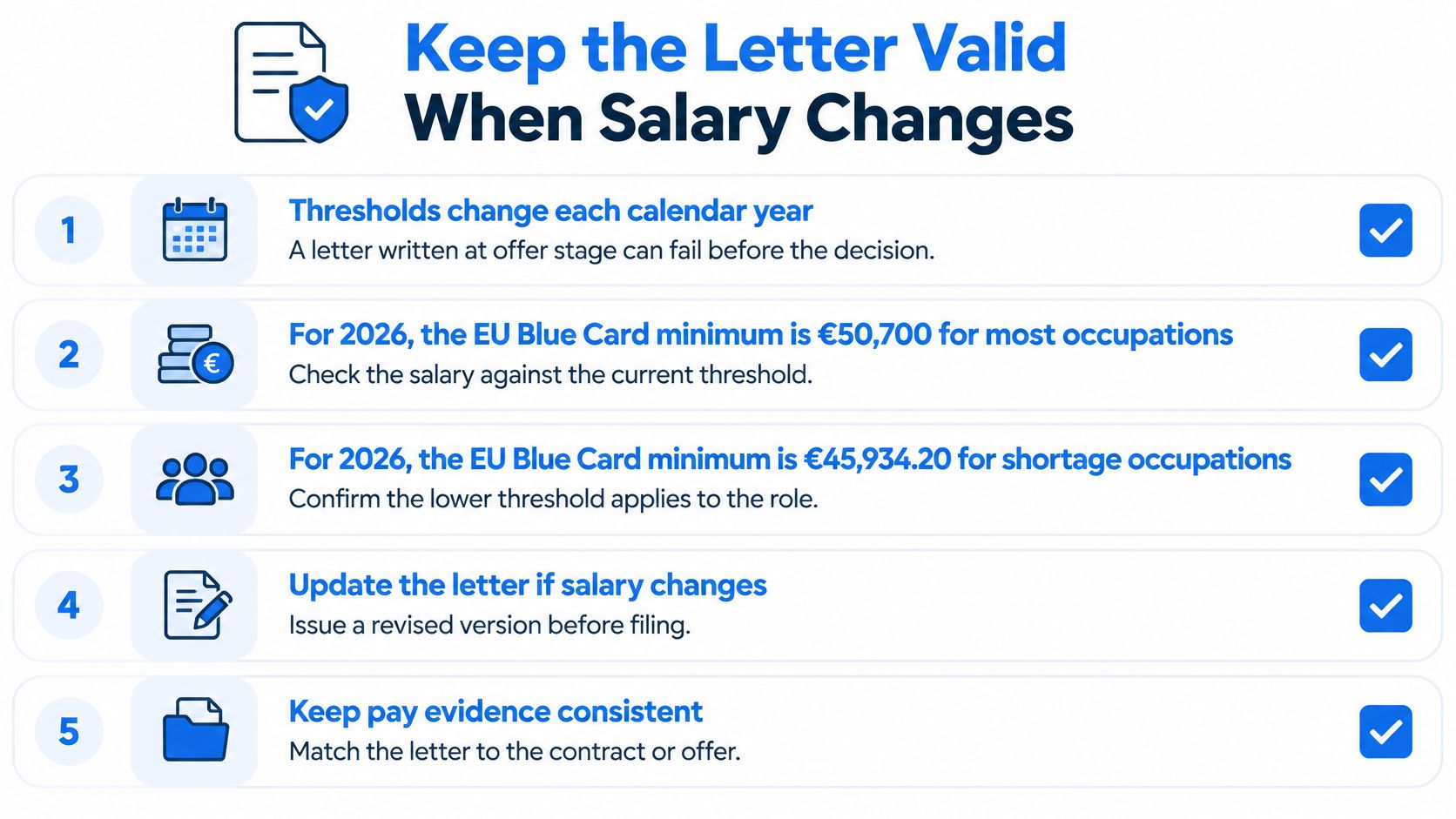
Annual Thresholds Can Overtake a Correct Draft
Salary thresholds change each calendar year. A letter written at offer stage can fail before the decision.
Official Berlin EU Blue Card guidance states the minimums change each calendar year, and for 2026 the threshold is €45,934.20 for shortage occupations or qualifying recent graduates and €50,700 for other occupations. The lower band needs proper classification, not employer preference.
Certain STEM and healthcare roles may fall in the lower band. A qualification completed within the previous three years may also matter.
The category should be documented. The salary basis should be documented too.
Employers should check current figures against the EU Blue Card requirements in Germany at filing time. A copied template from a prior year isn’t a safe source.
Applying for an EU Blue Card in Germany?
We handle your EU Blue Card from the first check to a lawsuit over any delay.
Tell us about your case, and we’ll get you through the next step.
Reissue Triggers Need a Named Owner
Reissue the letter after a new calendar year begins. Don’t assume the old salary still passes.
Other triggers include:
- Promotion: Title, duties, or salary changed.
- Contract amendment: Hours, pay, or duration changed.
- Delayed start: Entry or start date moved.
- Workplace change: Location no longer matches the letter.
- Category change: Occupation classification no longer fits.
Bonuses need separate treatment. Equity needs separate treatment too.
They usually don’t count as guaranteed gross salary. Listing them beside salary can mislead the reader.
The cleaner approach states guaranteed gross salary alone. Additional variable pay can be described separately, without using it for the threshold calculation.
Revalidation Checklist
- Valid as of date: Date the figures were last checked.
- Responsible signatory: Person accountable for reissue.
- Salary basis: Guaranteed gross annual amount only.
- Occupation category: Standard or lower threshold band.
- Review trigger: Event that prompted the check.
Keep a dated log of every version. Record versions sent to the applicant.
Record versions sent to the authority. The log shows which figures were true on each date.
A letter isn’t stale because it’s old. It’s stale when its facts no longer match the filing position.
Common Mistakes and Final Check Before Signing
Inflated Titles Fail Against Duties
A title that overstates the role can cast doubt on the whole application. If a junior analyst is called a department head, the authority may question whether the stated duties and occupation category are accurate.
Use the title in the contract, and make sure the duties support it. A precise, modest title is easier to reconcile with the job description and payroll records.
Vague Qualification Wording Wastes Space
“Well qualified” and “excellent candidate” give the authority little to assess. Name the relevant degree or certification, then explain how it relates to the role’s duties.
For a software developer, for example, identify the computer science degree and connect it to coding, testing, or systems design responsibilities.
Cross-Document Mismatches Create Avoidable Delay
Check the letter against the signed contract, payroll setup, and any sponsorship record before signing. The title, salary basis, work location, and start date should match across the documents. If payroll is set up for a different annual amount or pay frequency, resolve the discrepancy before the employer submits the file.
- Support letter: The employer’s statement about the role and employment terms.
- Contract: The signed terms or binding offer.
- Payroll record: The salary amount and pay basis used for payroll.
- Sponsorship record: Certificate or declaration details, where applicable.
For the UK route, sponsor requirements are separate from German immigration rules. The Skilled Worker sponsor guidance requires an approved sponsor and a valid Certificate of Sponsorship. It also says the occupation code and job description must accurately reflect the role in practice.
If the job description field is incomplete, add a sponsor note after assigning the certificate and explain the missing duties. Employers addressing recurring immigration issues in Germany should keep the letter, contract, and payroll records aligned.
Final Check Before Signature
- Confirm the route and filing-year threshold. Check that the stated salary meets the applicable threshold on the signing date.
- Confirm the title and contract duration. Match them to the signed contract and payroll records.
- Map each statement to a record. The employer should be able to identify the document that supports each material detail.
- Check every date. Confirm that the start date, signing date, and contract dates are consistent.
- Seek legal advice for unusual terms. A delayed start, unusual contract, or sponsor note may require a closer review.
Approval rates do not establish whether a particular letter is accurate. The practical test is whether its material statements match the records the employer will submit.
LegalWeg offers a free case assessment, which can be requested through a form on the contact page. People with questions about German immigration law or a need for legal support can contact LegalWeg through the contact page.