
Since 27 June 2024, Germany generally lets naturalised people keep an existing nationality after five years of lawful ordinary residence, but dual citizenship is possible only if the other country also allows it. Applicants must still meet the other naturalisation conditions.
The important distinction is between becoming German and keeping another nationality. Germany decides the first question, but it can’t decide the second for another state.
Table of contents
Dual Citizenship in Germany After June 2024
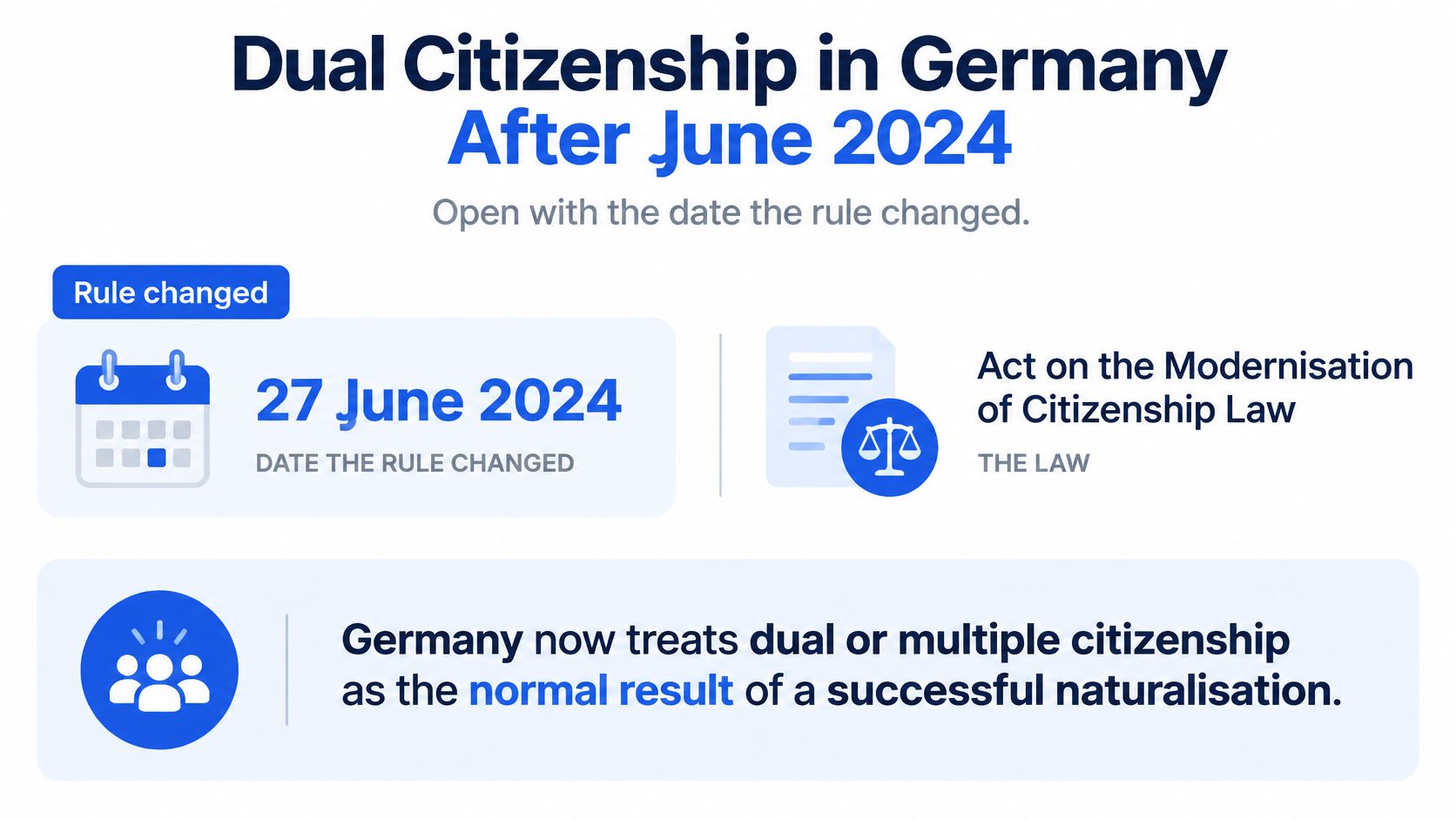
On 27 June 2024, the Act on the Modernisation of Citizenship Law entered into force, making multiple citizenship the normal legal position after successful naturalisation. The reform also reduced the ordinary residence requirement from eight years to five years of lawful residence.
The scale is substantial: the Federal Statistical Office recorded 292,020 naturalisations in Germany in 2024, according to its final naturalisation statistics. That’s a count of completed naturalisations, not a prediction of an individual applicant’s chances.
Need Help With Your German Citizenship Application?
We guide you from the first eligibility check to the final decision, and step in if the authority delays or refuses.
Tell us about your situation, and we can assess your case for free.
What the reform doesn’t remove
The amended Nationality Act, known as the Staatsangehörigkeitsgesetz or StAG, still requires an individual eligibility assessment. A residence permit isn’t a promise of citizenship.
Two limits matter immediately:
- Residence status: A temporary study permit alone isn’t a sufficient basis for naturalisation.
- Foreign nationality law: The original country may withdraw its citizenship or restrict the rights attached to it.
Applicants generally need a residence title that provides a qualifying basis for permanent residence. That doesn’t mean every applicant must already hold a permanent residence permit.
Practical rule: German permission to retain a nationality removes a German obstacle. It doesn’t remove an obstacle imposed by another country.
For someone researching how to get dual citizenship in Germany, the first task is therefore route selection. The comparison below separates ordinary naturalisation from family cases and cases involving someone who is already German.
Before spending money on filing or document preparation, the applicant should also establish what the other state will do. A complete German application can still produce an unwanted foreign-law consequence.
Routes That Can Give You Two Citizenships
Routes to dual citizenship under German law
| Route | Who it is for | Time or status test | German rule on the other nationality |
|---|---|---|---|
| Standard naturalisation | Foreign national with a qualifying residence title | Five years of lawful ordinary residence under the Nationality Act | Retention is the normal result if the other state agrees |
| Spouse or partner of a German | Spouse or registered partner of a German citizen | Facilitated family route if the Nationality Act’s shorter conditions are met | Retention is allowed under German law |
| Child of a German parent | Child who acquires citizenship by descent | No adult residence clock | German citizenship from birth; the other state decides any second nationality |
| German who takes another nationality | Person who is already German | Acquisition after the reform took effect | German citizenship is generally kept without a retention permit |
| Older retention-permit cases | German who took a foreign nationality before the reform | Whether a valid Beibehaltungsgenehmigung existed under the applicable rules | Loss may already have occurred if no valid permit was granted |
| Origin-country restriction | Anyone Germany would naturalise | Separate from the German residence clock | The other state may cancel citizenship, require notice, or limit rights |
Residents and family members
Standard naturalisation is the usual route for foreign professionals who have established their lives in Germany. Employment alone isn’t enough; the authority also examines the applicant’s status and supporting evidence.
The former three-year accelerated route based on special integration achievements is no longer available under the Nationality Act linked in the table. Older guides that still advertise that route shouldn’t determine an applicant’s filing strategy.
A spouse or registered partner of a German citizen may qualify under facilitated family conditions. Marriage itself doesn’t grant citizenship, and the applicant still needs an individual assessment.
Say a professional holds a qualifying work residence permit and is married to a German citizen. The useful question is which statutory route fits the household, not which route sounds fastest.
For a child of a German parent, the starting point is different. The authority may need to establish citizenship acquired by descent rather than process an adult naturalisation application.
Family-history cases need particular care because the law applicable to each birth can matter. The guide to alternative German citizenship routes for Israelis provides another starting point for applicants investigating a family connection.
Existing Germans and the old retention permit
A Beibehaltungsgenehmigung was a German permission to retain German citizenship when acquiring another nationality. It concerns someone who was already German, not an ordinary foreign resident applying to become German.
For acquisitions after the reform, German citizens generally no longer need that permission. Older acquisitions require a separate historical review.
- Check the acquisition event: Establish when and how the foreign nationality was obtained.
- Locate the permit: Find the actual retention decision rather than relying on a family recollection.
- Check its validity: Confirm that any permission applied to the acquisition concerned.
The reform shouldn’t be treated as automatically repairing an earlier loss of German citizenship. A missing historical permit can turn a seemingly simple passport matter into a citizenship-status question.
The final table row isn’t another German acquisition route. It’s a separate condition for achieving the intended result of holding both nationalities.
Applicants should select their route before collecting a full document bundle. Anyone relying only on a temporary study permit should pause and clarify the qualifying residence basis first.
What Your Other Country May Do
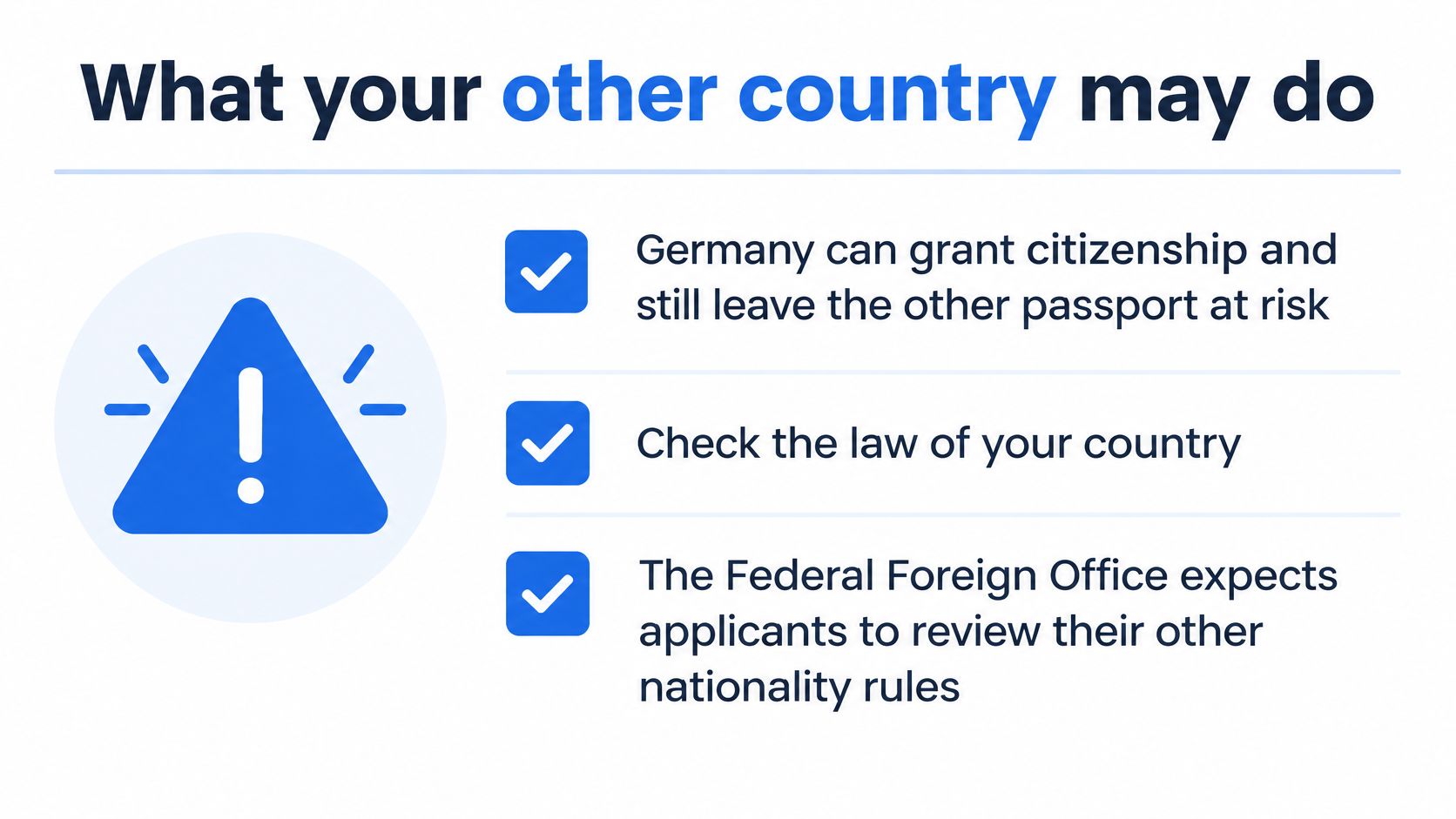
What will the other state do when its citizen becomes German? Germany can grant citizenship while leaving the original nationality at risk.
The Federal Foreign Office’s nationality guidance warns applicants to check whether their country of origin permits multiple citizenship. German acceptance doesn’t override foreign nationality law.
Similar German applications can have different consequences
Consider a software engineer from India and a spouse from Turkey. Both might satisfy the applicable German eligibility conditions, yet their original countries may treat German naturalisation differently.
The same caution applies to professionals from Russia or China. Neither a colleague’s experience nor the treatment of a neighbouring country establishes the rule for their nationality.
The United States and Japan are further examples of nationality regimes that shouldn’t be treated as interchangeable. A general German citizenship guide can’t supply a reliable yes-or-no answer for every personal situation.
Questions for the consulate or nationality authority
The applicant should describe the planned German naturalisation in writing. The enquiry should identify every nationality already held and any relevant family circumstances.
The questions should cover:
- Automatic loss: Would acquiring German citizenship automatically end the original nationality?
- Notification: Must the applicant notify an authority before or after naturalisation?
- Military service: Would any service obligation continue or change?
- Public office: Would dual nationality restrict eligibility for public employment or office?
- Inheritance: Would acquiring German citizenship affect inheritance rights or restrictions?
- Consular protection: What assistance would remain available when the person is also German?
These are questions to investigate, not consequences that apply to every nationality. The answer may also turn on how the original citizenship was acquired.
A valid foreign passport isn’t, by itself, proof that foreign citizenship will survive German naturalisation.
Written confirmation creates a usable record of the advice received. A verbal answer at a counter is harder to verify and may omit an important qualification.
If the consulate can’t give a definitive answer, the applicant should ask which nationality authority can. Complex cases may need advice from someone qualified in that country’s law.
The trade-off should be clear before filing. German citizenship may provide the desired security, but losing an original nationality could affect family plans or rights elsewhere.
The safest order is foreign-law clarification first, followed by the German application. That sequence allows an informed choice rather than an unexpected result.
Language Livelihood and Identity Proof
A strong naturalisation file treats each requirement as a separate gate. Success on one requirement doesn’t compensate for missing evidence on another.
Language and civic knowledge
German naturalisation normally requires B1 German, according to the Nationality Act’s language provisions. An accepted examination is the usual evidence.
Some applicants can instead use a qualifying German educational credential. The authority should confirm whether the particular document is accepted.
Possible evidence includes:
- School qualification: A qualifying German school certificate.
- Vocational qualification: Evidence of qualifying German vocational training.
- University credential: A qualifying German university qualification.
An applicant shouldn’t book another examination before checking whether an existing credential is sufficient. Equally, studying in Germany doesn’t automatically establish that every language requirement has been met.
Civic knowledge is a separate requirement. It generally concerns Germany’s legal and social order and living conditions.
The naturalisation test normally provides that evidence. Any exemption must be established rather than assumed from language ability or professional seniority.
Livelihood and identity
Livelihood evidence should show how the applicant supports the household. The authority needs a coherent financial picture, not just the most recent wage slip.
A useful bundle contains:
- Employment evidence: The current contract and recent wage slips.
- Tax records: Relevant tax assessments and supporting income records.
- Benefit history: A dated explanation of any benefit period, supported by documents.
- Household context: Evidence explaining relevant maintenance obligations or income changes.
Benefit receipt shouldn’t be hidden or treated as automatically fatal. The legal effect requires an assessment of the benefit involved and the applicable statutory conditions.
Identity evidence needs the same care. Names, dates of birth, and nationality details should agree across passports and civil records.
Foreign records usually need a German translation and may require authentication. The local authority’s document requirements should be checked before paying for either service.
A name difference after marriage should be explained with the record linking the names. An unexplained spelling difference can leave the authority unable to connect otherwise valid documents.
Applicants dealing with civil-status records can use the German birth certificate guide to understand the document’s role. A birth certificate supports identity evidence but doesn’t replace every other required record.
Final proof check
The applicant must also stand by Germany’s free democratic basic order. That commitment is a substantive condition, not merely another attachment.
Before filing, the document bundle should contain:
- Language proof: An accepted certificate or qualifying alternative.
- Civic evidence: The test result or an established exemption.
- Financial records: A complete livelihood bundle.
- Civil records: Matching identity and nationality evidence.
- Full disclosure: Details of every conviction and pending proceeding requested by the application.
Get support on your visa or citizenship application
Filing a visa or citizenship application alone can get overwhelming fast. You don’t have to go through it by yourself.
Get full support from an immigration lawyer, from finding the right forms to getting a final decision.
How to File a Naturalisation Application
The standard application goes to the competent local naturalisation authority. Family applicants generally need the same core evidence, with the relevant family residence test applied.
The Federal Statistical Office’s naturalisation page records completed naturalisations, not an application approval rate. Applicants shouldn’t interpret national totals as a guarantee that their own file will succeed.
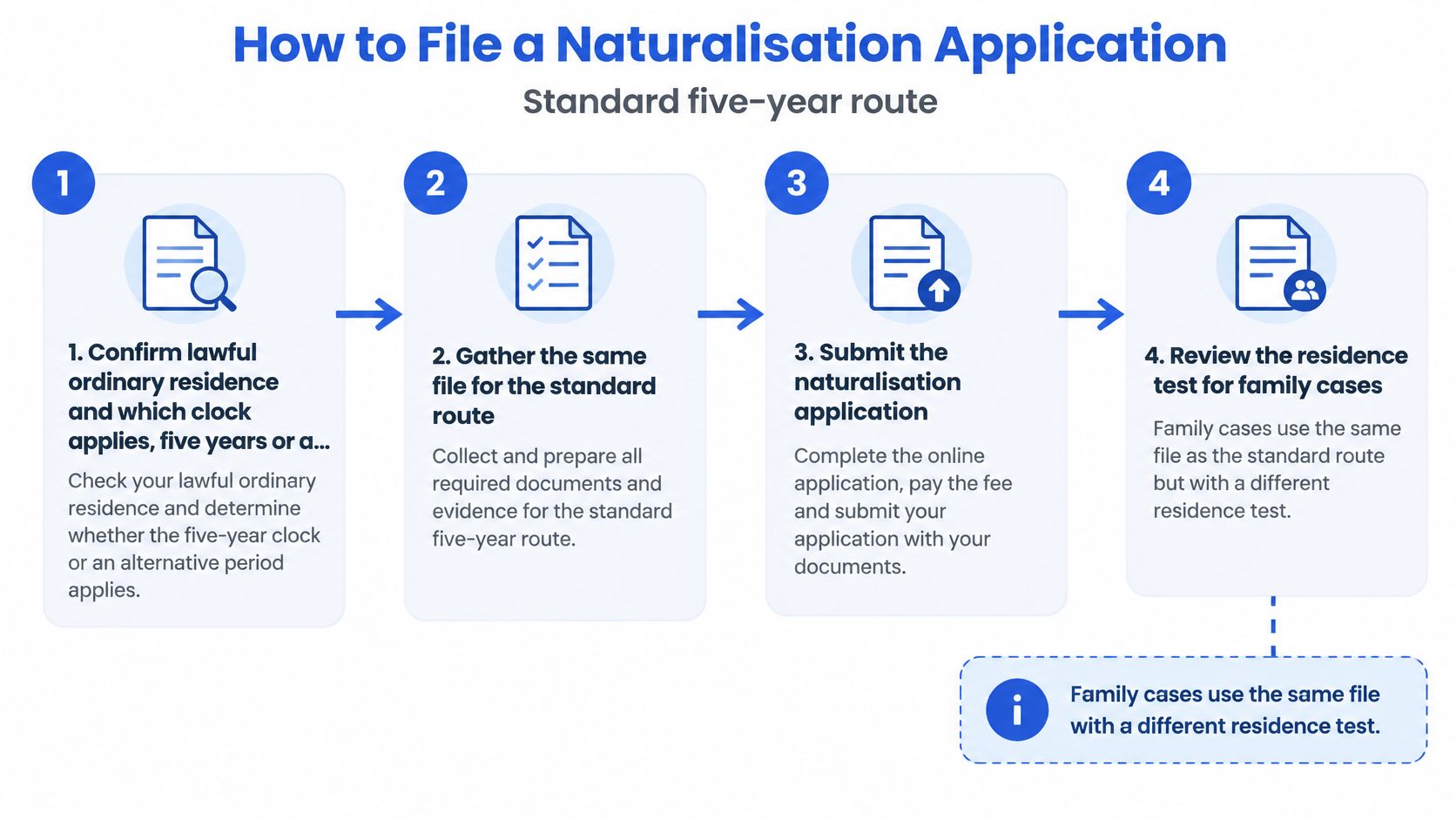
The application sequence
Confirm residence and route. Establish when lawful ordinary residence began and which statutory residence test applies.
Obtain the other country’s answer. Keep written confirmation of the foreign-law consequences with the application preparation records.
Resolve identity discrepancies. Correct inconsistent names or dates, and include records explaining legitimate changes.
Assemble livelihood evidence. Include employment, tax, and benefit history so the authority can understand the household’s finances.
Arrange language evidence. Book an accepted examination or obtain confirmation that an existing educational credential qualifies.
Complete the civic requirement. Take the naturalisation test or establish a statutory exemption; language evidence doesn’t replace this step.
Prepare the constitutional declarations. Read the declarations carefully and clarify anything that isn’t understood before signing.
Disclose convictions and proceedings. Provide the requested details in full, with relevant court or prosecution documents.
Submit to the competent authority. Use the office responsible for the registered address and retain proof of submission.
Receive the naturalisation certificate. The certificate completes the acquisition process; a German passport or identity-card application follows.
Keep a file that can be checked
The submission record should show exactly what the authority received. A document index makes later requests easier to answer.
Useful records include:
- Application copy: The completed form and every attachment.
- Delivery evidence: A portal receipt, acknowledgement, or other submission confirmation.
- Correspondence log: Requests from the authority and dated responses.
- Updated documents: Replacement evidence submitted after a job, address, or family change.
Applicants should answer a missing-document request with the requested evidence and a short cover note. A long explanation without the missing attachment usually won’t resolve the problem.
Before submission: Check every attachment against the authority’s current checklist, not an old checklist saved during early planning.
The foreign-law questions deserve particular attention before the application is sent. The questions under “What Your Other Country May Do” identify the matters that need written clarification.
Fees and processing expectations should be confirmed before filing. The guide to German naturalisation fee changes can help applicants identify what to clarify with the responsible office.
No fixed completion date should be assumed. Document completeness helps avoid preventable enquiries, but it doesn’t guarantee a particular processing time.
Fixes for Delays Refusals and Weak Files
A file can be complete yet still contain evidence that does not match. Inconsistent names or dates may prevent the authority from confirming identity. Provide corrected records and explain any remaining differences clearly.
Common file defects and fixes
| Defect | Fix before resubmitting |
|---|---|
| Names or dates differ across civil records | Obtain corrected or matching records and explain any remaining differences |
| Foreign documents lack translation or authentication | Provide the required certified German translations and authentication |
| Welfare use is unexplained | Give a short, dated explanation supported by work or income records |
| Tax or employment evidence has gaps | Provide relevant contracts, wage slips, or tax assessments |
| Conviction or pending case left out | Disclose it and provide the relevant court documents |
A refusal needs a response to the reasons
A refusal is a decision. An unanswered application is not. Read the refusal notice closely because its reasons and the available legal remedy determine the next step.
Keep the complete notice and a record of when it arrived. Any deadline for challenging the decision needs prompt attention.
- Evidence problem: Provide missing or corrected proof.
- Legal disagreement: Seek advice on the decision and possible challenge.
- Changed circumstances: Assess whether the new facts support a fresh application.
A new application may make sense if key evidence was missing. A legal challenge may be appropriate if the authority applied the law incorrectly. Either way, address the reason for refusal rather than resubmitting the same incomplete file.
Silence requires a different assessment
An Untätigkeitsklage, or failure-to-act action, asks a court to address an authority’s failure to decide. It does not replace missing naturalisation requirements.
Under section 75 of the Administrative Court Code, an action may generally be considered after three months if the authority has not decided the matter and has not provided a sufficient reason for the delay. The filing date, application history, and the authority’s explanation still matter.
The action seeks a decision, not an automatic grant of citizenship. The authority may still refuse an application that does not meet the legal requirements.
The guide to filing an Untätigkeitsklage explains the practical route for assessing administrative silence. Submission evidence and dated correspondence can help establish the history of the case.
LegalWeg prepares and files applications after clients submit their documents, and handles the process through to a final decision. If an authority does not respond, LegalWeg can file an Untätigkeitsklage.
Free case assessment
Waiting months for a response on your application. You don’t have to.
Get your free case assessment to learn the best next steps for your situation.
Decide Whether to File or Ask Counsel
Self-filing can be reasonable when the route is clear and the evidence is ready. Legal representation becomes more useful when the uncertainty concerns legal status rather than ordinary form completion.
When a legal review is practical
An old retention-permit issue deserves review before a new application is started. The applicant may need to establish whether German citizenship still exists rather than apply on the wrong legal basis.
A stalled application also needs a procedural assessment. Once the file is complete and the applicable waiting conditions are met, a failure-to-act claim may be more useful than another status enquiry.
Applicants preparing for advice can use the immigration lawyer consultation questions to organise the facts. A focused chronology helps separate missing documents from a legal dispute.
LegalWeg can review citizenship cases and administrative delays. Advice is available in English, German, and Russian.
The self-filing check
Self-filing is a practical option when all of these points are true:
- Residence completed: The applicable lawful-residence period has been satisfied.
- Qualifying title: The residence status provides an eligible basis for naturalisation.
- Evidence ready: Language, civic knowledge, livelihood, and identity proof are in hand.
- Foreign position confirmed: The other country’s nationality consequences have been clarified in writing.
- History disclosed: No conviction has been hidden, and no unresolved earlier loss of German citizenship affects the case.
A missing point is a reason to pause, not to guess. This is especially important where an earlier foreign naturalisation may have affected German citizenship.
The useful action this week is to prepare a single route-and-timeline page. It should identify the proposed route, the start of lawful residence, and whether the other state has answered in writing.
That page can accompany an enquiry to the naturalisation authority or a legal consultation. It gives the next conversation a clear factual starting point.
LegalWeg supports German citizenship applications alongside Blue Card, permanent residence, and family reunion cases. It also files an Untätigkeitsklage when authorities don’t respond. Applicants with an uncertain route or a stalled citizenship file can visit LegalWeg to request a case assessment.