
A skilled professional has spent years in Germany, renewed residence documents, and built a household around a demanding job. Another immigration appointment feels like more paperwork, but remaining dependent on a temporary permit has started to feel like the bigger inconvenience.
Permanent residence benefits become tangible when employment or family plans change. The strongest advantage isn’t just staying indefinitely, it’s having more control over those decisions without treating immigration compliance as finished.
Learn how to apply for a permanent residence permit in Germany ->
Table of contents
What Changes the Day You Hold a Settlement Permit
Consider a Blue Card holder approaching the general five-year residence milestone, although a faster route may already be available under the Federal Portal’s settlement-permit guidance. The practical question isn’t whether another card looks different, but whether the application changes ordinary working life.
On Monday, an attractive job offer arrives. Instead of starting with whether the position supports the original residence purpose, the holder can concentrate on the contract.
By Wednesday, the household is discussing a career break or a different professional direction. The conversation no longer has to begin with preserving the original reason for admission.
Planning to settle permanently in Germany?
From checking whether you qualify to filing your application, we can help you apply for a permanent residence permit.
Tell us about your situation, and we’ll get back to you directly.
A Different Starting Point for Everyday Decisions
A settlement permit separates the right to remain from the original purpose of residence. It also permits unrestricted gainful employment throughout Germany.
That changes the order of decision-making:
- Employment comes first: The holder can assess a role on its merits rather than its compatibility with an employment-based residence restriction.
- Location becomes a household choice: A domestic move needn’t preserve a particular work location imposed by the original residence title.
- Long-term planning becomes more credible: The family can consider commitments against a more durable residence position.
The distinction between temporary and permanent status matters more than the document’s appearance. A comparison of German visa and residence categories helps applicants identify what their current permission depends on.

What Doesn’t Change Overnight
Friday’s travel plans still require attention. Approval doesn’t make every absence harmless, and it doesn’t settle every relative’s immigration position.
The real upgrade is control over ordinary life decisions, not freedom from every immigration rule.
For an established professional, that control can justify the application effort. The sensible comparison is between preparing a complete permanent-residence file and continuing to organise life around a conditional status.
The Settlement Permit Explained Without the Legal Fog
A Niederlassungserlaubnis is an unlimited residence title. A temporary residence permit, by contrast, authorises residence on a particular legal basis.
The distinction resembles the difference between access dependent on a qualifying activity and a durable entitlement. The analogy stops there, because statutory conditions still govern acquisition and retention.
The Eligibility File Matters More Than the Anniversary
Under the general route, applicants normally need five years of residence and 60 months of pension-insurance contributions, according to the Residence Act’s settlement-permit provisions. In qualifying circumstances, a spouse’s contributions can satisfy the pension requirement.
The same framework requires more than elapsed time:
- Secure livelihood: The applicant must demonstrate financial stability for the relevant household.
- Health coverage: Insurance must form part of a sustainable living arrangement.
- Adequate housing: The accommodation must satisfy the applicable requirement.
- Language ability: Applicants need sufficient German for the relevant route.
- Integration knowledge: Basic knowledge of Germany’s legal and social system must be established.
Periods spent studying or completing vocational training normally count at 50% toward the general qualifying period, under the Federal Portal guidance cited earlier. Applicants shouldn’t assume that the date of arrival is automatically the start of a fully creditable residence history.
Build an Evidence Map
A useful self-check connects each requirement to a document. An unsupported assumption isn’t evidence, even when the underlying facts appear favourable.
| Eligibility question | Evidence to organise |
|---|---|
| Which residence periods count? | Previous permits and a chronological residence history |
| Is the household financially secure? | Income records and relevant household expenses |
| Are pension conditions satisfied? | Pension-insurance records or evidence of equivalent provision |
| Is accommodation adequate? | Housing documents |
| Are integration conditions met? | Language and relevant test certificates |
The residence-permit application process should begin with classification, not form-filling. The correct route determines which evidence matters.
Applicants should resolve gaps before submission whenever possible. A complete chronology is more useful than a large folder of documents that leaves the qualifying period unexplained.
Four Real Benefits Holders Actually Feel
The strongest permanent residence benefits concern work and continuity. Social rights and mobility matter too, but their scope depends on the precise status held.
Work Freedom Has Immediate Practical Value
The national settlement permit removes residence-law restrictions on the type and location of economic activity. Its statutory basis is section 9 of the Residence Act.
That matters for an employee considering self-employment. It also matters when a professional wants to change industries rather than preserve the employment arrangement supporting a temporary title.
A job change no longer needs immigration approval merely to satisfy an old employer restriction. That shouldn’t be confused with permission to ignore unrelated reporting duties or professional licensing requirements.
Social Standing Requires a Precise Label
EU long-term-resident status carries equal-treatment protections across important areas of economic and social life. The European Commission’s explanation of EU long-term residence identifies the relevant framework.
Its coverage generally includes:
- Working life: Employment, self-employment, and working conditions.
- Education: Education, vocational training, and recognition of qualifications.
- Economic participation: Access to goods and services and applicable tax advantages.
- Social protection: Relevant protections subject to the framework’s qualifications and national rules.
These are legal protections, not a promise that every benefit application succeeds. National law can limit social assistance to core benefits.

Mobility and Legal Security Need Separate Assessments
A durable German status makes domestic planning more secure. Cross-border relocation requires a different analysis, because national permanent residence and EU long-term residence aren’t interchangeable.
The practical recommendation is straightforward: assess the destination before accepting a foreign assignment. The word permanent on a German residence decision isn’t a substitute for permission from another country.
Legal security also requires careful wording. Official guidance describes an independent, consolidated status and increased protection against deportation for EU and EEA citizens with permanent residence rights in the Federal Portal’s permanent-residence explanation.
That guidance shouldn’t be presented as a blanket immunity for non-EU settlement-permit holders. Different residence regimes must remain distinct.
A stronger residence position deserves confidence, but not assumptions borrowed from a different legal category.
Which Route Gets You There Fastest
The fastest route depends on the applicant’s current title and evidence. Choosing by the most familiar permit name can mean waiting unnecessarily.
A Blue Card holder should check the accelerated route before defaulting to the general route. Someone planning a later move elsewhere in Europe should assess EU long-term residence before choosing solely for speed.
Three Routes to Permanent Residence in Germany
| Route | Minimum Residence | Language Level | Key Extra Requirement | Main Upside |
|---|---|---|---|---|
| General settlement permit | General qualifying period described above | Sufficient German | Pension record and the general eligibility file | Durable residence and unrestricted economic activity in Germany |
| EU Blue Card fast track | 27 months, or 21 months with stronger German, under the official Blue Card settlement guidance | A1, or B1 for the shorter period, under that same guidance | Qualifying employment and pension contributions throughout the required period | Earlier access for eligible professionals |
| EU long-term residence permit | Five years of lawful residence under the Federal Office’s permanent-residence guidance | Knowledge of German and German society | Regular sufficient income and adequate accommodation | Facilitated relocation to almost every other EU country, subject to destination rules |
The Blue Card route also requires secure living costs and sufficient housing. Basic knowledge of Germany’s legal and social system must be demonstrated, usually through the relevant integration test.
Choose According to the Next Major Decision
For a professional committed to Germany, the accelerated settlement route may be the obvious priority. The relevant comparison is the effort required to prove stronger German against the benefit of earlier eligibility.
For an internationally mobile household, the destination plan deserves equal weight. A slightly different application strategy may better support a later relocation.
The EU Blue Card eligibility requirements should be checked alongside the employment history. Holding the card isn’t enough if the qualifying work and contribution record don’t support the application.
Applicants should also avoid copying the general pension benchmark into every route. Different legal bases require different assessments.
A useful recommendation is to compare complete application files, not headline timelines. The route that looks quickest on paper may not be ready if its decisive evidence is missing.
Contact us for immigration support
Have a question about your visa, citizenship, or immigration case?
Contact our team, and we’ll get back to you directly.
Family Reunion After Permanent Residence
A permanent sponsor has a more durable position from which to plan family life. That doesn’t mean every relative acquires a right to join.
German law recognises settlement permits and EU long-term residence permits as relevant sponsor statuses. Ordinary family reunification still requires a separate assessment of maintenance and suitable accommodation under the Residence Act’s family-reunification framework.
Start With the Family Relationship
Spouses and minor children should be assessed under the rules relevant to their relationship. Adult children shouldn’t be treated as interchangeable with minor children.
The same caution applies to parents. An established household in Germany doesn’t, by itself, establish a qualifying route for every older relative.
A sensible preparation order is:
- Identify the relationship: Establish who is applying and the legal basis being considered.
- Check the sponsor’s title: Confirm the actual residence category rather than relying on an informal description.
- Calculate household support: Assess the financial position after the relative arrives.
- Review accommodation: Match the housing evidence to the proposed household.
- Separate each file: Track every family member’s documents and residence position individually.
The Parents Rule Is Not a General Family Invitation
A special provision covers certain parents and parents-in-law where the adult child or the child’s spouse first received a specified skilled-worker title on or after 1 March 2024, under the family-reunification framework cited above. An EU Blue Card is among the specified titles.
The sponsor must secure living expenses. The critical question is therefore the qualifying skilled-worker history, not whether the sponsor later obtained permanent residence.
This distinction matters for families planning around an anticipated approval. Waiting for a settlement permit won’t necessarily solve a parent’s eligibility problem.
Family planning rule: A stronger sponsor status improves the starting position, but each relative still needs a viable legal route.
The family-reunification process in Germany should be assessed before travel or housing commitments become difficult to reverse. Each relative’s residence document also needs separate attention after arrival.
A sponsor’s permanent status isn’t a shared family document. Renewal, continued eligibility, and possible loss issues must be considered on the facts of each person’s case.
What Permanent Residence Does Not Give You
The most expensive mistakes often happen after approval. Holders stop distinguishing between a permanent legal entitlement and the documents or conduct needed to preserve it.
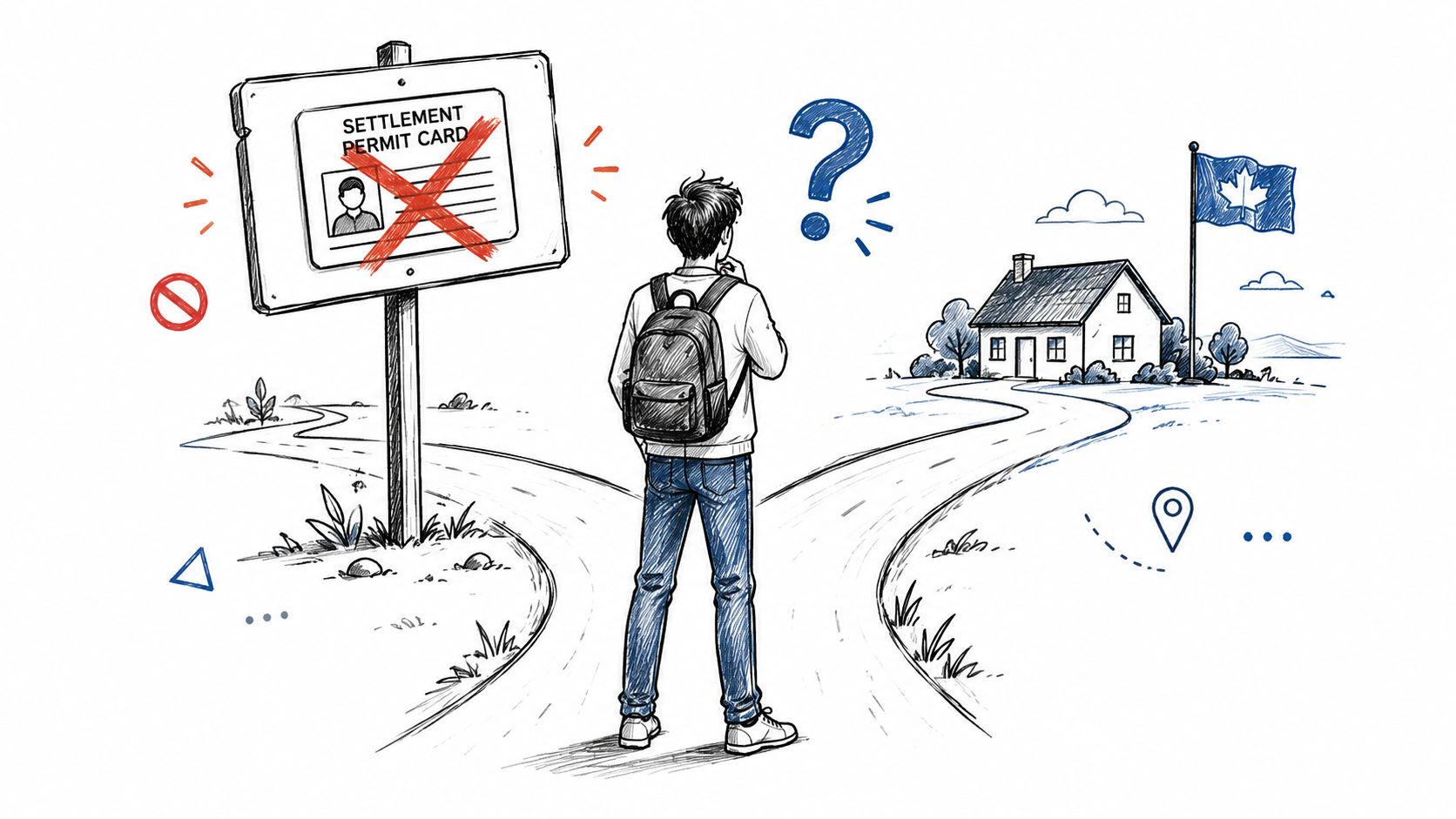
Social Support Isn’t Automatic
Applicants generally must neither receive nor be entitled to receive Bürgergeld or social assistance when meeting the settlement permit’s livelihood requirement. The Berlin settlement-permit service guidance explains that prerequisite.
After approval, benefit eligibility remains a separate legal question. Contribution history and household circumstances can matter, as can habitual residence and the specific benefit claimed.
Insurance-based unemployment support shouldn’t be confused with means-tested assistance. Neither approval nor refusal of a benefit should be treated as a complete answer about residence security or future naturalisation.
The Card and the Status Are Different
The electronic residence card still expires. Its expiry doesn’t itself end the underlying unlimited residence or work right, a distinction also clarified by Stuttgart’s immigration authority.
Holders should nevertheless plan document renewal and re-entry evidence before travelling. A continuing legal entitlement doesn’t remove the practical need to prove it.
Extended absences can affect the residence right. Administrative expulsion decisions and other statutory loss provisions can also matter.
| Planned activity | Sensible action before departure |
|---|---|
| Ordinary travel | Check passport and residence-document validity |
| A substantial period abroad | Obtain advice on status retention and any necessary advance approval |
| Relocation outside Germany | Assess the consequences before moving the centre of life |
| Travel near card expiry | Resolve renewal and re-entry documentation first |
European Mobility Requires the Right Instrument
EU long-term residents may seek residence in another Member State for more than three months for qualifying purposes, subject to receiving-country conditions under the EU long-term-residence directive. A new residence application may be required.
The destination can apply conditions concerning resources or health insurance. Accommodation and labour-market rules may also apply.
This isn’t automatic free movement. A national settlement permit alone shouldn’t be presented as the EU mobility instrument.
The safe approach is to verify the exact title before accepting an overseas role. Any proposed absence should then be assessed against that title’s retention rules.
From Permanent Residence to Citizenship and Beyond
Permanent residence and citizenship answer different questions. The former establishes a durable residence position, while naturalisation requires its own eligibility assessment.
An old naturalisation timeline shouldn’t determine a current application strategy. Applicants should obtain a current assessment of German citizenship eligibility rather than assume that time spent in Germany settles every requirement.
Choose the Destination Before Choosing the File
For a household committed to Germany, permanent residence can provide stability while citizenship plans develop. It needn’t be dismissed as unnecessary merely because naturalisation is a later goal.
For a household considering another Member State, the exact permanent-residence category deserves closer attention. The mobility distinction described above should influence the decision before an application is prepared.
The sensible sequence is to identify the next major life decision, then choose the status that supports it. Applying for the best-known label without considering that decision is poor planning.
Prepare a Decision-Ready Application
A final readiness check should focus on unresolved evidence:
- Residence history: Reconcile previous permits with qualifying periods and relevant absences.
- Pension evidence: Obtain the contribution record required for the chosen route, rather than assuming every route uses the same benchmark.
- Livelihood: Document sustainable household support without treating access to means-tested assistance as proof of financial independence.
- Integration evidence: Secure the required language documents and arrange the relevant test where needed.
- Permit selection: Decide whether the national settlement permit or EU long-term residence better matches the household’s plans.
- Existing permission: Check current document validity and any procedural steps needed while the new application is pending.
Processing delays make early preparation sensible. Stuttgart has reported lengthy processing because of application volumes and limited staffing, so applicants shouldn’t build essential plans around an optimistic decision date.
A filed application is evidence of action, not proof that permanent residence has already been granted.
Applicants close to eligibility should prepare promptly and submit once the relevant conditions are met. They shouldn’t mistake an appointment booking or pending status change for unconditional legal certainty.
The strongest strategy combines a correctly chosen route with a coherent evidence file. After approval, the same discipline should continue through document renewal and travel planning.
LegalWeg offers permanent-residence eligibility assessments, application preparation, and representation in delayed immigration matters. Applicants can visit the practice to arrange an initial assessment of the appropriate permit route and the documents needed for a complete application.