
Planning to settle permanently in Germany?
Our team of expert immigration lawyers can help you secure your permit.
- Our legal team will review your permanent resident permit case for free.
- We will tell you which strategy fits your specific situation.
- We prepare your application, follow up with the authority, and file a lawsuit if required.
- We stay with you until the Ausländerbehörde decides on your application.
Known From







Applying for a Permanent Residence Permit?
Or Still Waiting for a Decision?
Not sure you qualify
Unclear requirements
Stuck at the Ausländerbehörde
No clear next step
How to Move Your Permanent Residence Visa Application Forward
You have not applied yet
Before you apply for a permanent residence permit, we determine which path fits you and make sure you meet the requirements.
We review your documents and submit a complete settlement permit application to avoid any delays. Requirements and document lists vary by city, so we also check what your Ausländerbehörde asks for, prepare it, and submit on your behalf.
You applied and are waiting for a decision
You applied for a permanent residence permit and have not heard from the authorities. This is not unusual.
We have helped people who waited more than a year to get their permanent residence permit.
Different immigration offices in Germany have different timelines for processing settlement permits. For example, Berlin usually processes your permanent Residence permit application within 6 months. If you are waiting longer, it usually means either your case is complex or the authority has forgotten it.
Some immigration offices are cooperative and work together to resolve the case without going to court. Some do not act unless a lawsuit is filed.
We assess your case to determine which strategy is the best for your situation.
Why Choose Us?
Expert Lawyers
Fair & Transparent
Honest Guidance
Complete Support
How We Help You
We'll handle everything for you.
Visa Application
We'll prepare and file your application.
Meet Your Immigration Lawyer
- Practicing law since 2016
- More than 250 successful court cases
- Offers advice in English, German, and Russian
- Specialised in immigration law
- Supporting expats for more than a decade

How It Works
Free Case
Assessment
We Support Your Application
We File The Lawsuit, If Needed
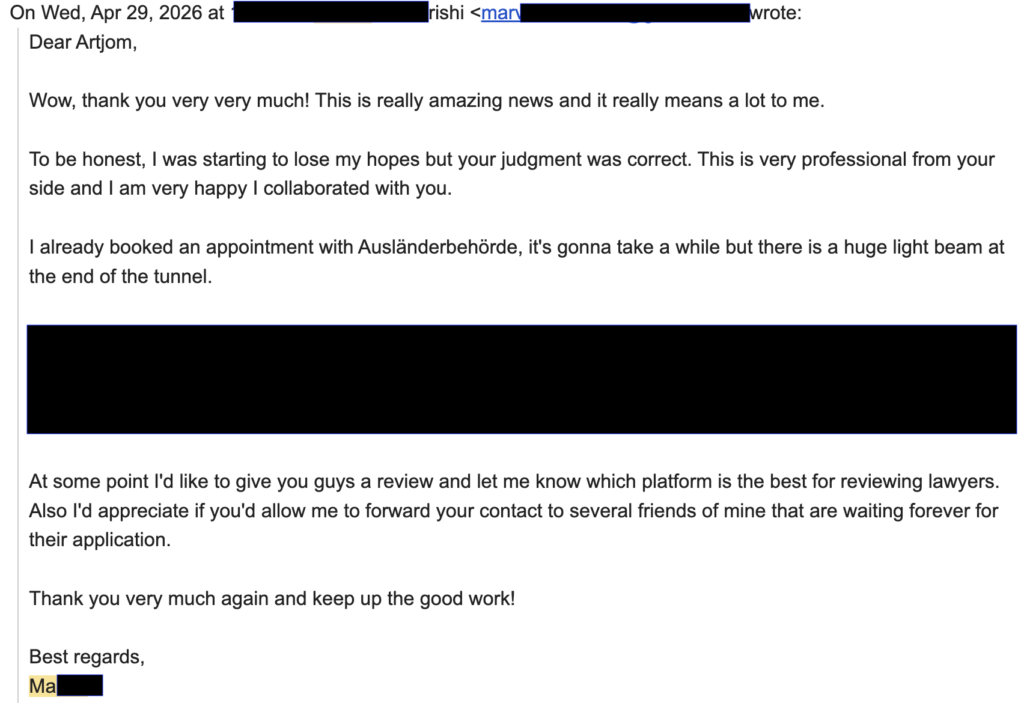
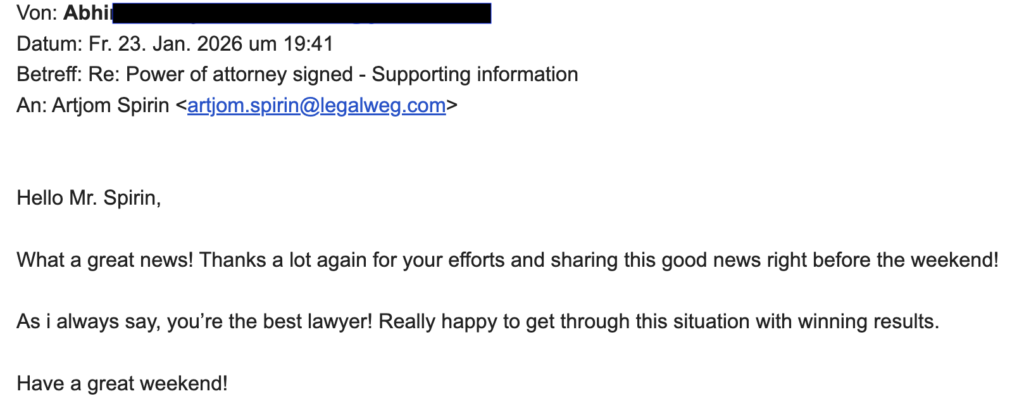
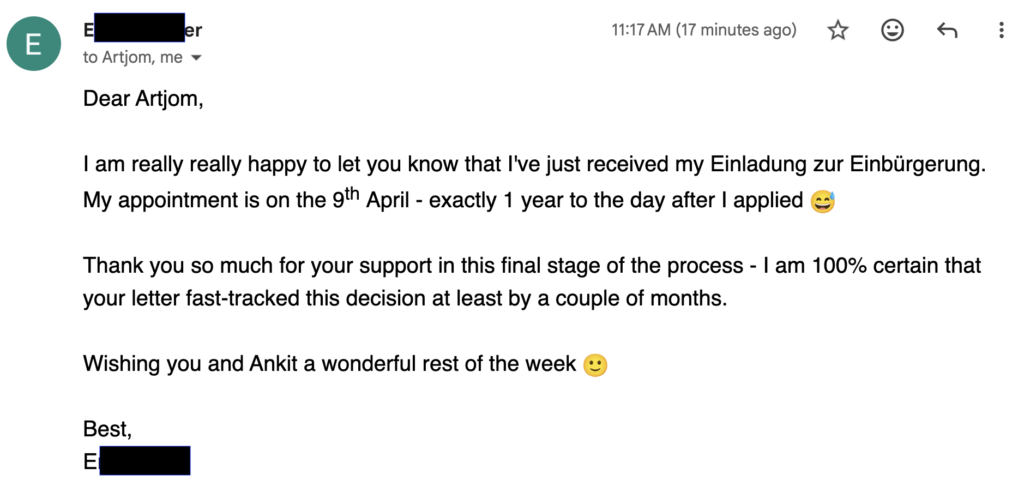
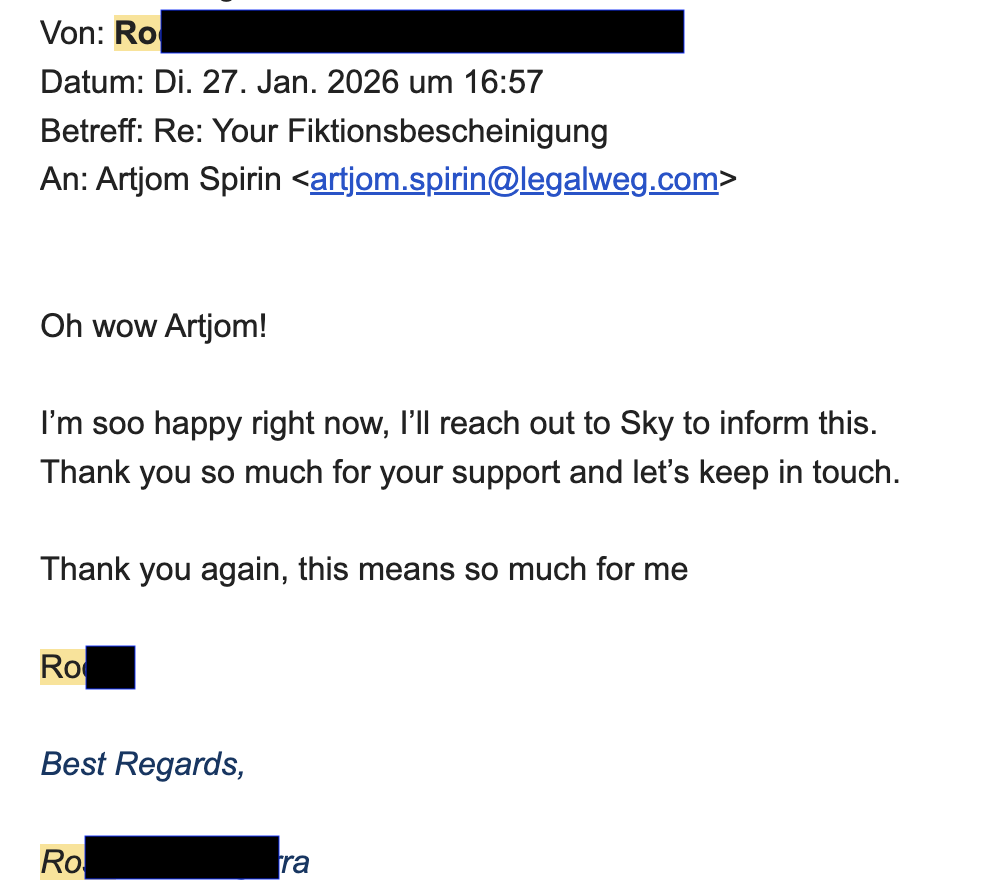
What Our Clients Say
Don't Put Your Future on Hold
Permanent Residence Permit Explained
What does permanent residence permit mean under German law?
A permanent residence permit in Germany (Niederlassungserlaubnis, also called a settlement permit) is a residence title with no end date. It lets you live and work in Germany with no time limit.
The permit is set out in Section 9 of the Residence Act (Aufenthaltsgesetz, AufenthG). It differs from German citizenship and from the EU long-term residence permit (Daueraufenthalt-EU), which has separate rules. The permanent residence permit guide explains each route in full.
A permanent residence permit has these advantages over a temporary permit:
- No end date (§ 9(1) AufenthG).
- Permission to work. You may work in Germany. Only a ban set by a statute limits this (§ 4a(1) AufenthG).
- Fewer restrictions. A temporary residence permit can carry restrictions, such as a limit on where in Germany you may stay (§ 12(2) AufenthG). A permanent residence permit can carry restrictions only where the Residence Act expressly allows it (§ 9(1) AufenthG).
- Your family can join you. As a settlement permit holder, you can bring your spouse and minor children. Our guide to family reunification requirements in Germany explains the conditions.
What are the requirements for a permanent residence permit in Germany?
The standard route rests on nine conditions in § 9(2) AufenthG. You are to be granted the permit when you meet all of them. The main conditions are:
- Time: 5 years with a residence permit.
- Financial capacity: a secured livelihood, including health insurance, and 60 months of pension contributions.
- German and civic knowledge: B1 German and basic knowledge of Germany’s legal and social order.
- Living space: enough space for you and your household.
- Other conditions: no public safety concern, permission to work, any other permit your work needs, and the general rules on identity, passport and visa entry (§ 5 AufenthG).
Who is exempt from the B1 German requirement for a permanent residence permit?
Three situations exempt you from the B1 German requirement on the standard route (§ 9(2) AufenthG):
- Illness or disability. A physical, mental, or psychological illness or disability keeps you from meeting the German and civic knowledge conditions.
- Simple spoken German. You can communicate in simple spoken German and had no right to an integration course, or were not required to take one.
- Hardship. The authority may waive the conditions to avoid a hardship. This is at its discretion, so hardship alone does not guarantee the waiver.
If you successfully complete an integration course (Integrationskurs), you also don’t need to prove your B1 German or your civic knowledge separately. The course counts as proof of both (§ 9(2) AufenthG).
How long does a permanent residence permit normally take?
There is no single nationwide processing time for a permanent residence permit. It depends on your office, your permit route, and whether your documents are complete.
In some cities, it takes less than 6 months, while other cities may take 6 to 12 months because of the high number of applications:
- Berlin: around 6-9 months.
- Munich: up to 12 months.
If you have waited longer than your office’s stated time, we can assess your case.
How do you apply for a permanent residence permit in Germany?
Apply for a permanent residence permit at your local immigration office (Ausländerbehörde). Follow these steps:
- Check how your Ausländerbehörde takes applications. Some offices ask for online applications, while others also accept them by post.
- Prove your German and civic knowledge. Completing an integration course proves both (§ 9(2) AufenthG).
- Gather the documents for your case. Offices usually ask for these:
- Your valid passport.
- A current biometric photo (frontal view).
- Proof of your secured livelihood. Employees show pay slips for the last 3 months, an employment confirmation, and a declaration on livelihood. The self-employed show proof of profit after tax, a tax office certificate and the livelihood declaration.
- Proof of your health insurance.
- Proof of your pension contributions, such as a Wartezeitauskunft from the Deutsche Rentenversicherung.
- Proof of adequate living space, such as a rental contract that states the floor area with rent statements, or a Wohnraumbescheinigung.
- Proof of German and civic knowledge, such as your integration course certificate.
- Submit your application and pay the fee.
- Apply at least 8 weeks before your current permit expires. If you apply online, save the PDF confirmation.
- The fee is 113 € for most applicants, 124 € for the self-employed, and 147 € for the highly qualified (§ 44 AufenthV) (as of October 2026).
- Attend your appointment. The Ausländerbehörde checks your identity and documents. If it approves your application, it takes your fingerprints for the electronic residence permit card (eAT).
- Receive the decision. If the office approves, the Bundesdruckerei (the federal printing office) produces your eAT, and you collect it in person from your local immigration office. If the office rejects, you receive a rejection notice.
Requirements vary by city, and missing documents can delay your application. We can assess your case for free and review your documents so you submit a complete application.
Frequently Asked Questions
What happens to my current permit while I wait for the decision?
If you applied before your permit expired, your current permit stays valid until the Ausländerbehörde decides on your permanent residence permit (§ 81(4) AufenthG).
The Ausländerbehörde must also give you a Fiktionsbescheinigung, a certificate that confirms the effect of your application (§ 81(5) AufenthG).
If you applied after your permit expired, the Ausländerbehörde may order your permit to continue to avoid undue hardship (§ 81(4) AufenthG).
Who can get a permanent residence permit sooner than 5 years?
Several groups qualify with less than 5 years on a residence permit:
- Skilled workers: 3 years, or 2 years after German vocational training or study (§ 18c(1) AufenthG).
- EU Blue Card holders: 27 months, or 21 months with B1 German (§ 18c(2) AufenthG).
- Self-employed people: 3 years (§ 21(4) AufenthG).
- Family members of Germans: 3 years (§ 28(2) AufenthG).
- Spouses of § 18c permit holders: 3 years (§ 9(3a) AufenthG).
- Refugees and people entitled to asylum: 3 years with C1 German (§ 26(3) AufenthG).
These routes shorten the time you need with a permit. They do not speed up the Ausländerbehörde’s decision, and you must still meet the other conditions of your route, such as a secured livelihood.
Can you lose your permanent residence permit?
Yes, your permanent residence permit expires if you:
- Leave Germany for a reason that is not temporary.
- Do not return within 6 months, or within the longer period your Ausländerbehörde set (§ 51 AufenthG).
After 15 years of lawful residence, these rules no longer apply if your livelihood is secured and no relevant expulsion interest exists (§ 51(2) AufenthG).
Before a long stay abroad, ask your Ausländerbehörde which period applies to you.
What is an Untätigkeitsklage?
An Untätigkeitsklage (“action for failure to act”) is a lawsuit you file at the administrative court (Verwaltungsgericht) when an authority sits on your application without deciding it. It doesn’t ask the court to grant you the permit directly — it asks the court to make the authority finally do its job.
In immigration cases, the authority is usually the Ausländerbehörde, but it can also be the Bundesverwaltungsamt (citizenship), a Standesamt, or a German embassy.
When can I file an Untätigkeitsklage?
You can generally file an Untätigkeitsklage once three months have passed since you applied and the Ausländerbehörde has not decided, without a good reason for the delay (§ 75 VwGO).
- A shorter wait is possible if special circumstances in your case call for it. § 75 gives no examples, so we can help assess this for you.
- If the office has a good reason for the delay, the court pauses the case until a date it sets.
What can the court actually order?
Depending on your case, the court can:
- Require the Ausländerbehörde to decide on your application.
- Order the Ausländerbehörde to issue the permit, if you clearly meet the requirements and the law leaves the office no discretion.
A court cannot guarantee a positive decision if you don’t meet the requirements. If your application is weak, forcing a decision can produce a faster rejection. We tell you that before you spend money.
What is the difference between Untätigkeitsklage and einstweiliger Rechtsschutz?
An Untätigkeitsklage is the standard route: it resolves the delay properly, and takes weeks to months.
Einstweiliger Rechtsschutz (provisional injunctive relief) is the emergency route, used when waiting itself will cause you irreversible harm. E.g., you’re about to lose a job offer, your Fiktionsbescheinigung is expiring, a family member is stuck abroad. It’s much faster, but the court has to accept that your situation is genuinely urgent.
The two are not mutually exclusive, and in the right case filing both applies real pressure. Which route fits you is a strategic decision. We explain you what strategy makes sense in your situation in the beginning.
Will filing a lawsuit make the Ausländerbehörde treat me badly?
No. This is the fear we hear most often, and it isn’t how the system works. Officials are bound by law, not by mood, and processing your application faster is exactly what the court obliges them to do. A decision on your permit has to be made on the legal requirements alone.
Filing a claim is a normal, routine legal step in Germany.
Do you handle both the letter and, if needed, the lawsuit?
Yes, we offer complete service at a flat rate.
Based on your case, we try to resolve it out of court, file a lawsuit, or move forward with provisional injunction relief. We stay with you until you get your permanent residence permit.
Even after you receive your permit, you can reach us if you have any issues, questions, or concerns.
Which cases do you handle?
Any delay in a German immigration matter, including:
- German citizenship (Einbürgerung)
- Permanent residence (Niederlassungserlaubnis, Daueraufenthalt-EU)
- Blue Card and work permits
- Family reunification and spouse visas
- Residence permit extensions and change of purpose
- Settlement of EU/EEA family members
- Delayed appointments and unanswered Widerspruch
If you’re not sure your situation fits, ask. The assessment is free either way.
Do I have to appear in court?
Usually not. So far, we haven’t seen a case where a court hearing is scheduled.
Most delay cases are resolved in writing or end once the authority decides. Personal attendance is rarely required.
What does winning the lawsuit mean?
Winning a delay lawsuit means the Ausländerbehörde makes a decision on your application. The decision can be in your favor or against you.
Once the office decides, the case ends. If you could expect a decision before you filed, the authority bears the costs (§ 161(3) VwGO). We then request reimbursement on your behalf.
Does my legal insurance cover the cost of the lawsuit?
Whether your legal insurance covers a lawsuit against the Ausländerbehörde depends on your policy.
Some legal insurance plans in Germany include administrative law cases, which can cover a lawsuit over a delayed permanent residence permit.
Contact your insurer to confirm whether it covers the costs of an Untätigkeitsklage.
Will taking legal action make the Ausländerbehörde slow things down further?
No. The Ausländerbehörde has to decide on your application whether or not you take legal action. A delay lawsuit exists for the case where the office has not decided within a reasonable time (§ 75 VwGO). The office decides on whether you meet the requirements of your route, not on whether you went to court.
Do I get the legal fees back after winning the lawsuit?
In Germany, if you win a lawsuit, the opposing party (in this case, the immigration office) typically covers your legal fees, including court and lawyer costs. However, the specifics can depend on the individual case and ruling.
It’s always best to confirm with your lawyer for details specific to your situation.