
You set the wedding date, and both families already ask when the move happens. The certificate feels like the finish line.
It is not. To marry a German citizen is to open a legal file, not to receive a residence right.
The correct route depends on the foreign spouse's nationality, the place of the wedding, and where the couple lives now. One generic checklist hides those splits.
Why Marrying a German Does Not Grant Automatic Residence
Many couples treat the wedding day as the day life in Germany can begin. The law does not work that way.
Section 28 of the Residence Act allows a non-German spouse to receive a residence permit when the German spouse has their ordinary residence in Germany. The marriage must be legally recognized.
The authority still examines identity, documentation, and other statutory conditions. A valid ceremony does not skip those checks.
The German spouse's nationality creates a specific permit category. It does not create an automatic right to enter, work, or remain.
Three outcomes people mix up
People often fold three different results into one idea of "being married now." Each result has its own legal basis, its own conditions, and its own clock.
- Family reunification residence permit: This is the status most joining spouses receive first. It is time-limited, and it depends on a recognized marriage plus the German spouse's ordinary residence in Germany.
- Permanent residence: This is a later status with its own eligibility rules. The wedding does not hand it over.
- Naturalization: Citizenship is a separate administrative process. Language, civic knowledge, residence time, and documents still have to be shown.
Practical rule: The wedding date starts a file. It does not start a right to cross the border for a long stay, take a job, or hold a residence card.
A person can be legally married and still be unable to travel for settlement. The same person can arrive and still be unable to work until the correct permit is issued.
That gap is where cases stall. Couples who assume the certificate overrides entry rules lose months while the application has not even started.
The place of the marriage also changes the paper trail. A wedding abroad and a wedding in Germany do not produce the same records, even when both are valid.
Prior marriages, children, and incomplete civil-status records can change what the authority asks to see. Those facts belong in the file from the start, not as a surprise at the appointment.
Official guidance keeps these pathways apart. Consumer checklists often compress them into one list, which is why a married couple can still be stuck outside Germany.
Treat the certificate as page one. Everything after it is an application, a deadline, and a decision by an authority.
Documents to Gather Before You Apply
Build the file before anyone books a flight. A thin folder is the most common reason a clean marriage still waits.
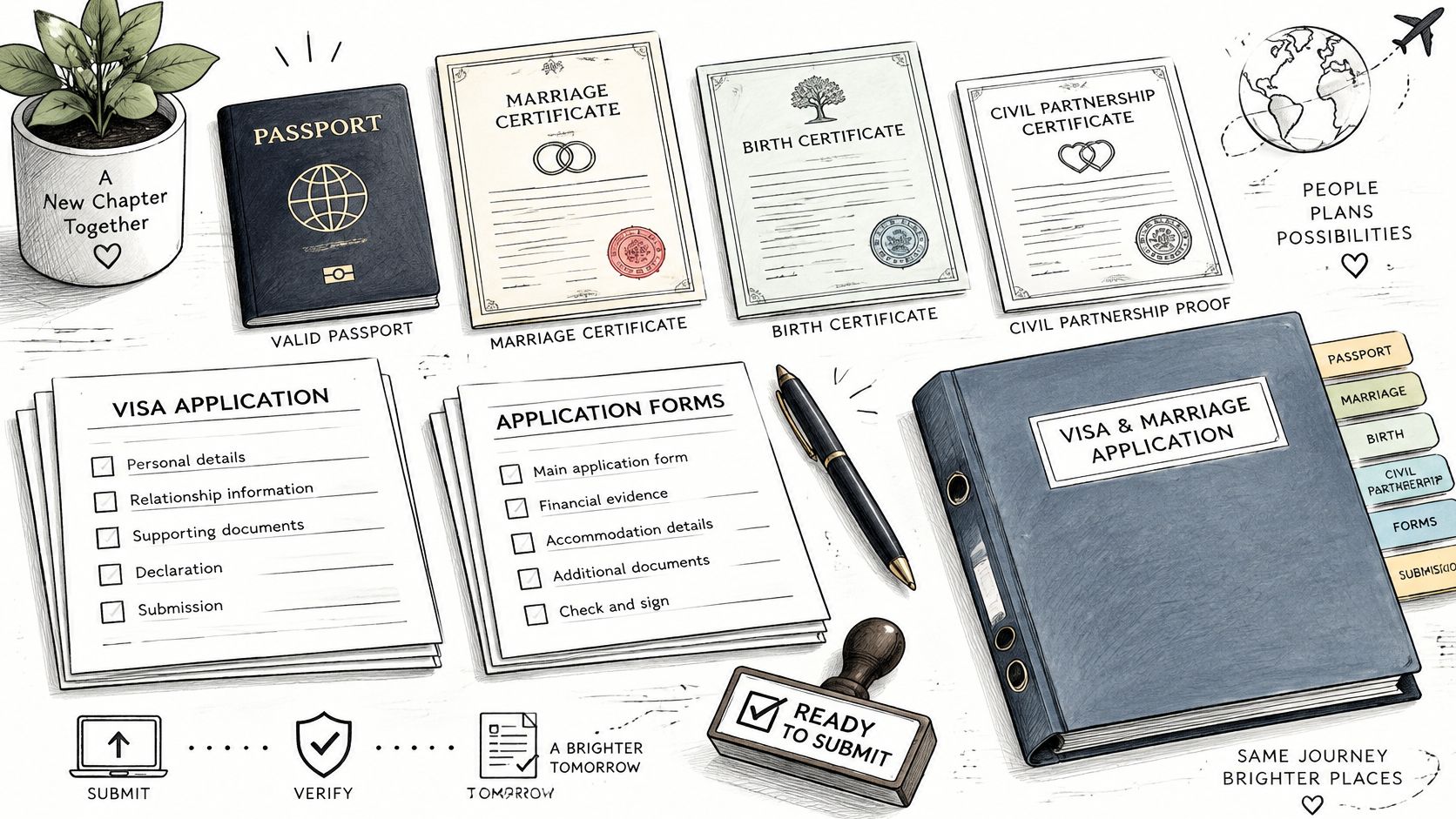
A joining spouse from a visa-required country normally needs a family reunification visa before entering Germany. Make it in Germany lists the core records authorities expect to see.
The core set
Group the papers by what they prove. Do not file them as one unsorted scan.
- Valid passport: It proves identity and must cover the planned travel. Names, dates, and the photo page should be easy to read.
- Marriage certificate, or proof of a registered civil partnership: This is the starting civil-status record. It is not the whole application.
- Birth certificates: Authorities may request them for both spouses. They help when names, parentage, or prior status need a cross-check.
- Proof of accommodation: This shows where the couple will live in Germany. A lease, owner confirmation, or similar housing record is the usual form.
- Health insurance evidence: Cover should be in place for the joining spouse. Ask the mission which proof it accepts before you buy a policy that will not count.
- Financial documents: These show how the household will be supported. Payslips, contracts, or other income records are typical, and the exact set varies by case.
Foreign documents often need authentication before a German authority will rely on them. A certified German translation is usually required as well.
Start those steps early. Authentication and translation take longer than most couples expect, and a late stamp can hold the whole file.
Why names have to match
The name on the marriage record, the passport, and the forms should be the same name. A hyphen, a maiden name, or a different order of given names can look like two people.
Fix the mismatch before filing. Do not hope the officer will "see what you mean."
A complete file is one cross-checked submission, not a drip of extra scans after the mission asks.
Mission checklists differ. Pull the local list before you file, and compare it with a family reunion document guide so nothing mission-specific is missing.
Keep a copy of every original, every translation, and every receipt. You will need the same set again after arrival.
Applying From Abroad and Entering Germany
A non-EU spouse who wants to move after the wedding follows a set order. Skipping a step does not save time. It usually resets the case.
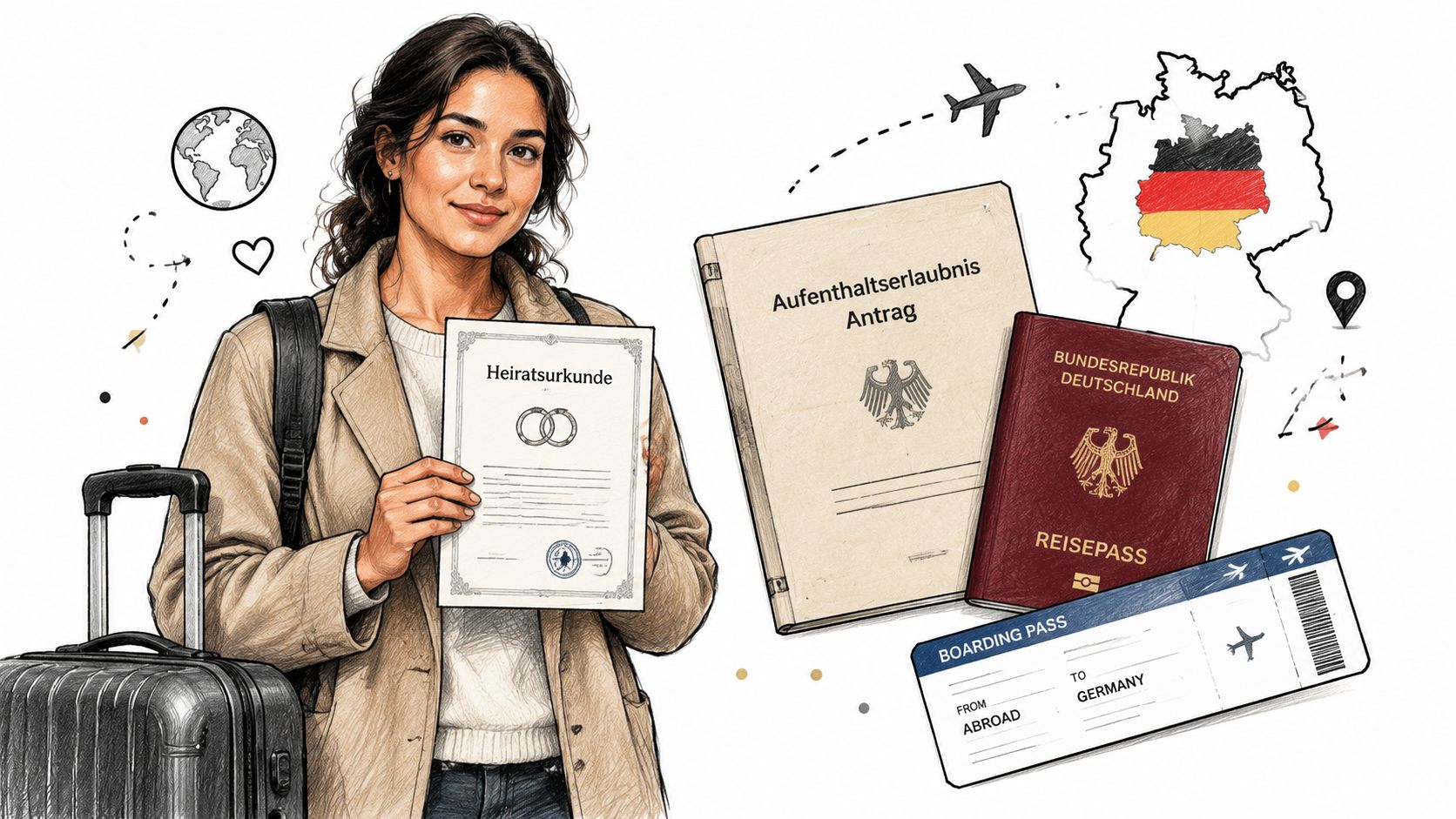
The German Foreign Office treats family reunification as its own visa route. The final residence permit is issued in Germany after arrival, not at the wedding.
The sequence that holds
- Authenticated marriage record and the German spouse's passport copy. Get both before you book the visa appointment. The mission needs proof of the marriage and proof of who the German spouse is.
- Family reunification visa at the competent German mission. File where that mission has jurisdiction over the applicant. The wrong post will not "forward it along" as a courtesy.
- Handoff to the foreigners authority. The mission sends the file to the authority responsible for the intended German address. The mission cannot issue the entry visa until that authority approves.
- Entry only after approval and visa issuance. Wait for the visa. Do not travel on a guess that approval is "basically done."
- Address registration, then the residence permit. Both happen in Germany, and both have to fit inside the visa's validity.
That handoff is the predictable delay. The couple does not control how fast the authority reads the file.
You can shrink avoidable delay. Send the authenticated marriage record, passport evidence, address details, translations, and mission forms as one checked pack.
Piecemeal email trails get lost. Officers then ask for items you already sent.
The short-stay trap
Entering on a short-stay Schengen visa does not convert automatically into a spouse residence permit. A tourist or visitor stamp is a different legal stay.
Couples try this because a visitor visa is faster to get. They then discover they cannot switch it into the spouse route from inside Germany.
The visa in the passport has to match the purpose of the stay. A wedding visit and a move are not the same purpose.
Some nationalities can enter visa-free for a short visit. That exemption is not the same as permission to settle. Check the residence rules for visa-free entry before anyone assumes the border stamp is enough.
Read the mission checklist for your post before you file. Requirements shift by nationality and by the family's circumstances.
If the couple already lives in Germany under another lawful status, the abroad sequence may not be the right first step. That is a different case, and it should be sorted before anyone exits and tries to re-enter.
Registering Your Address, Name and Permit
Picture a couple landing on a Thursday with a family reunification visa and a folder of copies. The visa is valid. The residence permit does not exist yet.
The registration that comes first
The joining spouse registers the new address at the local Residents' Registration Office. Do this before the permit appointment.
The foreigners authority needs a registered address in its district. A hotel booking or a friend's sofa is a weak stand-in if the couple's real home is somewhere else.
Book the registration as soon as the keys are in hand. Some cities fill appointment slots weeks ahead.
Bring the passport, the visa, the marriage record, and the housing proof. Ask for a stamped confirmation and keep it.
The permit appointment
The spouse then applies in person at the local foreigners authority. This has to happen before the entry visa expires.
A missed expiry turns a simple case into a hard one. The person can be in Germany with no continuing right to stay while the file is still open.
The officer may ask for records that were not in the visa pack. Birth certificates, fresh housing proof, insurance, and financial papers are common requests.
Do not arrive with only the marriage certificate. Treat the appointment as a second full review.
The name checkpoint
Check the name on the marriage record against the passport and the residence forms. Any mismatch should be resolved before filing, not explained at the counter.
A name change after marriage needs its own paper trail. If the passport still shows the old name, say so in the forms and attach the supporting record.
Bring originals plus copies. Keep every stamp, receipt, and appointment slip in one envelope.
That envelope is the case history if a letter goes missing. It also shows you met the deadline.
For the steps after the visa itself, a clear residence permit walkthrough helps you see which office comes first. Follow the local office's own booking rules. They differ by city.
Work rights usually attach to the permit, not to the wedding. Do not start a job on the assumption that marriage alone authorizes it. Read the visa vignette. Some entry visas limit work until the card is issued.
Choosing the Right Route for Your Situation
Marriage is not the same as an immediate right to enter, work, or remain in Germany. As Make it in Germany frames family routes, the path depends on nationality, the German spouse's status, the place of marriage, and whether the couple already lives in Germany.
The marriage certificate is often only the starting document. Change one fact, and the first step changes with it.
What shifts the first step
Nationality is the first split. A visa-required nationality starts at a German mission abroad. A visa-exempt nationality may enter for a short stay, but settlement still needs the correct permit route. Do not treat exemption as a residence right.
Place of marriage is the second split. A wedding abroad needs an authenticated foreign record and, usually, a German translation. A wedding in Germany produces a German civil record, but the foreign partner may still need a visa to enter for the marriage itself.
The sponsor's status is the third split. A German citizen with ordinary residence in Germany opens the Section 28 category already discussed. An EU or EFTA spouse can point to a different family route. Mixing those two files causes refusals for the wrong form.
Family history is the fourth split. Children, a prior marriage, or a missing divorce record can change what must be proven. An incomplete civil-status file should be repaired before the application, not during it.
Route checks by situation
| Your situation | Route to check first | Document to confirm early |
|---|---|---|
| Visa-required spouse, couple lives abroad | Family reunification visa at the competent mission | Authenticated marriage record and German spouse's passport copy |
| Visa-exempt spouse planning to settle | Whether a visa is still required for the long stay | Passport nationality and the entry rules for that purpose |
| Wedding will take place in Germany | Entry rules for the marriage trip, then the permit after the wedding | Proof you can marry in Germany, plus passports |
| Wedding already took place abroad | Recognition and authentication of the foreign marriage | Apostille or other authentication, plus translation |
| Couple already lives in Germany lawfully | Permit application at the local foreigners authority | Current status and its expiry date |
| German spouse vs. EU or EFTA spouse | The family route that matches the sponsor's nationality | Sponsor's passport or status evidence |
| Children, prior marriage, or gaps in civil records | Same route, with extra civil-status proof | Birth, divorce, or custody records |
Use the row that matches the case, then confirm the document in the last column before you book anything. A useful overview of German visa types helps when the first split is still unclear.
LegalWeg, a Germany-based immigration practice, offers a free initial case assessment, though complex matters may incur fees after review. It prepares and files visa and residence applications, gives written cost estimates up front, works in English, German, and Russian, handles cases remotely on a secure platform, and can file an Untätigkeitsklage if an authority stays silent past the legal timeframe.
Pick the route from the facts you have, not from a friend's timeline. Two weddings can look identical and still need different first steps.
Naturalization Timelines and Your Next Step
A marriage certificate starts a legal file. It does not hand you a passport. The residence permit lets you live in Germany. Citizenship is a later grant with its own tests, and the file that began with your wedding paperwork is the one that file builds on.
The standard residence requirement for naturalization is five years. A spouse-specific pathway can apply after three years of residence if the applicant has been married to a German citizen for at least two years, as summarized in federal naturalization guidance.
What marriage does not remove
Marriage can shorten the residence clock. The other conditions stay in place.
- Language evidence: You still need the required German level. A wedding does not replace the certificate.
- Civic knowledge: The test, or a recognized exemption, still sits in the file.
- Financial self-sufficiency: Income and benefits are examined. Dependence on certain benefits can block the application.
- Lawful residence status: The years have to be the right kind of stay. Gaps and the wrong permit category do not all count the same way.
- Documentation and identity: Names, prior citizenship, and civil records have to line up with the earlier marriage file.
- Absences: Long stretches outside Germany can break the residence count. Keep a simple travel log from year one.
Special rules can also matter for a spouse who joined around the relevant period. That connection can help a case. It does not replace the citizenship application or guarantee a yes.
Eligibility is not a decision date
The earliest eligibility date is a planning marker. The passport arrives when the office finishes your file, and some offices carry months of pending applications. Volume and staffing, not your wedding date, often decide the calendar.
Treat older articles with caution here. German naturalization law was revised recently, and guidance written before those changes can describe accelerated routes that no longer exist in the same form. Before you plan around any three-year figure that is not the spouse pathway described above, check the current version of the law or have an adviser confirm it.
Build a milestone map and keep it on one page. Use these markers.
- Lawful residence start date
- Marriage date and the two-year mark
- Language and civic-test evidence
- Income and benefits position
- Absences
- Prior citizenship questions
- The day you submit
If an authority stays inactive past the legal response time, ask which remedy fits before the file goes cold. A delay is a procedural problem, not proof that the marriage route failed. A structured look at the German citizenship process keeps the residence years and the marriage years on separate lines, so you do not apply a year early or a year late.
This week, book an initial case assessment if the route is still unclear. Gather the document set from the checklist. Write down every key date, from the wedding to the permit expiry to the day you can first apply for citizenship.
LegalWeg helps spouses of German citizens with family reunification visas, residence permits, and later naturalization, including cases where an authority has gone quiet. If you are about to marry a German partner or you already hold the certificate and need the next filing mapped, start with a look at your documents and dates. Visit LegalWeg to request an initial case assessment.