
A software engineer in Bangalore has a Berlin offer in hand. A doctor in Cairo is weighing a hospital contract in Munich. Both are asking the same practical question: does the EU Blue Card deliver enough to justify choosing it over a standard German work permit?
The answer depends on more than the right to work. The Blue Card can improve the route to permanent residence, make family relocation easier, and support later moves between participating EU countries. But it isn’t an automatic EU-wide work permit, and a cross-border move can complicate a settlement plan.
Table of contents
Why the EU Blue Card Matters Right Now
For a qualified professional with a German job offer, the Blue Card is a serious option, not an obscure immigration category. Eurostat-based figures show that 89,055 EU Blue Cards were issued in 2023, up from 81,846 in 2022. Germany issued 69,353 of the 2023 cards, about 78% of the EU total (Eurostat’s Blue Card figures).
Those figures matter to an applicant because Germany is the main destination within the scheme. They also show that the Blue Card is an established route for recruiting non-EU professionals, rather than a permit that works only in unusual cases.
The basic bargain is straightforward. The applicant needs to meet the relevant qualification, employment, and salary requirements. In return, the permit provides residence and work rights for a highly qualified job, with potential advantages for family reunification, mobility, and settlement.
The practical point: The Blue Card is valuable when its added rights fit the applicant’s plans. A high salary alone isn’t a reason to choose it if another permit better suits the role or the intended length of stay.
The scale of the scheme doesn’t make every application simple. National authorities still handle applications, and the rules that matter most to a particular worker are the rules of the country where the job is based. For someone considering Germany, the essential question is what the permit delivers after the first job begins, especially if family members may relocate or a move to another EU country is on the horizon.
Applying for an EU Blue Card in Germany?
We handle your EU Blue Card from the first check to a lawsuit over any delay.
Tell us about your case, and we’ll get you through the next step.
What the EU Blue Card Actually Is
The EU Blue Card is a residence and work permit for non-EU citizens taking up qualifying highly skilled employment. A useful analogy is an express lane with an entry price: the job and salary must meet the relevant national conditions, but the permit can offer advantages beyond the initial right to work.
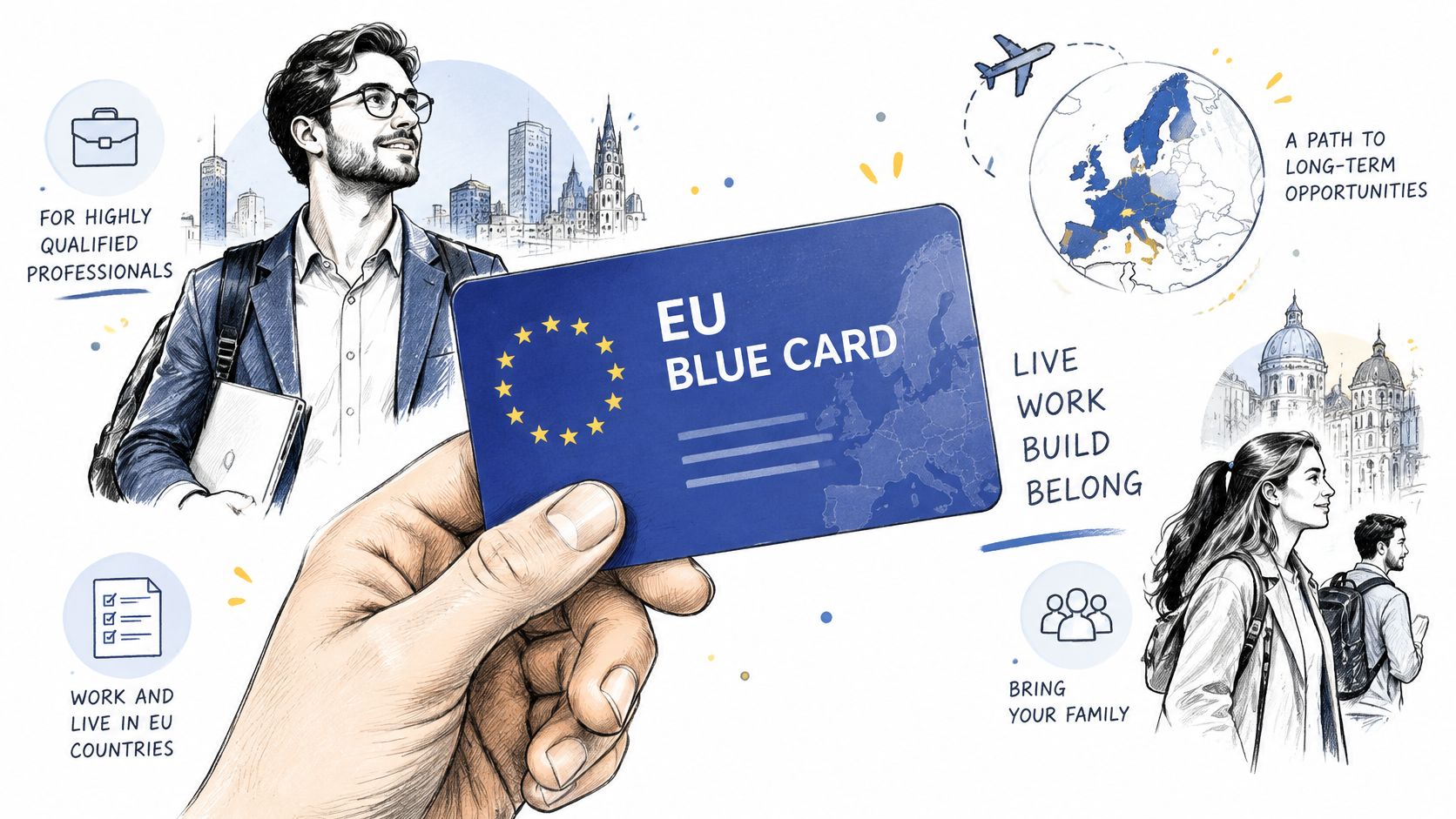
In practice, an applicant and employer should check three pillars:
- Qualification: The applicant must meet the applicable education or professional qualification rules. The authority may need evidence that a qualification is recognized or comparable.
- Employment: The applicant needs a qualifying job offer or employment contract. The role must meet the highly qualified employment conditions.
- Salary: The offered pay must satisfy the threshold set by the country of employment. A threshold that works in one Member State doesn’t automatically work in another.
The details differ by country. Germany’s process is not identical to the process in another Member State, even though the system rests on common EU rules. The revised framework is set out in Directive (EU) 2021/1883, while national authorities administer applications and apply the relevant domestic requirements.
That distinction is easy to miss. The Blue Card isn’t a single permit that a worker obtains once and then uses to take any job anywhere in the EU. It grants residence and work rights under the issuing country’s rules, with defined routes for mobility and other benefits under conditions.
Applicants should check their qualification, salary, and job conditions before relying on an offer. A focused review of EU Blue Card requirements can help identify which points need attention before an application is filed.
The Five Core Benefits at a Glance
The EU Blue Card’s benefits make most sense when treated as a set of distinct rights, not as a blanket promise of unrestricted work or movement. For a German applicant, five benefits deserve attention.
| Benefit | What it means in practice |
|---|---|
| Qualified work | The card supports residence and employment in a qualifying highly skilled position, subject to the applicable conditions. It isn’t general permission to take any job. |
| A salary floor | The job must meet the issuing country’s salary requirement. That can limit eligibility, but it also makes salary a central part of the permit assessment. |
| Mobility | A holder can use simplified rules to seek highly qualified employment in another participating Member State after a qualifying period of residence in the issuing country. |
| Family reunification | Qualifying family members can join the Blue Card holder. In Germany, the rules for spouses and other relatives are more favourable than many applicants expect. |
| A settlement route | In Germany, a qualifying holder can reach a settlement permit faster than under most other permits; the exact timelines are covered below. |
As the figures above show, Germany dominates the scheme, which makes the German route especially relevant to applicants with a German offer.
Three catches sit inside this table. Mobility runs on a clock: twelve months of residence in the issuing state generally must pass before the simplified movement rules apply, so it rewards applicants who stay put first. Family reunification, relaxed in Germany in March 2024, still runs through an application with document checks rather than happening automatically on approval of the card. And the settlement timeline favours continuity in Germany, since residence accumulated under another Member State’s card does not feed a German settlement permit the way applicants often assume.
Which benefit matters most depends on the plan. A worker building a long-term German career may care most about settlement. A specialist expecting an internal transfer to another EU office may value mobility more. For a household relocating together, family rights may be decisive.
Treat each benefit as a separate legal advantage with its own conditions. Approval of the card does not settle every later question.
How Intra-EU Mobility Works in Practice
Mobility is useful, but it isn’t immediate and it isn’t automatic. Under the revised EU framework, a Blue Card holder can generally seek highly qualified work in a second Member State after 12 months of legal residence in the country that issued the card. The framework also allows a further move after six months of Blue Card residence in the first destination in specific circumstances (Directive (EU) 2021/1883).

The move still requires action by the worker and employer. A holder considering another country should:
- Confirm eligibility in the destination. The new job must qualify there. The destination country can apply its own salary threshold, qualification rules, and requirements for an employment contract or binding offer.
- Prepare the application. The applicant may need to present a valid Blue Card and evidence of the new highly qualified role. The receiving authority may also require notification or a formal application.
- Check the start date. Under the directive’s mobility rule, after a complete application in the second Member State, the holder must be allowed to start work no later than 30 days later. That isn’t a guarantee of automatic approval or a substitute for the required filing.
The important advantage is procedural. The destination country generally cannot require the applicant to repeat the original labour-market test, and the move can be simpler than starting a fresh immigration route from outside the EU. But the holder shouldn’t resign, relocate, or start work on the assumption that an existing card alone authorizes employment in the new country.
Practical rule: Before accepting a transfer, confirm the destination’s filing steps, salary requirement, and permitted start date. Mobility reduces friction; it doesn’t remove the receiving country from the decision.
For employers with teams in several Member States, this structure can make internal career moves more manageable. For workers, it means the first EU job may support a later move. Neither benefit turns the Blue Card into unrestricted permission to work across the EU.
Comparing the Blue Card With Other German Permits
The Blue Card isn’t the right choice for every qualified worker. Its main attractions are the settlement route, family provisions, and potential mobility, but an applicant may face a salary requirement that a different German permit doesn’t impose in the same way.
| Feature | EU Blue Card | Skilled Worker Visa (§ 18b) | ICT Card |
|---|---|---|---|
| Salary threshold | Must meet the relevant Blue Card threshold. | A role below the Blue Card salary floor may still qualify under the applicable skilled-worker rules. | Must meet the applicable rules for an intra-company transfer. |
| Qualification rules | Designed for highly qualified employment and requires the relevant qualification or other accepted basis. | Can suit qualified workers whose role or salary doesn’t fit the Blue Card route. | Intended for an eligible transfer within the same corporate group. |
| Family treatment | Offers family reunification advantages, including important German changes for spouses. | Family eligibility depends on the applicable rules for the permit and household. | Family rights depend on the relevant permit conditions and individual circumstances. |
| Settlement timeline | In Germany, a qualifying holder may apply after 27 months, or 21 months with B1 German. | The timeline depends on the relevant residence route and conditions. | The permit is designed for a temporary transfer, so a long-term settlement plan needs separate assessment. |
| Mobility | Provides a defined route to move to another participating Member State under simplified rules. | Doesn’t provide the same Blue Card mobility framework. | Supports a qualifying intra-company transfer, not general EU mobility. |
The comparison is a decision aid, not a substitute for checking the exact legal route. Germany’s visa and residence permit options can help an applicant compare categories against the job offer and the intended stay.
The Blue Card often has the clearest advantages for a professional who meets its salary and qualification conditions and wants a faster German settlement route. A standard skilled worker permit may be more practical when the role is eligible but the employer can’t meet the Blue Card salary floor.
The ICT route deserves attention when the move is an internal company transfer. Its purpose is different from a direct local hire, so the applicant should compare the expected length and structure of the assignment before choosing. A permit that is easier for the employer to arrange may not provide the same long-term benefits for the worker.
Family Reunification Under the March 2024 Rules
Germany’s family rules for EU Blue Card holders changed on 1 March 2024. The changes reduce several barriers, but they don’t make approval automatic. Families should plan around both the relaxed conditions and the evidence that still needs to be provided.

For spouses, the practical changes are significant. A spouse joining a German Blue Card holder generally doesn’t need to prove German-language knowledge, and can work without an additional labour-market restriction. The Blue Card holder also generally doesn’t have to prove sufficient living space for family reunification.
Minor children may join under the applicable family rules. A new option also allows a first-time holder of a German EU Blue Card to bring parents and parents-in-law, subject to the relevant conditions. That can change a relocation decision for a household that depends on support from older relatives.
The relaxed rules don’t eliminate the core documentation. Applicants still need to establish identity and the family relationship, meet health-insurance requirements, and comply with lawful-entry procedures. The correct process can vary depending on whether the family applies alongside the Blue Card holder, applies later from abroad, or is already in Germany.
A candid distinction: Easier family reunification means fewer barriers. It doesn’t mean that a spouse or parent can arrive without documents and expect a permit.
The family should settle the application sequence early. A spouse applying with the principal applicant may face a different process from a spouse joining later, and a family already in Germany may need to deal with the local immigration authority rather than apply through an embassy. The German government’s EU Blue Card questions and answers set out the relevant family provisions.
Before booking travel, the household should gather passports, relationship records, and any required insurance evidence. A clear checklist for family reunification in Germany can help families avoid treating the principal applicant’s approval as approval for every relative.
Need help with your family reunion visa?
From completing the documents to filing a lawsuit over the delay in results, our team can help.
Reach out to our team, and we’ll get back to you directly.
The Path to Permanent Residence and EU Long-Term Status
The 27-month and 21-month timelines introduced above are only the starting point. What matters for a worker weighing a cross-border move is how that clock behaves once Germany is no longer the only country on the record.
Two conditions decide the German count. The clock only runs on months of qualifying employment with statutory pension contributions, and the shorter route stays closed without documented B1 evidence. Reaching a month count does not convert the card into a settlement permit on its own; the application still has to be filed, and the livelihood and language requirements still have to be met on the day it is decided.
The cross-border picture works differently. EU rules let qualifying Blue Card residence periods in different Member States be combined toward EU long-term-resident status. The applicant must have two years of legal and continuous residence in the Member State where the application is made immediately before applying, and must still meet the relevant national conditions (European Parliament summary of the long-term residence provisions).
That distinction should drive the transfer decision. Time in Germany and time in another Member State can add up for the EU-wide status, but a German settlement permit is a German calculation. A holder who leaves after two years may keep the long-term-resident track alive while weakening the practical path to a German settlement permit, which rewards continuous qualifying employment in Germany itself.
Plan the destination and the clock together. A stronger role abroad can still be the right call, but check first which residence status the move preserves and which one it sets back.
Keep employment contracts, residence documents, and pension contribution records organized in every country of stay. A worker considering a foreign offer should run a review of permanent residence requirements in Germany before signing, because discovering afterward that the German clock effectively restarted is an expensive way to learn the difference between the two statuses.
Planning to settle permanently in Germany?
From checking whether you qualify to filing your application, we can help you apply for a permanent residence permit.
Tell us about your situation, and we’ll get back to you directly.
When the Blue Card Is the Wrong Choice
The Blue Card can be the wrong route when its conditions don’t match the job or the worker’s actual plan. The clearest example is a salary below the Blue Card threshold. If the offer still qualifies for a German skilled worker permit, insisting on a salary increase may delay the hire without improving the worker’s immediate position.
An internal transfer also calls for a separate assessment. When an employee is moving from a company branch outside the EU for a temporary assignment, the ICT route may fit the arrangement better than a Blue Card based on a local employment offer. A researcher may also have a suitable research-specific route, depending on the host arrangement and the work.
Mobility shouldn’t be oversold. A second Member State still applies its own requirements, and the 30-day work-start rule applies after a complete application under the directive. It doesn’t mean the holder can arrive and start work without filing or receiving the necessary authorization.
A worker can seek a change of residence route later, but that creates paperwork and timing issues. The decision should be based on the role, salary, family plans, likely duration of the German stay, and any expected cross-border transfer. For a worker weighing a settlement route, German settlement permit support for skilled workers can help clarify the requirements that apply to the individual case.
A sound choice is direct: choose the Blue Card when the offer qualifies and its family, mobility, or settlement advantages serve the worker’s plans. Choose another permit when it fits the job or transfer better, and don’t confuse a more prominent permit category with a better legal outcome.
LegalWeg advises non-EU professionals and families on German EU Blue Card applications, family residence, and settlement permits, including document preparation and filing support. For a case-specific assessment of the offer and the right permit route, visit LegalWeg.