
The application is filed. The applicant believes the file is complete, but an official won’t accept a document, and months pass without a decision.
That situation calls for a diagnosis, not another generic reminder email. Immigration issues in Germany require different responses depending on whether the obstacle is missing evidence, legal eligibility, or an authority’s failure to decide.
Table of contents
Immigration Issues in Germany at a Glance
Germany recorded net immigration of 430,183 people in 2024, down 35.1% from 662,964 in 2023, according to the Federal Office for Migration and Refugees. A national migration balance says little about the queue inside any particular immigration office.
Existing applications and later requests from residents already living in Germany still land on the same desks. A lower inflow figure can sit alongside a crowded caseload, so the applicant’s own correspondence matters more than the national trend when deciding what to do next.
Recurring Immigration Issues in Germany and First Moves
| Issue | Who it hits | Typical sign | First move |
|---|---|---|---|
| Slow citizenship or residence decisions | Naturalization and permit applicants | No decision after many months | Send one written status request quoting the file number and submission date |
| Administrative silence | Applicants with a complete file | No reply after the legal waiting period | Get written confirmation that the authority holds a complete file |
| Refused or incomplete documents | Applicants with name, date or translation gaps | Refusal letter or request for more evidence | List every cited defect with its own deadline before responding |
| Job-route thresholds and quotas | Blue Card and skilled worker applicants, Western Balkans regulation applicants | Salary below threshold or quota exhausted | Compare the offered salary with the route’s current threshold before fixing a start date |
| Family reunion limits | Unmarried partners, adult children, relatives, subsidiary protection holders | Application ineligible under current rules | Check whether the sponsor’s residence status supports that relationship category |
The distinction between a document request and a refusal matters immediately. A request usually calls for additional evidence, while a refusal requires attention to the available remedy and its deadline.
For job routes, the contract’s salary, occupation, and residence category decide whether processing speed is even the right concern yet.
Identify the Obstacle Before Escalating
Applicants should separate the authority’s actual position from assumptions about it.
- An acknowledged application: Keep the receipt and ask in writing what the authority still considers outstanding.
- A disputed document: Obtain the exact objection in writing rather than repeatedly sending the same attachment.
- An unanswered complete file: Keep a dated record of the submission, every reminder and every response before weighing an Untätigkeitsklage.
- A potentially unavailable route: Check eligibility before spending more on translations or travel.
Family reunion files raise a separate eligibility question, since qualification turns on the sponsor’s residence status and the specific relationship category.
The practical starting point is the row that matches the authority’s latest communication. That choice decides whether the next useful action is more evidence, an eligibility review, or a written record strong enough to support an assessment of administrative silence.
When a Slow File Becomes Unreasonable Delay
A busy restaurant kitchen may take longer to prepare an order. An order that was never written down presents a different problem.
Immigration administration requires the same distinction. A pending check may explain some waiting, while unexplained inaction on an application can raise a legal issue.

The Legal Test Is More Than Elapsed Time
Section 75 of the Administrative Court Procedure Code, discussed in the Federal Ministry of the Interior’s migration information, concerns applications or objections left undecided for an unreasonable period without sufficient reason. An Untätigkeitsklage normally cannot be filed until three months after the application or objection, although special circumstances can justify a shorter period.
That waiting rule isn’t a universal deadline requiring every authority to approve every application. The court considers whether there is sufficient reason for the delay in the individual proceedings.
If the authority issues the requested administrative act within a deadline set by the court, the claimant can declare the main dispute resolved. The procedural response still needs attention to the decision’s contents and the remaining costs.
Practical rule: A delay lawsuit seeks judicial action on administrative inaction. It doesn’t turn an ineligible application into an eligible one.
Free case assessment
Waiting months for a response on your application. You don’t have to.
Get your free case assessment to learn the best next steps for your situation.
What Litigation Can and Cannot Achieve
Several assumptions lead applicants toward the wrong strategy.
- A lawsuit doesn’t force approval: An authority may decide against the applicant if the substantive requirements aren’t met.
- Eligibility doesn’t guarantee speed: Officials still need to establish that the evidence supports the application.
- A long wait doesn’t automatically justify suing: The authority’s explanation and the procedural history remain relevant.
Litigation also introduces costs and procedural obligations. An applicant should weigh those against the consequences of continued waiting, rather than treating a claim as a stronger reminder email.
A focused review of filing an Untätigkeitsklage should establish the correct defendant and competent court. It should also address any unresolved substantive weakness before proceedings begin.
The useful questions are factual, not rhetorical:
- Completeness: When did the authority receive the evidence needed to decide?
- Further requests: What has the authority requested since, and when was it supplied?
- Written explanation: What reason or timetable has the authority given?
A vague recollection that everything was sent months ago is a weak starting point. Dated answers allow a meaningful assessment of whether further waiting is justified.
Processing Times and Backlogs Behind Citizenship Delays
In 2024, 291,955 foreign nationals acquired German citizenship, an increase of 91,860 people, or 46%, over 2023, according to Destatis. This was the highest annual total since the national statistical series began in 2000.
Completed naturalizations count decisions. They reveal nothing about the size of the pending queue, so a record year nationally can coexist with a stalled file locally.
The reform reduced the standard residence requirement from eight years to five years and introduced a three-year route for particularly strong integration achievements. Applicants should confirm which residence period and which accelerated provisions apply to their own record before planning around a shorter wait.
Reported Citizenship Processing Signals
| Signal | Source | Reported figure | What it means for applicants |
|---|---|---|---|
| Naturalizations in 2024 | Destatis figures stated above | Annual completions rose sharply | National output doesn’t establish a local completion date |
| Processing time and security checks | Munich citizenship authority | 18 months or longer overall, with security checks taking about four to six months | Plan for a prolonged process; checks can account for part of it |
| Queue order | Reported local authority practice | Older applications generally handled in receipt order | Get your own queue position confirmed in writing before relying on any reported figure |
Authority statements change over time. Munich’s security-check period shouldn’t be added mechanically to its overall estimate, because stages can overlap.
A reported queue position also reflects a single point in time. Receipt-order processing means a complete file can still wait behind older applications, which is a normal backlog rather than a sign of trouble. Silence becomes harder to accept once the authority holds everything it requested and still gives no decision or timetable, so ask in writing where your application stands before treating an older report as a forecast.
Remove Avoidable Document Delays
Officials must establish more than the length of residence. They examine identity and the other statutory conditions, including language, civic knowledge and livelihood.
A strong application therefore needs an intelligible history rather than a large collection of unexplained attachments.
- Names and dates: Explain differences across passports and civil-status records.
- Translations: Make sure every translation corresponds to the submitted original.
- Residence periods: Identify changes of status and any periods needing explanation.
- Employment evidence: Present a chronology that matches the supporting records.
Repeatedly uploading unchanged documents won’t move a file forward in a receipt-order queue. Gaps and inconsistencies will, however, push it backward, since each clarification request restarts correspondence.
The German citizenship application guide provides a starting point for organizing the application. For an existing case, the more useful request is the authority’s written account of outstanding checks and its current processing expectations.
Get support on your visa or citizenship application
Filing a visa or citizenship application alone can get overwhelming fast. You don’t have to go through it by yourself.
Get full support from an immigration lawyer, from finding the right forms to getting a final decision.
Blue Card and Skilled Worker Thresholds That Stop Job Visas
An employer confirms the hire, sends the contract, and sets a start date. Three checks still decide whether a job visa can issue: the salary threshold for the route, any required agency approval, and quota availability where admission is rationed.
Germany issued more than 41,000 first-time EU Blue Cards in 2023, a 5% increase over the previous year, and approximately 113,500 holders lived in Germany at year-end, according to BAMF’s Blue Card statistics, which also report that slightly less than half of first-time recipients already held another German residence title.
Job-Route Thresholds and Limits for 2026
The lower Blue Card threshold below covers qualifying shortage occupations with Federal Employment Agency approval and qualifying recent graduates. The standard threshold applies to every other case.
| Route | Threshold or limit | Condition | Risk for employer or applicant |
|---|---|---|---|
| Standard EU Blue Card | €50,700 gross per year | Normal case | A lower salary requires another qualifying category or route |
| Shortage occupation Blue Card | €45,934.20 gross per year | Federal Employment Agency approves the employment | Required approval must be obtained in the procedure |
| Recent graduate Blue Card | €45,934.20 gross per year | Final degree or equivalent obtained less than three years earlier | Entry-level jobs in any profession qualify, but the degree must still be proven |
| Western Balkans regulation | 50,000 annual admissions, doubled in mid-2024 | Quota must remain available | Quota exhaustion can block progress despite a genuine vacancy |
2026 thresholds per the Make it in Germany skilled immigration guidance.
The Federal Employment Agency reports the Western Balkans quota increase to 50,000 annual admissions and around 18,000 enquiries rejected in December 2025 after exhaustion, plus approximately 420,000 socially insured employees holding an employment-based residence or settlement permit by June 2025.
Check the Route Before the Start Date
The graduate route and the recruit route run on different tracks. A graduate already holding a German residence title converts status inside the country, while a recruit abroad enters the consular queue and needs an appointment before the file can move at all.
The salary comparison must use the contract’s gross annual pay. Employers should identify which contractual components count before assuming that a package clears the threshold.
Agency approval needs careful sequencing too. Where advance approval is available, it speeds preparation, and some approvals can still be in progress when the application is filed rather than having to exist beforehand.
During the wait, keep the filing confirmation, appointment requests, and every authority response in one record. A pending approval or a quota queue is an ordinary processing delay. A complete application met with continued silence raises a different question.
A pre-offer review should address:
- Qualification evidence: Is the qualification recognized or otherwise acceptable for the proposed route?
- Salary: Does the contract satisfy the applicable category and year?
- Quota availability: Is access rationed under the selected route?
- Appointments: Can the applicant access the relevant consular procedure?
- Alternative categories: Would another route genuinely fit the applicant’s facts?
The EU Blue Card requirements guide separates salary eligibility from the remaining requirements. An alternative skilled-worker route can be worth assessing where the facts genuinely fit it; a route change cannot repair incompatible qualifications.
Employers should make start-date commitments conditional on immigration clearance. Urgency on the employer’s side leaves quota rules and missing legal requirements unchanged.
Family Reunion Limits and Who Qualifies
Family reunion is a separate immigration route with defined categories. Approval for one relative establishes nothing about another, and the slowest files are often those submitted under a category the law does not offer to the people involved.
A spouse or registered partner starts with the legally recognized relationship. The certificate must support the relationship claimed, and the sponsor’s residence status must permit the proposed reunion.
The Relationship Category Comes First
Unmarried partners without a registered partnership generally cannot use ordinary partner-based family reunion. A couple weighing registration or marriage should check its legal recognition and immigration consequences first, because that civil-status step decides which category exists at all.
Adult children joining a parent in Germany generally qualify only where exceptional hardship applies, and the same hardship test restricts siblings, grandparents and other extended relatives. Parents of a minor child living in Germany fall under a different provision tied to care and custody of that child. Financial dependence or a close emotional bond alone does not open a category.
Family reunion for subsidiary protection holders is suspended. The applicable suspension period and any relevant exceptions require a current legal check before an application is recommended.
Civil-status documents prove that a relationship exists. The right to enter Germany comes from the legal category behind those documents, so a strong paper trail under an unavailable category still fails.
A Practical Eligibility Sequence
- Identify the sponsor’s status. Use the actual residence document and its legal basis, not a general description such as refugee or worker.
- Name the family category. Distinguish a spouse from an unmarried partner, or a minor child from an adult child.
- Review civil-status evidence. Check certificates and required translations before booking travel.
- Check the consular procedure. Establish appointment access and the documents needed for the relevant location.
- Choose the filing strategy. Consider whether to apply now, await a relevant status change, or assess an independent route.
The family reunification requirements guide sets out the category conditions in detail. The decisive assessment still concerns the particular sponsor, relationship, and current rules.
Waiting for a status change can postpone reunion for months, and a pending file that sits unanswered raises the same delay questions as any other application. Filing under an unavailable category, however, consumes time and fees without resolving the underlying barrier.
Need help with your family reunion visa?
From completing the documents to filing a lawsuit over the delay in results, our team can help.
Reach out to our team, and we’ll get back to you directly.
How to Answer a Refusal or Missing Document Request
A letter from an authority needs classification before it needs a reply. A request for evidence, a hearing letter, and a formal refusal can require different responses.
The first task is to preserve the full letter and its delivery details. The next is to identify exactly what the authority requires.
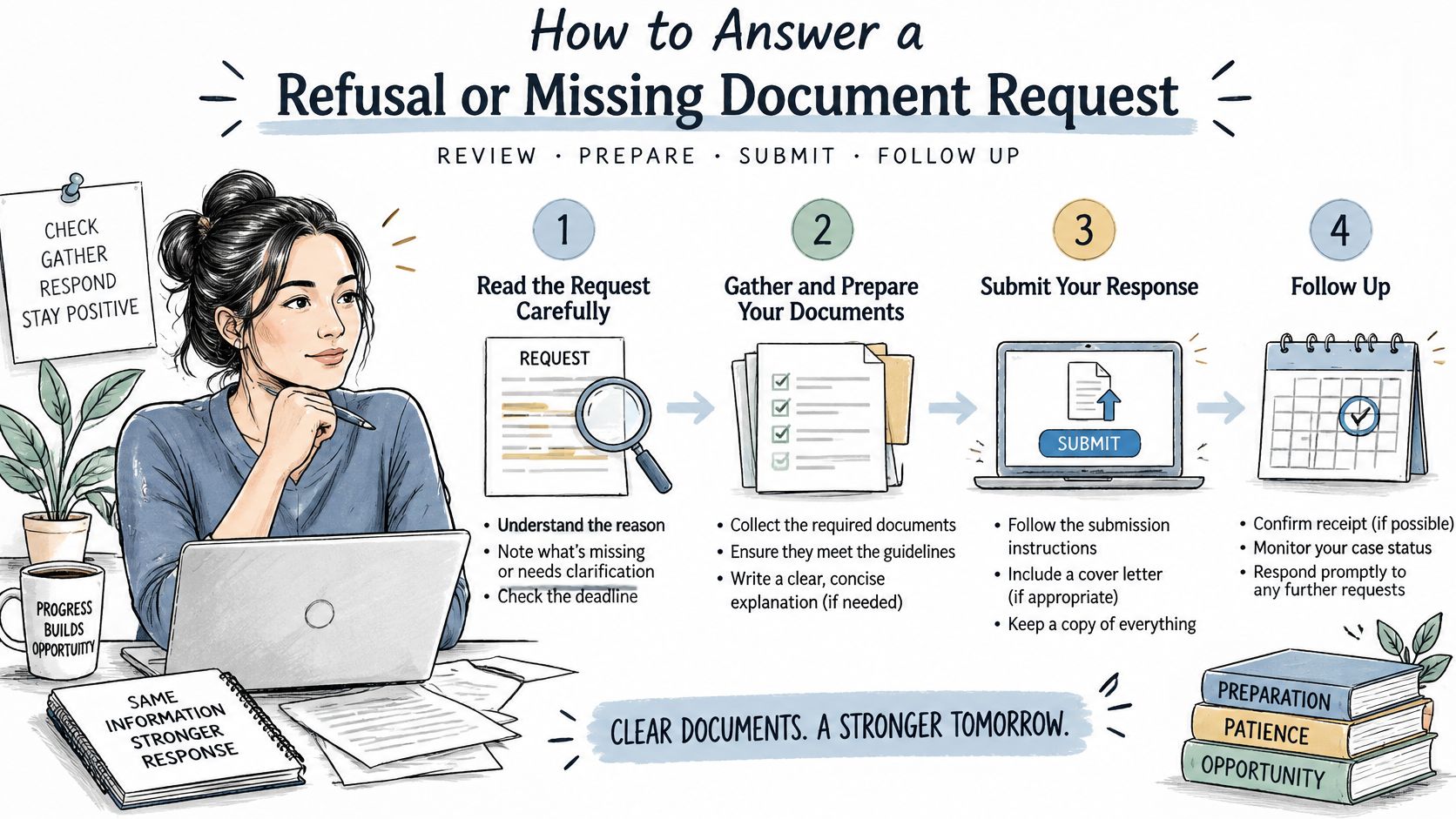
Build a Reply the Caseworker Can Check
Read the operative wording. Mark the legal basis, requested action and deadline; the common mistake is reading the explanation but overlooking the final instructions.
Extract every alleged gap. Copy each disputed fact into a response checklist instead of guessing what the official meant.
Match evidence to each point. Use the relevant passport, civil-status certificate, residence record or income document; unrelated attachments make the response harder to assess.
Resolve inconsistencies before sending. Explain spelling differences and conflicting dates, rather than submitting a translation that contradicts the original without notice.
Check translation requirements. Obtain certified translations where required, and make sure stamps and annotations haven’t been omitted.
Use an indexed cover letter. Answer the authority’s points in the same order and identify the supporting attachment beside each answer.
Calendar the correct remedy deadline. A Widerspruch often has a one-month deadline after notification, but state rules and the type of decision can change the available remedy.
Preserve submission evidence. Keep the portal receipt, postal tracking, or email acknowledgment with the exact package submitted.
Assess the next procedural step. If an objection is rejected or remains unanswered, establish whether court proceedings are available and which deadline governs them.
Protect the Remedy, Not Just the Correspondence
A substantive reply doesn’t necessarily preserve the right to challenge a refusal. Some decisions require a court action rather than an administrative objection.
The remedies notice deserves separate attention. If it’s missing or unclear, applicants should obtain a legal assessment rather than assume that an ordinary email is enough.
The family reunion visa document guide can help organize supporting evidence in that category. It doesn’t replace a response written specifically to address the authority’s actual objections.
If a requested document cannot be obtained in time, explain the obstacle before the deadline. Include evidence of attempts to obtain it and request a specific extension rather than leaving the request unanswered.
Evidence first: A persuasive reply connects each disputed requirement to a document or a clear legal explanation.
Each refusal needs its own case record. A well-written response cannot repair a substantive eligibility problem unless the missing requirement can be satisfied.
Building a Delay File and What One Case Shows
A delay file turns silence into a reviewable record. It shows what was submitted, which requests were answered, when the file became complete, and how long the authority has since failed to decide.
Keep it separate from the substantive evidence bundle. The substantive file proves eligibility; the delay file proves procedure. Mixing them forces an adviser or court to reconstruct the chronology from scattered messages before anyone can assess whether the wait has moved from ordinary backlog to legally unreasonable silence.
What the Record Should Contain
| Record | What to preserve | Why it matters |
|---|---|---|
| Initial submission | Application copy, attachments and receipt | Establishes what reached the authority |
| Follow-ups | Date, method, recipient and message | Shows the attempts to obtain progress |
| Further requests | Full request and delivery details | Identifies what the authority considered missing |
| Supplementary submissions | Exact documents and acknowledgment | Shows when a stated gap was answered |
| Authority correspondence | Full messages, letters and attachments | Preserves explanations without paraphrasing |
| Quoted timelines | Written estimate or a dated note of a call | Separates documented statements from recollection |
Telephone notes should identify the speaker and substance of the conversation. They should also be labelled as notes rather than treated as written promises by the authority.
A chronology is strongest when every entry points to an underlying document. Record each date beside the receipt, message or letter that proves it. Where a receipt is missing, mark the gap plainly instead of letting the timeline imply delivery.
A Hypothetical Complete-File Sequence
A citizenship applicant submits the forms and supporting records, receives an acknowledgment and later answers a request for a missing certificate. The delivery confirmation goes into the delay file with the exact certificate sent. After that, the authority issues no decision and raises no further written request for a prolonged period.
At that stage, the question is narrower than “why is this taking so long.” The file can be tested for completeness: exact submission evidence, proof that the later request was answered, every reminder sent afterward, and the absence of any new objection in writing. That is the point where an Untätigkeitsklage assessment becomes concrete rather than speculative.
If the authority then schedules an appointment, the sequence records movement while leaving causation unproven. Territorial jurisdiction still requires a separate assessment for any court filing, and registration of a claim does not by itself establish that a named court is competent.
What the Sequence Establishes
The useful lesson is disciplined preparation before escalation. Applicants lose time when they can describe frustration but cannot show the procedural facts that decide whether silence has become unreasonable.
- The chronology improves clarity: It makes the application history easier to assess.
- The documents remain decisive: A dated record supports escalation while substantive eligibility still rests on the underlying evidence.
- The endpoint must be verified: An invitation to receive a certificate leaves the handover incomplete until it takes place.
Preserve the distinction between an encouraging development and a legally completed outcome. A clean delay file makes that distinction visible early, while there is still time to choose the correct remedy.
Confirm Your Deadline Before You Act
A file can contain both a refusal and a period of silence. Treat these as separate issues: the refusal may trigger a deadline to challenge the decision, while an Untätigkeitsklage addresses a failure to decide. Calendar the refusal deadline first and get advice on the appropriate remedy before it expires. A delay claim does not replace a challenge to a refusal.
For other files, use the evidence and timing questions set out earlier to decide whether the delay justifies escalation. Keep the chronology tied to dated receipts and correspondence. That record gives a legal assessment a clear factual starting point.
LegalWeg offers a free case assessment and files an Untätigkeitsklage when authorities do not respond. Complex matters may incur fees after review. Applicants can request an assessment through the LegalWeg contact page and provide submission dates, authority letters, and follow-up records.