
Stop collecting every document on the internet. That’s the most popular advice on spouse visa Germany requirements, and it’s wrong for many families.
The sponsor’s title decides the route first. A file that’s complete for one sponsor can be overbuilt or still incomplete for another.
Table of Contents
- Spouse Visa Germany Requirements by Sponsor
- Age Rules and the A1 German Test
- Income Housing and Health Insurance
- Documents to Gather Before You File
- From Embassy Application to Residence Permit
- Two Cases That Changed the File
- Check Your Route Before You Apply
Spouse Visa Germany Requirements by Sponsor
Spouse visa Germany requirements follow family reunification under Section 30 of the Residence Act, and the sponsor’s residence title decides which version of them applies.
The sponsor is the spouse already in Germany. A German passport, a Blue Card, a settlement permit, and a student permit each produce a different file for the same marriage.
A spouse who needs a visa applies for a national visa for family reunification. Unmarried partners can’t use spouse reunification without a registered partnership; the marriage, or registered partnership, is the legal basis for the route.
This page is the checklist. For the legal background on joining a spouse who is not a German citizen, see our spousal reunification guide. If your spouse is German, our guide to marrying a German covers the process from wedding to residence permit.
Need help with your family reunion visa?
From completing the documents to filing a lawsuit over the delay in results, our team can help.
Reach out to our team, and we’ll get back to you directly.
Read the Sponsor Row First
Pick one row, then ignore the requirements that row drops.
| Sponsor in Germany | A1 before entry | Livelihood check | Housing check | Health insurance at visa stage |
|---|---|---|---|---|
| German citizen | Usually required unless a statutory exception applies | Ordinary third-country livelihood test does not automatically apply | Ordinary third-country housing test does not automatically apply | Generally not required during the visa process |
| EU or EEA national | Free-movement family route, not the ordinary Section 30 test | Not the ordinary third-country livelihood test | Not the ordinary third-country housing test | Follows the EU-family route |
| EU Blue Card holder | Not required under Section 30 | Usual test does not apply the same way under Section 29 | Usual living-space test does not apply the same way under Section 29 | Arrange cover for the joining spouse |
| Settlement permit or listed skilled-worker title | Often exempt where Section 30 lists the title | Check unless a statutory exemption applies | Check unless a statutory exemption applies | Required unless a specific exemption applies |
| Student | Usually required | Must support both people without public funds | Part of the accommodation rules | Required; marriage must pre-date the permit and stay must exceed one year |
| Other third-country resident | Usually required | Sufficient livelihood without public funds | Sufficient living space | Required; statutory inclusion or private cover following the sponsor |
The Blue Card row carries the legal basis for the biggest shortcut in the table. Under Section 29 of the Residence Act, the usual requirements for sufficient living space and livelihood security do not apply in the same way where the family member joins an EU Blue Card holder.
A German citizen sponsor sits outside the ordinary third-country tests as well. The livelihood and housing checks don’t automatically apply in that row.
An EU or EEA sponsor falls under free movement rather than Section 30. That family needs an EU-family file, not a third-country checklist.
The student row is narrower. Authorities usually look for specific facts:
- Existing permit: The student already holds a residence permit.
- Marriage timing: The marriage existed when that permit was granted.
- Stay length: The expected stay exceeds one year.
- Support: The student supports both people without public funds.
Other third-country sponsors face the fuller ordinary test. Livelihood, housing, insurance, and A1 usually stay in play.
Practical rule: Identify the legal route the sponsor’s title creates before you upload a single document.
Check the sponsor’s exact title and expiry date. Then check the EU Blue Card requirements in Germany if that row might apply soon.
A title change can change the whole file. Filing one month too early can mean proving tests that the new title removes.
Age Rules and the A1 German Test
Section 30 of the Residence Act sets two thresholds for the joining spouse. Both spouses must be at least 18, and the joining spouse must be able to communicate in German at a basic level.
That basic level is shown in practice with an A1 certificate. The mission checks the issuing provider and the certificate format, so the certificate has to come from the exam itself rather than the course.
Accepted providers commonly include:
- Goethe-Institut
- telc
- ÖSD
Check the mission’s own provider list before booking. Acceptance is set locally, and the certificate has to match the format that the mission accepts. Screen the exemption below before paying for either the course or the exam.

When A1 Drops Out
The EU Blue Card route covered under the sponsor rules already removes the pre-entry language certificate, so a spouse joining that holder skips this test.
Section 30 names further cases that can remove A1:
- Listed skilled-worker permits: The statute names specific titles.
- Settlement permits: A listed status can change the test.
- Unreasonable learning: Pre-entry learning isn’t reasonable in the specific case.
- Impossible learning: Pre-entry learning isn’t possible in the specific case.
A course fee doesn’t fix a wrong route analysis.
The exemption also has to be legible in the file. State the sponsor’s exact permit title in the application so the authority sees which limb of Section 30 applies.
There’s no separate cultural certificate in the ordinary spouse-and-child checklist, and no separate integration certificate either.
Don’t delay a family file for a certificate the statute doesn’t demand.
Applying for an EU Blue Card in Germany?
We handle your EU Blue Card from the first check to a lawsuit over any delay.
Tell us about your case, and we’ll get you through the next step.
When A1 Still Applies
Book A1 early where no exemption applies. Test places and results can control the filing date.
A pending result can add weeks after the embassy appointment, and the visa still needs valid proof where A1 applies. It also needs consent from the authority at the future address. A passed test alone doesn’t issue the visa.
Read the A1 German test guidance for family reunion from India where that filing location applies. Use the provider and certificate format the mission accepts.
For non-exempt spouses, A1 is a substantive eligibility item. Budget the exam lead time into the filing plan.
Income Housing and Health Insurance
The livelihood test runs monthly. For many foreign sponsors, the authority expects two things: sufficient livelihood without public funds and adequate accommodation. Both are weighed against the household as a whole.
The exact burden follows the permit category. A student file and a Blue Card file shouldn’t be calculated the same way.
The Narrower Student Route
The Federal Foreign Office guidance on family reunification states that approval for a foreign student is usually considered only where the student already holds a residence permit, the marriage existed when that permit was granted, and the expected stay in Germany exceeds one year. The same guidance states the student must support both people without relying on public funds.
That timing point catches couples out. A marriage after the student permit was granted can change the analysis.
Health insurance also splits by status. Don’t copy insurance evidence from another sponsor category. The Federal Foreign Office distinguishes these positions:
- Statutory sponsor: The joining spouse may generally be included in statutory coverage.
- Gap before statutory cover: Travel or incoming insurance should cover the period before statutory coverage begins.
- Private sponsor: The joining spouse generally needs private insurance as well.
- German citizen sponsor: Family members generally do not need to prove health-insurance coverage during the visa process.
The sponsor’s insurance type changes the document. This link to the sponsor’s status is the one test in this section that holds on every route, including the Blue Card file.
What Closes a Monthly Gap
The rows below describe the ordinary work-permit route.
| Evidence | Usually counts | Limit to expect |
|---|---|---|
| Net salary after a tax class III recalculation | Yes | It must cover the household’s needs every month |
| Blocked account balance | No | In one file, a lump sum did not close a monthly gap of just under 200 euros |
| Hope that the spouse will find work | No | The authority asked for a concrete job contract |
| Written confirmation of a salary raise | Yes | One file moved to the consulate the day after the employer confirmed it |
| Public benefits | No | Student and ordinary routes require support without public funds |
Every “Yes” row produces income that repeats each month. Every “No” row produces a one-time balance, a future possibility, or funds the route excludes. That timing difference is what the authority prices when it reads the file.
Recalculate household net income before filing. Include tax class III where it applies, so the figure on the payslip is the net the household receives each month.
Calculation point: Savings can look large and still fail. The authority may ask whether income covers the household every month.
For a Blue Card sponsor, the livelihood and housing rows fall away under Section 29. The insurance question stays, because cover follows the sponsor’s insurance status on every route.
Documents to Gather Before You File
Start with core papers. Then add only the conditional papers for the sponsor’s row.
An authenticated marriage certificate is the core relationship document. A German sponsor also adds that spouse’s German passport.
A non-German sponsor adds the residence title instead. Check its category, validity, and expiry date.
Tick the File Against the Route
| Document | When it applies | Check before filing |
|---|---|---|
| Authenticated marriage certificate | Every application | Legalized, with German translation where the mission requires |
| German passport of the German spouse | Sponsor is German | Valid passport of the German spouse |
| Sponsor’s residence permit or EU Blue Card | Sponsor is not German | Validity, permit category and expiry date |
| A1 German certificate | Only where no exemption applies | Accepted provider and current certificate |
| Proof of livelihood (payslips, contract, tax class III recalculation) | Ordinary routes, not Blue Card under Section 29 | Covers the household’s needs every month |
| Proof of adequate housing | Ordinary routes, not Blue Card under Section 29 | Lease shows enough living space for the household |
| Health insurance proof | Follows the sponsor’s insurance status | Statutory, private or travel cover |
| Locally specified mission documents | Every application | Use the list of the mission that receives the file |
Conditional papers shouldn’t be gathered blindly. An A1 certificate belongs only where no exemption applies.
Livelihood proof belongs where the ordinary test applies. Housing proof belongs where the living-space test applies.
A Blue Card family can drop some ordinary papers under Section 29. It still needs proof of the Blue Card itself.
That title proof does the legal work. Without it, the authority can’t apply the Blue Card route.
Foreign documents may need legalization. They may also need German translations where the mission requires them.
Each mission may add locally specified documents. Use that mission’s list for the final check.
Use the family reunion visa document checklist for Germany as a working tick list. Then remove items the sponsor’s route doesn’t require.
Keep originals and copies together. Missions often check originals against copies.
Send later documents only through the named channel. A correct document sent the wrong way can still be missing from the file.
Label each document by its purpose. A caseworker shouldn’t have to guess why a paper is there.
From Embassy Application to Residence Permit
The route runs through two authorities. The German mission abroad takes the application, and the foreigners authority in Germany must consent before any visa is issued.
The Federal Foreign Office FAQ on joining a spouse confirms the sequence: a non-EU spouse who requires a visa normally applies at the competent German mission abroad, the mission forwards the application to the foreigners authority for the intended place of residence, and the entry visa can be issued only after that authority approves. It also identifies an authenticated marriage certificate and the German passport of the German spouse as core documents.
The process runs in two stages. The mission issues the entry visa, and the local foreigners authority issues the residence permit after arrival.
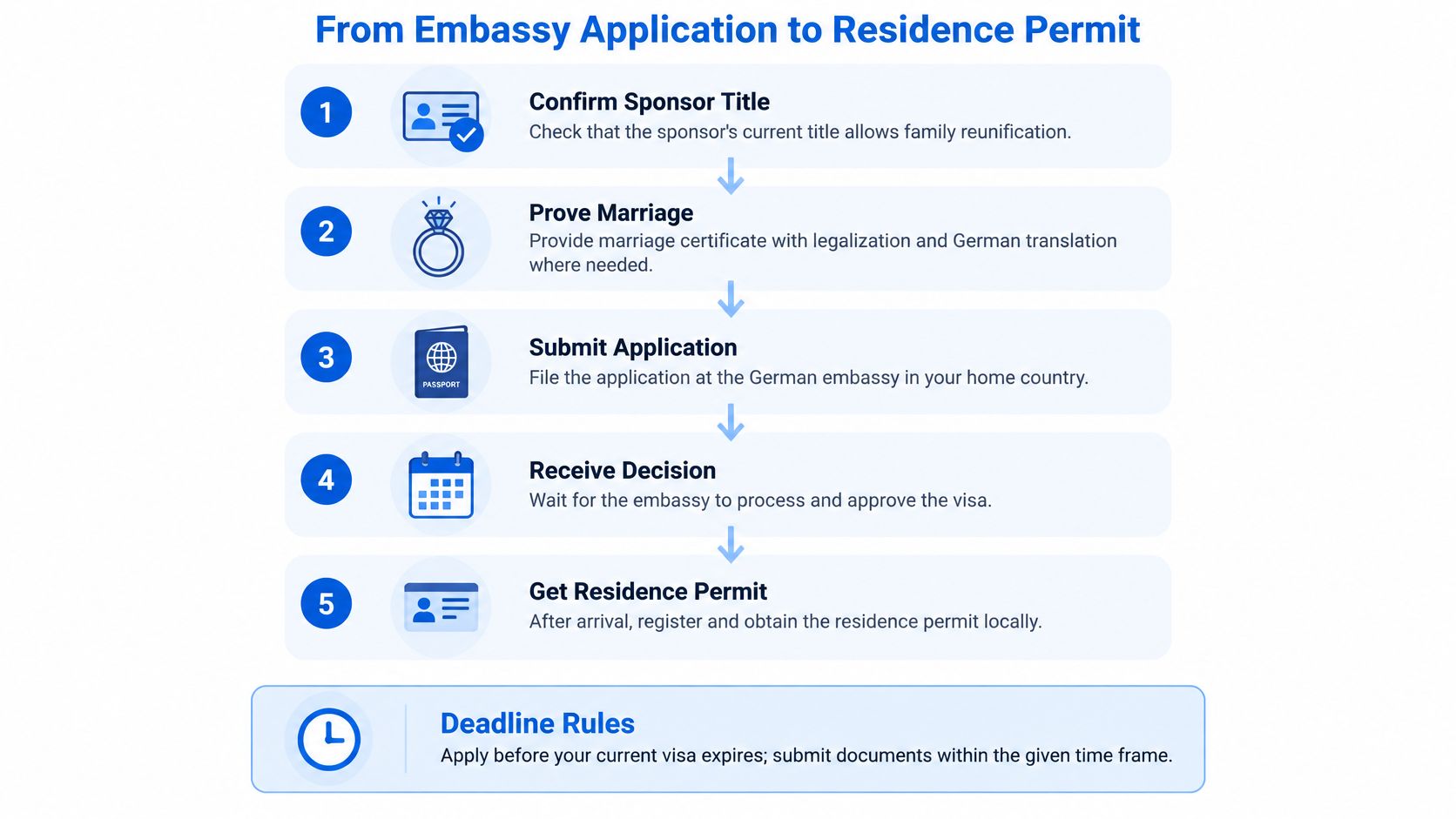
The Path in Order
- Confirm the title: Check that the sponsor’s current title allows family reunification.
- Prove the marriage: Add legalization and a German translation where needed.
- Attend the mission: Bring fingerprints, originals, copies, and the visa fee.
- Wait for consent: The foreigners authority for the future address must approve.
- Collect the visa: Enter Germany during its validity.
- Register the address: Complete local registration after arrival.
- Apply locally: Request the residence permit from the foreigners authority.
The timing trap sits at step four. A complete embassy file can still wait on the German authority.
The German missions visa navigator for spouses reflects the same division: the applicant applies at the German mission abroad while the mission seeks approval from the foreigners authority in Germany before issuing the visa. Plan document readiness and consent as two separate timelines, because they move at different speeds.
The sponsor’s title also shapes what the consent stage examines. A Blue Card file under Section 29 leaves the authority fewer tests to run than an ordinary work-permit file.
Don’t promise an employer a start date from the embassy appointment alone. Consent is a separate decision point.
Deadlines and Channels
Treat every deadline in an authority letter as binding. Visa departments can disregard evidence that arrives late, and an applicant who stays silent leaves the office free to decide on the file as it stands.
Ask before the deadline expires if a document will be late. Contact the named caseworker and propose a concrete new date.
Only the caseworker decides on that extension. In one anonymized Berlin case file, a written request produced an extension of about three months.
Ask for more time before silence becomes a refusal risk.
Confirm the accepted channel before anything goes out. The appointment letter or the office’s website states it, and some visa departments route submissions through an online contact form instead of email.
After entry, move quickly to local steps. The guide on how to get a residence permit in Germany covers the post-arrival direction.
Keep the future address consistent across the file. That address identifies the foreigners authority that must consent.
Don’t change the intended city casually mid-process. A new address can mean a different authority and a new consent decision.
Two Cases That Changed the File
Two anonymized files show the practical difference. One turned on an exemption letter. The other turned on what happens after the German authority finishes its part.

The Blue Card Certificate That Wasn’t Needed
A spouse and child applied from abroad. The sponsor in Germany held an EU Blue Card.
The Munich visa department checklist asked whether the spouse had a recognised German language certificate. A checklist item like that reads as a requirement. For this route, it wasn’t.
Counsel wrote to the authority and asked it to confirm the position in writing. The authority replied: no language certificate was required because of the Blue Card. The same reply confirmed it had already consented to visas for the spouse and the child.
The consulate issued the visas about two weeks after that consent. That figure describes this one file, and individual cases run differently.
The written confirmation did the important work. It stopped the family from paying for a language course the route never required, and it put the exemption on record. If a caseworker later applied the checklist strictly, the answer was already in the file.
Ask for that confirmation whenever a checklist item and an exemption collide. A verbal answer at a counter disappears. A letter stays.
Get support on your visa or citizenship application
Filing a visa or citizenship application alone can get overwhelming fast. You don’t have to go through it by yourself.
Get full support from an immigration lawyer, from finding the right forms to getting a final decision.
The Consent That Wasn’t the Finish Line
The second sponsor held a work-based residence permit. The livelihood test applied to that route, and the file passed it once the evidence matched what the authority would count.
The authority then completed its review and passed the file to the consulate. The consulate approved about three weeks later. The client held the visa about five to six weeks after the authority’s step.
Both timings come from this single anonymized case. They illustrate a structure, not a standard: the finished review in Germany and the issued visa sit on different sides of a handoff the applicant doesn’t control. The consulate makes its own issuance decision on the transferred file, and that stage takes its own time.
Plan in stages. The consent date tells you the German side is done. It says nothing about when the visa is printed and in the passport.
Treat consent as one milestone. The consulate still needs its own window before the visa exists.
Different refugee family routes raise different exemption questions. The page on family reunification for refugees in Germany covers that separate route.
Check Your Route Before You Apply
Decide the route before booking the embassy appointment. The sponsor’s residence title sets which checks apply, so match that title to the correct sponsor row and ask one question of it: does the file pass every requirement the title triggers, and only those?
Wait and reassess if a title change is close. A listed skilled-worker permit can change which checks apply. A settlement permit can do the same. Filing under the wrong route costs months, so don’t file on hoped-for income where livelihood is tested and don’t file on an unbooked A1 test where A1 is required.
A stalled consent needs a different response. In most family reunion files, the embassy waits for the local foreigners authority’s consent before it can issue the visa. If that authority stays silent for an unreasonable time after a complete application, an Untätigkeitsklage under Section 75 of the Administrative Court Code asks a court to order the authority to decide on the pending consent.
For a borderline income figure, an unclear A1 exemption, or a silent consent, LegalWeg offers a free case assessment through a form on the contact page. Its legal team supports clients all over Germany, advises in English, German, and Russian, and can check the sponsor’s title against Section 29 and Section 30 to set the next filing step.
Write down three facts before requesting that assessment: the sponsor’s exact title, its expiry date, and the future German address. Test the file against that one route first. That order prevents wasted language courses, the wrong insurance, and income evidence that doesn’t count.