
Applicants must assemble proof of the knowledge requirement before submitting a naturalisation application. The exam is one way to meet it: the Citizenship Test Regulation of 5 August 2008 established the test to assess knowledge of Germany’s legal and social order and living conditions. A preparatory course is available but not mandatory.
Keep the certificate or written exemption with the rest of your application documents. German language ability is assessed separately, generally at B1. Passing the German citizenship test does not prove German proficiency, clear a criminal-record check, or guarantee citizenship.
Table of Contents
- Test Format and Pass Mark at a Glance
- What the Test Covers and How Questions Are Drawn
- What Sample Questions Look Like
- How to Prepare With the Official Question Catalogue
- Leben in Deutschland Versus the Citizenship Test
- Exemptions and Alternative Proof When You Cannot Sit the Test
- How to Book and Take the Test
- Common Mistakes and What Happens After the Result
Test Format and Pass Mark at a Glance
The pass rule is fixed. You need at least 17 correct answers out of 33 within 60 minutes.
Every item is multiple choice. Each question has four answer options. The Federal Office for Migration and Refugees treats 17 correct answers as about 51.5 percent of the paper.
Pace matters more than people expect. Thirty-three questions in 60 minutes leaves about 109 seconds per question. A slow start on the first ten items eats the time you need for the last page.
Thirty questions cover three national areas.
- Life in a Democracy
- History and Responsibility
- People and Society
The other three questions follow the federal state of your registered primary residence. A move before the exam date can change that set. Check the registration address before you revise.
| Element | Detail | What It Means for You |
|---|---|---|
| Questions | 33 multiple-choice | About 109 seconds per question |
| Answer options | 4 per question | Choose one answer only |
| Time limit | 60 minutes | Pace yourself across all 33 questions |
| Pass mark | 17 correct answers | About 51.5 percent of the test |
| National questions | 30 across three subject areas | Life in a Democracy, History and Responsibility, People and Society |
| State questions | 3 for your federal state | Based on your registered primary residence |
| Retake | Allowed after a failed attempt | Book a new attempt |
| Certificate | Issued by BAMF after a pass | Submit it to the naturalisation authority |
A failed attempt can be repeated. The certificate that proves civic knowledge is issued only after the citizenship threshold is met. A near miss does not count as partial proof.
Practical rule: Note the rules in the table, then confirm which federal state applies to your registered address.
What the Test Covers and How Questions Are Drawn
The test focuses on Germany’s legal and social order and everyday life. Its questions cover institutions, rights protected by the Basic Law, elections, and the federal system.

The three national blocks
The nationwide questions are grouped under Life in a Democracy, History and Responsibility, and People and Society. They test specific civic knowledge, such as which institution exercises a particular power or how Germany’s federal structure works.
The state questions apply that knowledge to your federal state. For example, a nationwide question may concern the Basic Law, while a state question may ask about an institution or political leader in your Land. Your registered primary residence determines which state questions apply.
The official BAMF citizenship test catalogue lists 300 nationwide questions and 160 state-specific questions across all states. Review the nationwide material alongside the questions for your own state. For families comparing language requirements, the A1 German test guide for a family reunion visa covers a different kind of proof that may be relevant to a spouse’s application.
What Sample Questions Look Like
A real item is short. You see one question, four options, and one correct answer. There is no written explanation on the paper.
Do not rebuild questions from memory or from a blog summary. The catalogue wording is what the exam uses. Copy practice items from the current official list, including one state question labelled for your Land.
How to work one item
Use the same four moves on every question.
- Read the full question before you look at the options.
- Cross out any option that contradicts a right, an institution, or a date you know.
- Pick the best remaining answer. Do not leave the line blank.
- Note, in your own words, why that answer fits the legal or civic fact.
A hard item should not take more than its share of about 109 seconds. Mark it and move. You can return if time remains.
Reading an answer key alone does not show why the answer is right. If you cannot explain the choice, the next unfamiliar wording will fail you.
Before a full timed set, test yourself on five more catalogue questions. Score them only after you have written the reason for each choice.
How to Prepare With the Official Question Catalogue
A passing practice score is useful only if it reveals what you still need to learn. The test is one part of the naturalisation file, so prepare for the questions while checking separately which proof your application requires. Under Section 10(1)(7) of the Nationality Act, a passed citizenship test is normally evidence of civic knowledge. A preparatory naturalisation course is optional.
Before booking, check whether an exemption or a German school or vocational qualification can provide accepted proof instead. This can save the cost and time of sitting a test you do not need.

A weekly routine
Use the current official catalogue referenced in the sample-question guidance, then build a routine around the material you need to cover:
- Identify your federal state and focus on its state-specific questions. Questions for other Länder do not help you prepare for your own test.
- Divide the nationwide questions by subject. A mixed set can make gaps in one topic harder to spot.
- Study one subject block each week. Say the answers aloud to practise recalling them, not just recognising them.
- Review each wrong answer. Write down why the correct option fits, rather than memorising its letter.
- Repeat practice sets until you consistently score above the pass mark. A personal target of 20 correct answers out of 33 gives you a seven-answer margin; it is a study buffer, not an official requirement.
Memorising answer letters alone leaves you exposed when options are shuffled or wording changes. Focus on understanding the civic fact behind each answer.
Leben in Deutschland Versus the Citizenship Test
The citizenship test and the Leben in Deutschland test draw on the same official question catalogue, but their certificates are not automatically interchangeable. The naturalisation authority must accept the document as proof of civic knowledge. Check the certificate and its date before booking another exam.
The BAMF question catalogue covers both tests. The test format and catalogue figures are explained in the earlier section on how questions are drawn.

A decision path
- Check which certificate you hold and the date on it.
- Ask the naturalisation authority in writing whether it accepts that document.
- If the authority accepts it, you do not need to book another exam.
- If it does not accept it, or you have no certificate, book the citizenship test.
- Check that you are preparing for the questions for your federal state.
Older integration-course documents can require closer review. The file’s legal acceptance is a major bottleneck. Spouses considering a marriage-based route can read about German citizenship after marriage before relying on a course certificate as proof.
Need Help With Your German Citizenship Application?
We guide you from the first eligibility check to the final decision, and step in if the authority delays or refuses.
Tell us about your situation, and we can assess your case for free.
Exemptions and Alternative Proof When You Cannot Sit the Test
The statute waives the knowledge requirement in defined cases. It is not a general hardship discretion you invent in a cover letter.
The Nationality Act allows the language requirement and the civic-knowledge requirement to be waived when illness, disability, or age prevents the applicant from meeting them. Further civic-knowledge waivers exist for certain integration and schooling rules. An exemption can cover language as well as the test, so check which conditions the waiver names.
| Your Situation | Proof to Gather | Who Decides |
|---|---|---|
| Physical, mental or psychological illness | Medical certificate | Naturalisation authority |
| Disability | Medical or official disability record | Naturalisation authority |
| Age | Official proof of age | Naturalisation authority |
| Special integration or schooling rules | School or qualification records | Naturalisation authority |
What to send
The authority decides. You document.
- A doctor’s letter or official disability record for health grounds
- Official proof of age where age is the ground
- School or qualification records where a schooling rule is the ground
Say an applicant has a long-term condition that blocks a timed exam. They attach the medical certificate to the naturalisation file and ask for the waiver in writing. They do not book a seat and hope the centre will excuse the result later.
Raise the exemption before you book. A sitting you cannot fairly take still consumes time in the file. Other routes that avoid a standard sitting are outlined in alternative German citizenship routes.
How to Book and Take the Test
The exam is a logistics problem as much as a knowledge problem. A strong score does not fix the wrong state, a missing ID, or a certificate that never reaches the file.
The Federal Ministry of the Interior states the same 60 minutes, 33 questions, and 17 correct answers, and reports that more than 90 percent of applicants have passed in recent years. Because passing is the norm, the failures that stall files are operational. Booking slots, the correct Land, identity papers, result delivery, and keeping the original certificate matter more than another study app.
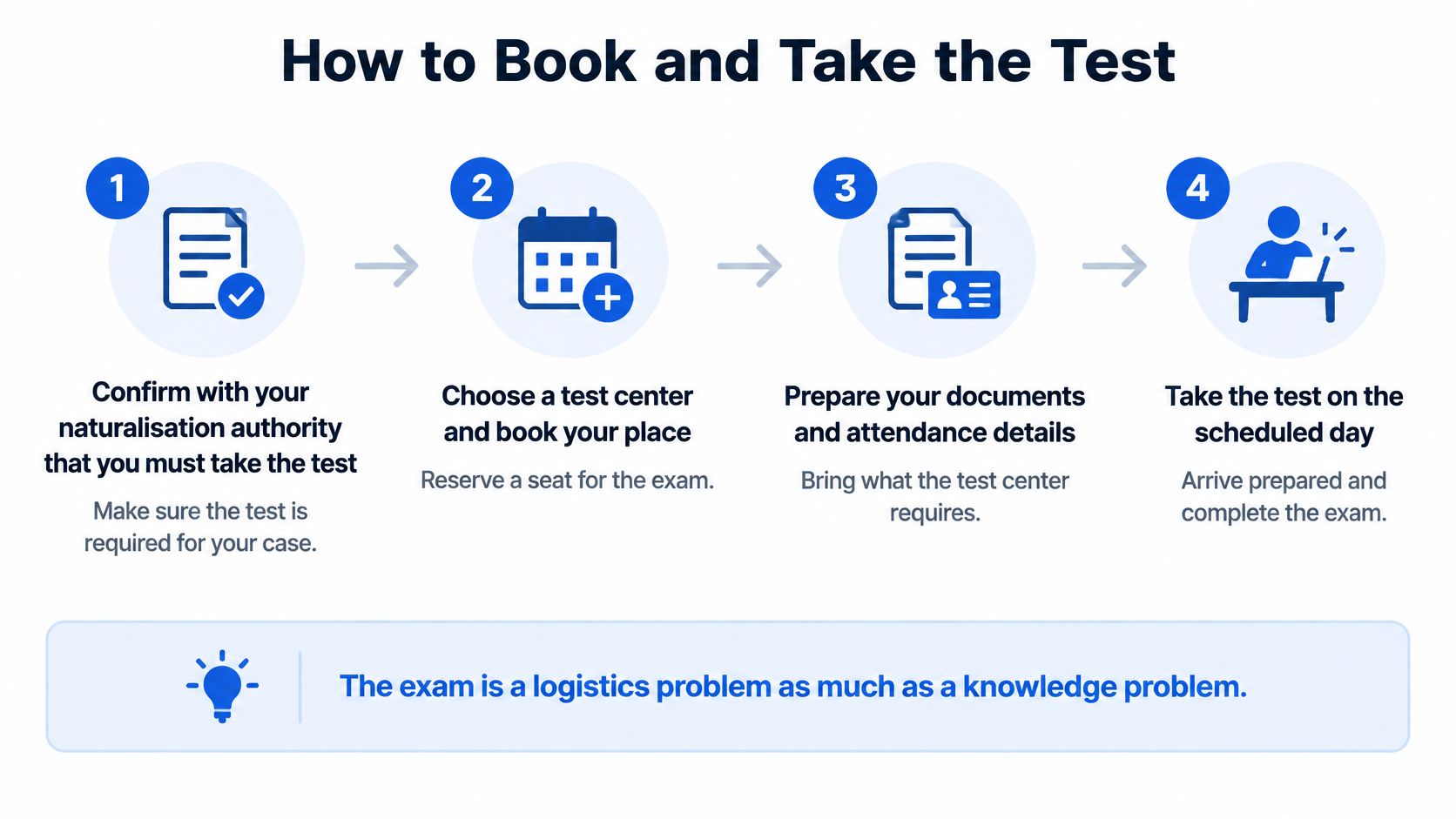
Booking sequence
- Confirm with the naturalisation authority that you must sit the test. An accepted certificate makes the booking pointless.
- Fix the federal state from your registered primary residence. That choice sets the three local questions.
- Request a date at an approved centre. Popular slots fill before a residence card expires.
- Ask for accommodation in advance if illness, disability, literacy, or anxiety may affect the sitting.
- Bring valid identity documents on the day. A centre can refuse entry without them.
- Arrive early and plan for the full hour. Leaving early does not speed the certificate.
- After a pass, keep the original and send a copy to the authority.
Fit the exam to the rest of the file
Passing does not itself create a right to citizenship. Coordinate the date with expiring residence documents, a job change, or a family move. If you already meet the knowledge rule and you are only waiting for the certificate, tell the authority the application is otherwise ready.
If processing delays change the sequence, ask for written confirmation of what still blocks the file. LegalWeg files an Untätigkeitsklage when an authority does not answer, and it handles that work across Germany in English, German, and Russian.
Common Mistakes and What Happens After the Result
The certificate and application timeline need attention after the test. Avoid three common errors: relying on a practice score instead of an official certificate, letting a certificate or residence document expire while the file is pending, or assuming a delayed result leaves the rest of the application unchanged.
After the result
After a pass, send the BAMF certificate to the naturalisation authority and keep the original. If you fail, review the subject areas that caused difficulty and book another test when you are ready. A failed attempt can delay the citizenship process, so check whether any other documents or conditions may change while you wait.
If the result is delayed, ask the authority in writing how this affects your application. Set reminders to follow up on the certificate and, if needed, the retake date. For the wider application process, see this guide to applying for German citizenship.
LegalWeg prepares German citizenship and naturalisation applications, including guidance on civic-knowledge proof and exemptions. A free case assessment is available, with advice in English, German, and Russian. Visit LegalWeg to have the test, certificate, and rest of your application reviewed before you book.