
A trip is approaching, an old passport has expired, and a folder of family records is waiting on the desk. The applicant may be ready to book an appointment but still unsure whether those records prove German citizenship.
An application for German passport starts with that legal question, not the form. Once citizenship is clear, the practical work is choosing the correct authority, assembling documents, and leaving enough time for production and delivery.
Table of Contents
- Confirm German Citizenship Before You Apply
- Documents to Bring for Each Application Type
- How to Apply for a German Passport Step by Step
- Passport Fees and What Adds to the Cost
- Processing Times and How to Plan Your Travel
- Special Cases for Spouses and Naturalized Citizens
Confirm German Citizenship Before You Apply
German ancestry isn’t the same as German citizenship. A German grandparent, or a parent born in Germany, doesn’t automatically establish eligibility for a passport.
For a claim through descent, the decisive starting question is whether a parent held German citizenship when the applicant was born. The authority must then consider the nationality rules that applied to that birth.
Why birth dates and marriage dates matter
The Federal Foreign Office citizenship guidance explains that children born before 1 January 1975 to married parents generally acquired citizenship through the German father, with a declaration route available until 31 December 1977 for choosing German citizenship through the mother. Since August 2021, many descendants excluded by those older rules can acquire citizenship by declaration under section 5 of the Nationality Act, with a deadline of 19 August 2031.
Consider siblings with the same German father but different birth years. Their shared parentage doesn’t remove the need to check the law applicable to each birth, including their parents’ marital status.
The authority may request:
- Parents’ nationality evidence, such as German passports or nationality certificates.
- German records, including birth or citizenship documents.
- Civil-status certificates, establishing parentage and marriages.
- Connecting documents, linking the applicant to the German parent.
A birth certificate establishes family relationships. It doesn’t necessarily establish the parent’s citizenship on the relevant date.
Start with status: A passport documents citizenship that already exists. Submitting a passport form doesn’t create nationality.
When the citizenship position is unclear
An applicant who can’t establish citizenship must resolve the underlying issue with the competent German authority. That may involve confirming existing citizenship, investigating its retention, or pursuing an acquisition route.
Families considering other possibilities can consult the explanation of alternative German citizenship routes for Israelis. Marriage-based and standard naturalization routes also require a separate citizenship process before passport issuance.
A useful first action is preparing a family timeline. It should record parents’ and grandparents’ births, marriages, and citizenship status at each relevant event, with supporting documents beside each entry.
Need Help With Your German Citizenship Application?
We guide you from the first eligibility check to the final decision, and step in if the authority delays or refuses.
Tell us about your situation, and we can assess your case for free.
Documents to Bring for Each Application Type
A German passport application must establish two separate facts: the identity of the person applying and the citizenship behind the claim. A file that proves one without the other stalls at the counter, so the records are best sorted by the application type they serve.
Core documents by application type
| Application type | Core documents | Often also needed |
|---|---|---|
| Adult first application based on citizenship | Valid ID or existing passport, biometric photo, completed application form, proof of citizenship | Birth certificate, proof of current address |
| Renewal of an expired passport | Expired passport, biometric photo, completed application form, fee | Proof of name change if details have changed |
| Child under 18 | Child’s birth certificate, ID of both parents or guardians, biometric photo, completed application form | Written consent from parents or guardians if the authority requires it; children now receive a regular passport, because the children’s passport was abolished on 1 January 2024 |
| Passport based on a German parent | Parent’s German passport or nationality certificate, applicant’s birth certificate linking the applicant to the parent | Civil-status documents supporting the parent’s citizenship at the applicant’s birth |
| Replacement after loss or theft | Photo, completed application form, proof of identity, fee | Police report or declaration of loss |
Adult first applications need a clear connection between the person attending and the citizenship evidence. An existing identity document is usually the starting point, while a birth certificate explains parentage and personal details.
Renewals generally begin with the expired passport. A changed surname needs its own documentary explanation, such as a marriage or name-change certificate.
Applications through a German parent succeed on a documentary chain linking the applicant, the parent, and the parent’s citizenship on the relevant date. A guide to obtaining a German birth certificate helps identify which civil record can carry that connection.
Lost or stolen passports create an additional identification problem. The applicant should ask which alternative identity evidence and loss documentation the office accepts before attending.
A worked example: a child’s application with one parent abroad
Take a mother applying for her seven-year-old at a German mission while the father lives overseas. The file needs the child’s birth certificate, both parents’ identity documents, the biometric photo, and the completed form. Because the parents share custody, the office will also want the father’s consent. Some authorities accept a signed declaration together with a copy of his passport; others expect the signature to be formally certified. Before booking, the family confirms which version the office requires, whether the child must appear in person, and whether the mother can attend alone. One call ahead prevents a wasted appointment.
Reconcile names and prepare the originals
Names should match across the file or carry a documented explanation. Say the child’s birth certificate shows the mother’s married name while her own birth certificate shows her maiden name. The marriage certificate bridges the two records; without it, the official sees two people who cannot be connected on paper. Bring the original certificates along with copies, because photocopies alone will not stand in for records the official needs to inspect.
The biometric photo must meet the receiving authority’s current submission standard. Since 1 May 2025, passport authorities in Germany accept only digital photos, taken at the office (€6) or sent electronically by a certified photographer, while German missions abroad generally still work with printed photographs. Check which process the office uses before paying for new ones.
How to Apply for a German Passport Step by Step
Each stage of the application has a clear outcome: the right office, an accepted form, a compliant photo, a booked slot, a complete submission, and a confirmed way to receive the passport. A filled-in form alone does not secure any of these.
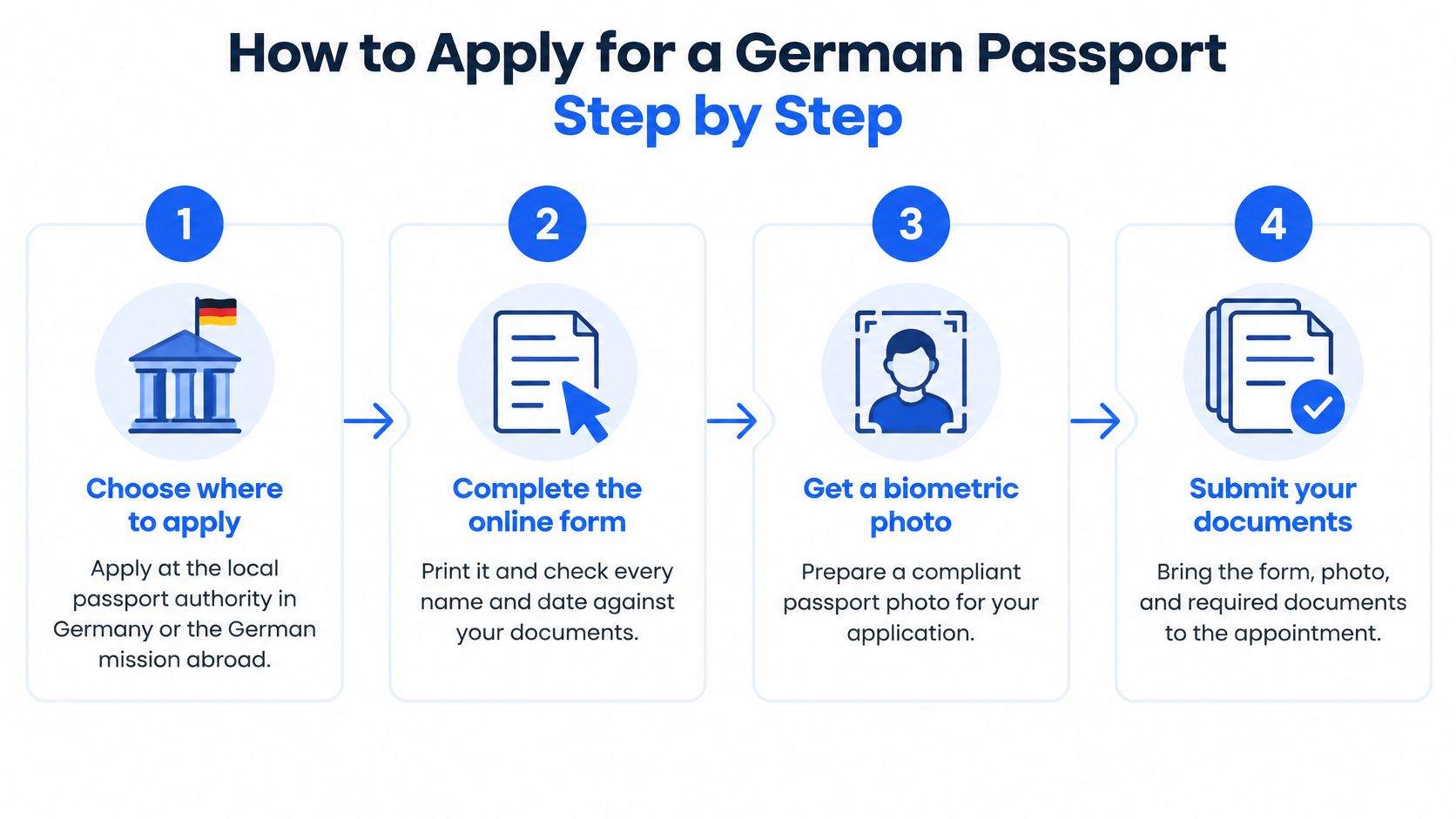
Prepare the application and appointment
Choose the responsible authority. If you live in Germany, contact your local passport authority. If you live abroad, identify the German mission responsible for your place of residence. The nearest office is not automatically the responsible one. Confirm jurisdiction first so you avoid a wasted appointment or an extra charge for applying outside your area.
Complete the authority’s application form. Fill in the online form where the authority provides one, then print it exactly as instructed. Check every name and date against the supporting records. Place the birth certificate, your current identity document, and the form side by side. Resolve any mismatch before submission instead of explaining it at the counter. Follow the authority’s instructions on when to sign. Some offices require the signature in front of the official, so do not sign in advance unless the instructions say so.
Arrange a compliant biometric photograph. Check the receiving office’s current photo procedure before visiting a photographer. A photo that passed elsewhere can still be rejected, for example if the background or head size does not match the German office’s specification. In Germany, printed photographs are no longer accepted, so use the office’s photo terminal or a certified photographer’s digital transfer. Abroad, ask the mission which format it accepts. Bringing the wrong format can stall an otherwise complete file.
Book an available appointment early. Check the mission’s or authority’s booking rules and choose the correct appointment category. A citizenship consultation and a passport submission often require different bookings, so pick the passport category only if your citizenship is already confirmed. Keep travel plans flexible until you know the appointment and collection windows. Save the booking confirmation together with your document checklist.
Submit the application and confirm the handover
Attend personally with the complete file. The official checks the original documents and collects the required biometric information. Fingerprints are taken where required, and the photograph goes through the office’s accepted process. Bring the originals plus the copies the office requests. Confirm the payment method and the full amount beforehand, including the foreign-service surcharge when applying abroad. Before leaving, ask whether anything remains outstanding. If a certificate is missing, agree on how and when you will submit it rather than assuming the office will obtain it.
Confirm tracking, collection, or delivery. Keep the receipt or reference number in a safe place. Ask how the office notifies you when the passport is ready and whether collection needs a second appointment. Where delivery is offered, check the address and dispatch method carefully. At collection, inspect the passport’s personal details before you travel with it.
If citizenship remains uncertain, the explanation of how to apply for German citizenship helps distinguish the underlying legal process from passport issuance. LegalWeg offers a free case assessment through its contact-page form, where applicants can also raise legal-support questions. Artjom Spirin, a licensed lawyer specializing in German immigration law, handles questions of legal status that need resolving before passport forms are submitted.
Get support on your visa or citizenship application
Filing a visa or citizenship application alone can get overwhelming fast. You don’t have to go through it by yourself.
Get full support from an immigration lawyer, from finding the right forms to getting a final decision.
Passport Fees and What Adds to the Cost
The fee follows the applicant’s age, not whether the application is a first issue or a renewal. The Federal Ministry of the Interior passport fee overview sets the basic fee at €70 for applicants aged 24 or older with 10 years of validity and €37.50 for applicants under 24 with 6 years of validity. Since 1 May 2025, the Passport Ordinance adds a €36 foreign-service surcharge when the application goes through a German mission abroad.
German passport fees and common add-ons
| Item | Amount | Notes |
|---|---|---|
| Adult passport, age 24 or older | €70 | Valid for 10 years |
| Passport, under age 24 | €37.50 | Valid for 6 years |
| Foreign-service surcharge at a German mission | €36 | Normally added to applications submitted abroad |
| 48-page passport instead of 32-page | €22 on top of the basic fee | Useful for frequent travellers who need visa pages |
| Express processing | €32 on top of the basic fee | Charged only when requested; in Germany the passport is usually ready within three working days, while abroad courier time is added |
| Applying at a non-local authority | Basic fee doubled | Ask the office for the exact figure |
| Issuance outside normal service hours | Fee doubled for temporary passports and passport changes | Confirm before booking |
| Home delivery in Germany | €15 | Available since May 2025 where the authority offers it |
A family budget example
Two adults and one child applying at a German mission abroad make the arithmetic concrete: each adult pays €106 (the €70 basic fee plus the €36 surcharge), and the child pays €73.50 (€37.50 plus €36). The family total comes to €285.50 before any extras.
Document retrieval, photographs, and any optional service still need their own allowance on top of that figure. The safest move is to ask the office for a written total that lists every add-on before paying.
An expired passport can’t be extended. What applicants commonly call renewal is a fresh application with a new fee.
Some missions require payment in the local-currency equivalent rather than euros, as the Federal Foreign Office information on consular fees notes. Confirm the accepted payment method and payable total shortly before the appointment.
Budgeting rule: Add the overseas surcharge and an allowance for applicable extras before committing money to travel.
Processing Times and How to Plan Your Travel
Appointment availability is the first potential bottleneck. Production starts only after submission, so an available appointment matters as much as a completed form. An applicant who finishes gathering documents but cannot find a slot has gained nothing.
The Federal Foreign Office passport information notes that several weeks pass between application and handover abroad, and many missions quote around six to eight weeks. Passports are centrally produced by the Bundesdruckerei in Berlin and shipped to overseas missions, so the waiting period begins at submission rather than at booking.

Passport stages and typical timing
| Stage | Typical time | What the applicant controls |
|---|---|---|
| Booking the appointment | Depends on office and mission availability | Checking slots early and having documents ready before looking |
| Biometric visit | The appointment day itself, once a slot is secured | Bringing originals, an accepted photograph, and the correct payment |
| Central production and dispatch | Several weeks; many missions quote six to eight | Asking the office how delivery and collection notification work |
The third row is where applicants lose track of time. Printing happens centrally, and dispatch adds transit before the passport reaches the mission or local office. Asking whether the office’s current estimate already includes delivery prevents an unpleasant surprise at the end.
Plan backwards from the travel date
A practical planning target is to begin at least ten weeks before travel. This is an editorial buffer rather than an official service guarantee, and scarce appointments or unresolved citizenship questions can require a much earlier start. Booking the appointment first, even before every supporting record is in hand, is often the safer sequence.
Prepare a contingency for urgent travel
For imminent travel, the office should be asked about express production (€32 extra) or a temporary passport, which has no chip and is valid for up to one year. Availability, fees, documentary requirements, and destination acceptance all need confirmation before relying on an alternative.
A German identity card (Personalausweis) is usually enough for travel within the EU, but generally not for entry to countries outside it.
Dual nationals face a further question about which valid document each country expects; the final section covers that case, and the guide to dual citizenship in Germany explains the underlying nationality rules.
An application receipt is not a travel document. An expiring passport can still block a trip while its replacement is being processed.
Special Cases for Spouses and Naturalized Citizens
Marriage-based naturalization and standard naturalization both end at the same place: citizenship first, passport second. A pending citizenship application gives no right to immediate passport issuance.
Marriage starts the process; the authority still has to assess eligibility and complete the naturalization procedure. According to the Federal Foreign Office guidance for spouses, the spouse route shortens the standard residence period and adds a minimum duration of marriage, subject to the other legal conditions.
The Federal Foreign Office naturalization guidance explains that the standard residence requirement fell from eight years to five years on 27 June 2024. The conditions below complete the eligibility test for both routes.
Compare the routes before preparing a citizenship file
| Route | Residence requirement | Marriage requirement | Important qualification |
|---|---|---|---|
| Spouse of a German citizen | Normally three years of lawful residence in Germany | At least two years of marriage | Other legal conditions must also be met |
| Standard naturalization | Five years of lawful residence | No marriage requirement for this route | The same further conditions apply in full |
The further conditions include:
- German-language knowledge sufficient for the applicable requirement.
- A naturalization test demonstrating the required knowledge.
- Financial self-support under the applicable rules.
- A clean criminal record meeting the legal standard.
- Commitment to Germany’s constitutional order.
Applicants considering the spouse route can review the practical explanation of German citizenship after marriage. A marriage certificate proves the relationship; the remaining conditions each need their own evidence.
Multiple citizenship and travel documents
The Federal Foreign Office naturalization guidance confirms that German law now generally permits multiple citizenships, so naturalizing applicants usually keep their existing nationality. The other country’s nationality law still needs separate attention.
Permission to hold multiple citizenships doesn’t settle which passport should be presented at a border. Each country sets its own entry and exit rules for its citizens, so a dual national should check both sides’ requirements before departure and match the booking name to the passport used for that journey.
For a newly naturalized citizen, the naturalization certificate is an important addition to the identity file. The passport authority can confirm which further documents the separate passport application requires.
Children’s citizenship is assessed separately from a parent’s outcome. Families should confirm each child’s position before assuming the household can apply for passports together.
LegalWeg offers citizenship eligibility assessment and support with naturalization applications, including document and form guidance before a separate passport application. Applicants with an unclear citizenship history can visit LegalWeg and request a free case assessment through the contact-page form before booking a passport appointment.