
A long-term resident has the passport scans ready, an employment contract saved, and a folder of residence permits. The application still stalls at the same questions: which residence periods count, which documents need certification, and what happens after submission?
Learning how to apply for German citizenship means managing more than a form. A workable application also needs a nationality-risk check and a plan for keeping the file moving.
Table of contents
Check Your Eligibility and Pick the Right Route
The Act on the Modernisation of Citizenship Law entered into force on 27 June 2024, changing the naturalisation framework described in the Destatis citizenship framework notes. It shortened the ordinary residence requirement and generally removed Germany’s previous expectation that applicants give up another nationality.
The reform also introduced a three-year route for exceptional integration under former § 10(3) StAG, but that route was abolished with effect from 30 October 2025. There is no transitional rule: applications already filed under the three-year route are decided under the five-year standard. The federal government’s residence-period guidance confirms five years as the general minimum going forward.
One three-year route remains, but it rests on a different provision. Under § 9 StAG, spouses and registered partners of German citizens should (soll) be naturalised after three years of lawful habitual residence in Germany if the marriage or registered partnership has existed for at least two years. The requirements of § 10(1) StAG, including B1 German, civic knowledge, and self-sufficiency, still apply, and the abolition of the exceptional-integration route didn’t change this spouse rule.
Applications filed before 27 June 2024 don’t keep the old eight-year standard either. The authority applies the law in force when it decides, so the five-year rule governs these files too; only applications lodged by 23 August 2023 may still rely on the former livelihood rules where those are more favourable.
Contact us for immigration support
Have a question about your visa, citizenship, or immigration case?
Contact our team, and we’ll get back to you directly.
Naturalisation routes and their residence requirements
| Route | Residence needed | Key condition | Notes |
|---|---|---|---|
| Standard route | Five years of lawful habitual residence | B1 German, civic knowledge, financial self-sufficiency | Applies to most applicants |
| Exceptional integration | No longer available (abolished from 30 October 2025) | Not applicable | Pending three-year applications are decided under the five-year rule |
| Spouse or registered partner of a German citizen (§ 9 StAG) | Three years of lawful habitual residence | Marriage or registered partnership existing for at least two years; § 10(1) requirements still apply | A “should” (soll) rule; separate from the abolished exceptional-integration route |
| Former guest workers | Ordinary residence requirement unless another provision applies | Oral German skills can be sufficient | Naturalisation test not required in qualifying cases |
| Study-only permit | Doesn’t count as a qualifying title for this route | An eligible residence position is needed | Check the current title before calculating eligibility |
The residence periods in the table reflect the federal guidance linked above. Language evidence and the special treatment of former guest workers require a separate assessment.
A study-only permit isn’t sufficient as the current qualifying residence title. That doesn’t mean every earlier period spent studying must automatically be discarded from the residence calculation.
The reason is the residence title itself. Under the Make it in Germany guide to naturalisation, applicants must hold a permanent right of residence, such as EU free-movement status, a settlement permit, or a residence permit that can lead to permanent residence. A graduate who moves into skilled employment should confirm that the new permit meets that test before counting down to an application date.
A practical eligibility check
- Establish the lawful starting point. Use residence records, not a flight booking or the date of arrival.
- Check the current residence title. Confirm that it qualifies for naturalisation rather than assuming that any valid permit is enough.
- Resolve identity questions. The authority needs a clear account of identity and nationality.
- Review financial support. Identify any reliance on benefits under Social Code Books II or XII and obtain advice about applicable exceptions.
A researcher may discover a gap between permits while preparing the residence chronology. That gap can push the qualifying starting point later than expected, although its legal effect needs assessment rather than an automatic assumption that every calculation restarts.
Applicants changing residence categories can use this guide to permanent residency in Germany to distinguish settlement status from citizenship eligibility.
The authority decides on the file as it stands on the day of decision, not on the file the applicant planned to have. Mixed residence histories therefore need a scenario check rather than a simple calculator:
- Blue Card holder changing employers: Old and new permits, and any gap between jobs, need to show continuous lawful residence.
- Parent who joined a child through family reunification: The permit type held in each period decides how the authority treats those years.
- Applicant approaching a settlement permit: Filing too early can leave the application resting on a permit that doesn’t yet support naturalisation.
- Spouse or registered partner of a German citizen: Marriage duration and residence duration are checked separately; see our guide to German citizenship after marriage.
Eligibility checkpoint: Strong integration evidence can support an application, but it can’t revive a residence route that current law no longer provides.
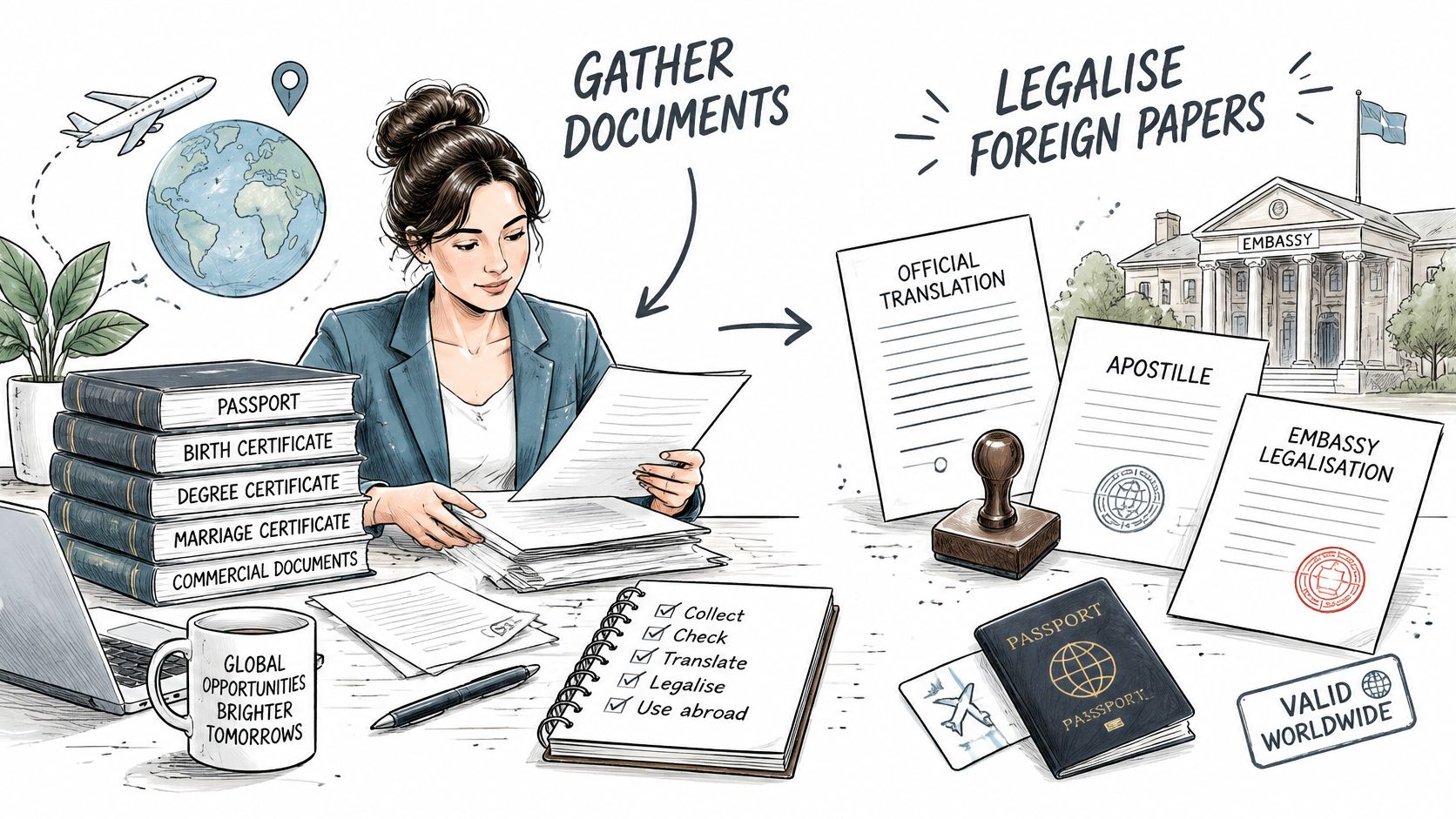
Gather Documents and Legalise Foreign Papers
Request the local naturalisation office’s checklist before ordering translations. Otherwise, applicants can spend money on the wrong document version or omit a country-specific certification.
The checklist should become a working index. Each item needs a status such as available, requested, awaiting translation, or requiring clarification.
Build the core document file
- Identity documents: Valid passport and identity card, where applicable.
- Birth record: Birth certificate showing the relevant personal and parental details.
- Family status: Marriage certificates, divorce decisions, and other relevant civil-status records.
- Address history: Registration certificates covering previous addresses requested by the authority.
- Residence history: Current permit and evidence of earlier residence permissions.
- Employment and income: Employment contract, employer confirmation, and current income evidence.
- Financial records: Relevant tax records or pension statements.
- Housing: Tenancy agreement or evidence of ownership and housing costs.
- Health insurance: Current confirmation of coverage.
- Criminal matters: Accurate disclosure of convictions and ongoing proceedings.
- Language and civic knowledge: Accepted certificates once available.
The documents need to tell a consistent story. A marriage certificate that changes a surname should connect clearly to the name on the current passport.
Three gaps appear again and again in delayed files:
- Unexplained residence gaps: A missing registration period invites questions about where the applicant lived.
- Incomplete tax records: Payslips without tax records leave income harder to verify.
- Unrecognised certificates: A language certificate from a provider the authority doesn’t recognise doesn’t prove the requirement.
Explain any inconsistency in a short written note in the file rather than leaving the authority to find it.
Check foreign papers before translating
Foreign civil-status documents often need a certified German translation. They may also require an apostille or legalisation, which confirms authenticity, unless an exemption applies.
The correct process follows the issuing country and document type. The local authority should confirm the required form before the applicant pays for certification.
Consider a surname originally written in Cyrillic. The passport uses one spelling, the birth certificate translation uses another, and the marriage record uses a third.
Those differences can trigger an identity query even when every document is genuine. A translator’s explanation or an additional civil-status record may resolve the discrepancy, but the authority should confirm what it needs.
Keep originals intact, retain complete scans, and record which document supports each application field.
A document index also makes later requests easier to answer. Instead of resending an unlabelled bundle, the applicant can identify the relevant record and explain exactly what changed.
Get support on your visa or citizenship application
Filing a visa or citizenship application alone can get overwhelming fast. You don’t have to go through it by yourself.
Get full support from an immigration lawyer, from finding the right forms to getting a final decision.
Language and Civic Knowledge Tests Explained
The ordinary language requirement is B1 under the Common European Framework of Reference. Applicants need accepted evidence, not merely confidence that everyday conversations go well.
A certificate and a school diploma aren’t automatically interchangeable. Before booking an examination, the applicant should ask whether existing German-language educational records already satisfy the requirement.
Language and civic knowledge evidence by requirement
| Requirement | Accepted evidence | Who may be exempt | Notes |
|---|---|---|---|
| German language at B1 | An accepted B1 examination certificate | Qualifying former guest workers may rely on oral German | Confirm school diploma rules with the authority |
| Civic knowledge | Naturalisation-test certificate or an accepted Life in Germany examination | Qualifying former guest workers aren’t required to sit the test | Study from the official catalogue |
| Age or health exemptions | Medical evidence where applicable | Applicants who satisfy the relevant statutory exception | The authority assesses the individual evidence |
| Language evidence timing | Evidence accepted when the application is assessed | Applicants covered by a recognised exception | Book early and confirm certificate requirements |
The federal government’s citizenship reform explanation confirms that oral German can be sufficient for qualifying former guest workers. It also states that those applicants aren’t required to take the naturalisation test.
Applicants shouldn’t assume that a family connection to a former guest worker establishes an exemption. The authority must confirm that the applicant belongs to the qualifying group.
Choose evidence before booking
The naturalisation test assesses knowledge of Germany’s legal and social system. Preparation should use the official question catalogue rather than informal summaries that may omit relevant material. Our overview of the German citizenship test explains the format.
An accepted Life in Germany examination can sometimes provide the necessary civic-knowledge evidence. The applicant should send the authority the exact certificate title and result before assuming that a previously completed course satisfies the requirement.
- Check the examination: Confirm that the specific certificate is accepted for naturalisation.
- Check existing qualifications: Submit school or educational records for assessment before purchasing another examination.
- Check booking availability: Reserve a suitable appointment early enough to leave room for results and certificate delivery.
- Check personal details: Ensure the certificate matches the passport and application.
A language course attendance record isn’t necessarily proof that the required level was achieved. Likewise, completing an integration course doesn’t remove the need to produce the accepted result documentation.
Age and health exceptions require careful evidence. They arise under legal rules, not merely from local preference, although the local authority assesses whether the submitted records establish the exception.
Special Cases That Change Your Application
“Dual citizenship is allowed” is only half an answer. Germany’s permission doesn’t determine whether another country will let an applicant retain its nationality.
Since 27 June 2024, Germany has generally permitted naturalised citizens to keep their existing nationality, according to the Federal Foreign Office’s nationality guidance. That removes a German-law obstacle, not the consequences imposed by another legal system.
Separate German eligibility from nationality risk
A country-of-origin enquiry should address concrete consequences rather than ask only whether dual citizenship exists.
- Retention of nationality: Does acquiring German citizenship cause automatic loss, or require permission or registration?
- Military obligations: Could obligations continue despite residence abroad?
- Tax treatment: Does nationality create reporting duties or other consequences?
- Voting rights: Are there restrictions affecting citizens with another nationality?
- Consular protection: How will the country treat a dual national within its territory?
- Written confirmation: Which authority can provide an authoritative answer for the applicant’s circumstances?
An informal answer from a community forum isn’t a sound basis for risking nationality loss. The applicant should keep the written official response with the citizenship file.
Identify files that need a different assessment
Applicants who began preparing under the former renunciation rules should check whether outstanding instructions still apply. They shouldn’t surrender a nationality merely because an old checklist says so.
Historical nationality cases also need separate analysis. Someone exploring German citizenship connected with Danzig, Gdansk, and Jewish ancestry may need an ancestry-based assessment rather than an ordinary residence application.
Pending criminal proceedings must be disclosed before the decision, even when the applicant considers them minor. Silence can create an additional problem beyond the underlying allegation.
A current study-only permit also requires attention before submission. Changing to a qualifying residence category may be necessary, but the treatment of earlier residence should be assessed separately.
Nationality risk is a separate decision: An applicant can satisfy Germany’s requirements and still face serious consequences under another country’s law.
How to File Your Application Step by Step
A strong file can still stall if it goes to the wrong desk or arrives through the wrong channel. The competent office’s written procedure controls the filing, so the applicant should confirm whether the authority accepts digital submission, requires an appointment, or uses a different method.
An enquiry email is not necessarily a formally submitted application.

Submission and assessment
Find the competent authority. This is normally the naturalisation office responsible for the applicant’s home address; sending the file to the wrong office can create avoidable transfer work.
Obtain the official form and local checklist. Use the current version, mark inapplicable fields clearly, and explain genuine gaps in a short cover note.
Submit through the accepted channel. Book an appointment where required and provide copies with originals available for inspection; a missing translation can prevent meaningful assessment even after submission.
Pay the application fee when instructed. The official fee is €255 per adult and €51 for each minor child included in the application under the Nationality Act application framework, and paying it doesn’t establish eligibility or guarantee approval.
Attend any required interview or document check. Staff may need to clarify identity or residence history, so answers should match the chronology and records already submitted.
Make the required declarations. These concern Germany’s constitutional order and historical responsibility; applicants should read the wording carefully and ask before signing if any part is unclear.
Update the file after submission. A new criminal charge, investigation, conviction, or change in residence status should be reported in writing with the case number and current status.
Complete the final declaration and receive the certificate. Follow the authority’s appointment instructions and bring the requested identity documents; a positive update alone isn’t the naturalisation certificate.
The precise order of interviews, payment, and declarations can differ between authorities. Applicants should follow the written instructions attached to their own case and keep copies of everything sent and received.
Keep payment and status separate
Fee questions should not delay checking the file itself. Applicants concerned about costs can consult the explanation of German naturalisation fees and proposed changes while relying on the authority’s current payment notice.
The submission record should contain the final application, its attachments, and proof of delivery. Keep any receipt, reference number, or appointment confirmation with the file.
A German passport requires a separate application after naturalisation. Once the naturalisation certificate is available, the new citizen can arrange the passport appointment and provide the documents requested by the passport office.
Travel arrangements should leave room for that separate process. Citizenship approval doesn’t automatically place a passport in the applicant’s hand.
Timelines and What to Do When Nothing Happens
The German government’s naturalisation guide advises applicants to expect 18 months or longer, with processing times differing by federal state and individual case. That is a planning expectation, not a promise that every application takes the same period. If your application has been pending for months with no decision, see our guide to the Untätigkeitsklage for Einbürgerung.
Meeting the residence threshold establishes potential eligibility. It doesn’t impose a matching deadline for the authority’s decision.
Naturalisation phases, typical timing and reader actions
| Phase | Typical timing | What to do |
|---|---|---|
| Completeness check after filing | Set by the office’s workload and procedure | Keep proof of submission and any receipt |
| Requests for missing documents | Deadline stated in the letter | Answer in writing within the deadline |
| Language and test scheduling | According to available examination appointments | Book early and keep the certificate ready |
| Interview and declarations | Appointment set by the authority | Bring originals and a copy of the file |
| Overall decision | Extended processing should be anticipated | Maintain a regular follow-up schedule |
| Oath or declaration to certificate | After approval, as arranged by the authority | Plan attendance and bring identity documents |
No reliable local estimate should be invented from a national average. A municipal backlog, an identity enquiry, and an unanswered document request call for different responses.
Use a correspondence log
- Record receipt: Save the delivery confirmation, case reference, and acknowledgement.
- Track requests: Note what the authority asked for and the response deadline.
- Answer precisely: Provide the requested evidence with a short covering message.
- Report changes: Update relevant employment, address, or family circumstances.
- Keep continuity: Use the case reference instead of submitting a duplicate application.
Consider a family whose main earner changes employers during processing. A written update with the new contract and payslips is more useful than restarting the application.
Ordinary delay and an actionable failure to decide aren’t identical. The reasons for inactivity, the procedural history, and any outstanding evidence all matter when assessing escalation.
A focused written status request should ask whether the file is complete and what prevents a decision. If silence continues, an assessment of an Untätigkeitsklage for administrative inaction can establish whether court action is appropriate.
The legal clock works as follows. An action for failure to act under Section 75 of the Code of Administrative Court Procedure is generally possible three months after a complete application, counted from filing rather than from the first enquiry. A delay lawsuit forces an answer rather than guaranteeing approval: if the authority approves during the case, it is usually declared settled, and if it refuses, the action can generally continue against the refusal.
A written refusal starts a much shorter clock. The applicant has one month from delivery of the notice to lodge an objection (Widerspruch) or sue, and state rules decide whether an objection step applies. Mark that deadline on the day the notice arrives.
Destatis recorded 11.8 years of average residence at naturalisation in 2024, according to its annual naturalisation release. That measures residence before citizenship, not processing time after filing.
Applicants in different municipalities can experience very different administration under the same federal law. A complete file reduces preventable enquiries, but it can’t eliminate local capacity constraints.
Start Your File This Week
Write down the lawful residence history. Match the proposed starting date to permits and supporting records, then flag any gaps for assessment.
Select the applicable route. List the evidence already available and separate missing documents from unresolved legal questions.
Request the local checklist in writing. Ask about the submission channel and any document requirements specific to the applicant’s country of origin.
Contact the original country’s authorities. Obtain a written explanation of how acquiring German citizenship affects existing nationality.
Arrange outstanding examinations. Confirm which evidence the authority accepts before booking a language examination or civic-knowledge test.
Decide whether the file needs another review
A straightforward file has a consistent residence chronology and clearly established identity. Its nationality position is understood, and the evidence matches the local checklist.
An applicant in that position can prepare the file through the authority’s published procedure. Original certificates and foreign civil-status records still have to be requested by the applicant; that collection work runs the same way whether a lawyer reviews the file or not.
A complicated file needs a different approach. Disputed residence periods, contradictory civil-status documents, and uncertainty about losing another nationality all produce questions that resurface at the decision stage if they stay unanswered.
The useful legal question is specific. “Does this residence gap interrupt eligibility?” produces a more focused assessment than “Is everything fine?”
Before paying for help: Separate document collection from legal uncertainty, then identify the exact issue that requires a professional decision.
Make the next step concrete
LegalWeg offers a free case assessment through the form on its contact page, with advice available in English, German, and Russian. Clients upload the required documents through a secure online platform, and the practice then prepares and files the application with the authorities. Complex matters may incur fees after review.
A written estimate should explain the proposed scope before commitment. The guide to immigration lawyer costs helps applicants frame questions about preparation, representation, and any separate delay proceedings.
By the end of the week, the file should hold three things: a document index, a list of unresolved legal questions, and a dated record of every request sent and every reply received. That turns an indefinite intention into a file that can be assessed and filed.
Applicants with unclear residence histories, nationality concerns, or administrative silence can visit LegalWeg to request an assessment.