
A parent is preparing a passport application for a child born in Germany. The German birth certificate is ready, but the authority also wants evidence of citizenship.
That request can feel confusing. A Geburtsurkunde proves important facts about a birth, but the document needed for an immigration filing depends on what the authority must establish.
Table of contents
What a German Birth Certificate Records
A German birth certificate is an official civil-status document issued from the birth register. The competent Standesamt, or civil registry office, maintains that register.
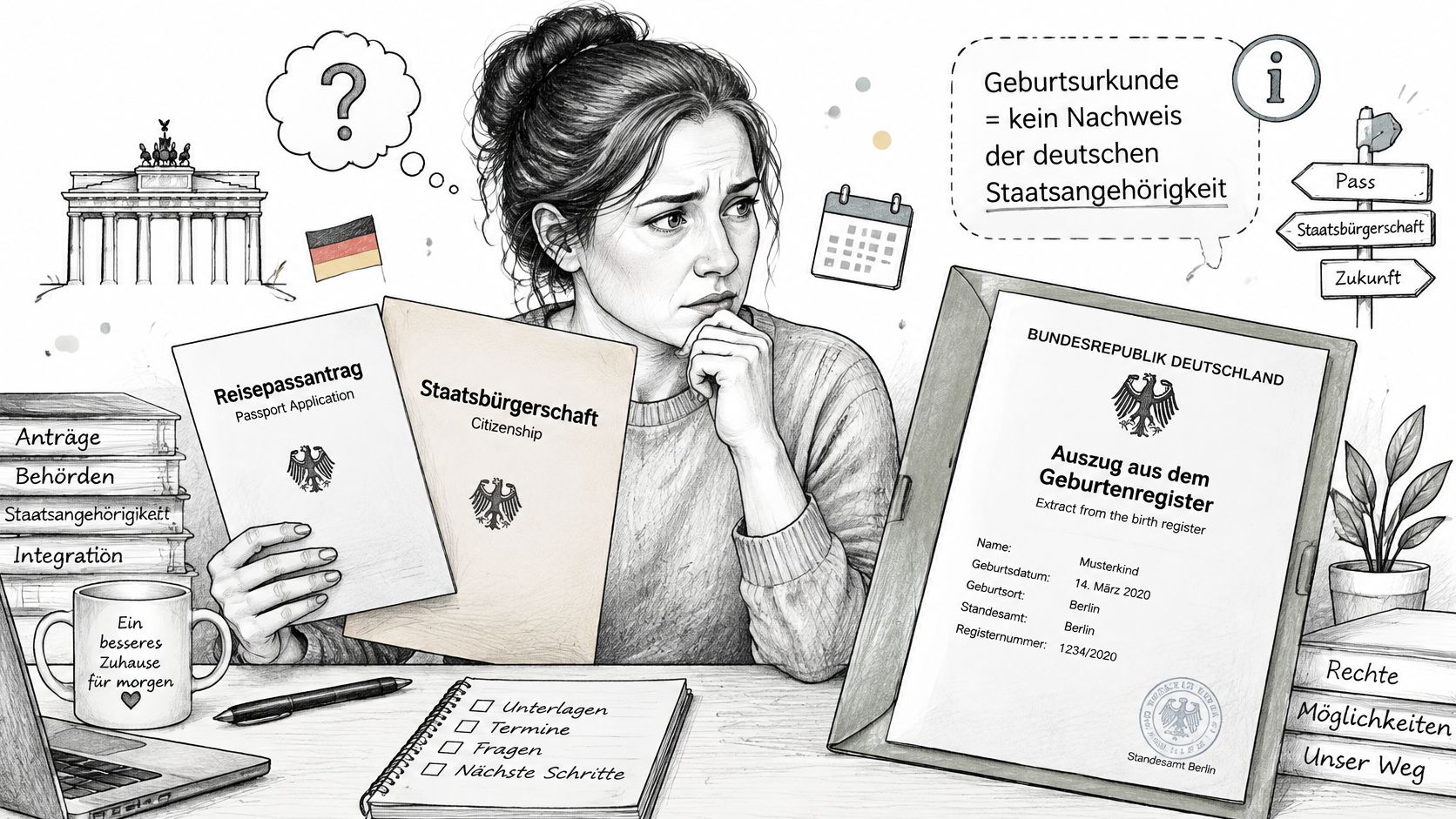
The document records that a birth took place in Germany. A German birth certificate does not establish that the named person is German.
Contact us for immigration support
Have a question about your visa, citizenship, or immigration case?
Contact our team, and we’ll get back to you directly.
The certificate and the fuller record
Section 59 of the German Civil Status Act specifies four core categories, including birth time down to the hour and minute:
- The child’s names: Given names and birth name.
- The child’s sex: The registered information.
- The birth details: Place and exact date and time.
- The parents’ names: Their given and family names.
The certificate works like the cover sheet of an official file. It shows the legally defined core information and nothing more.
The register behind it can hold additional entries, and those matter when an authority needs to trace a family’s legal history. They may include:
- Established foreign nationality: The parents’ foreign nationalities where these have been established.
- Marriage information: A reference to the parents’ marriage.
- Earlier registrations: References to the registration of the parents’ births.
- Citizenship acquisition: Where applicable, a note that the person acquired German citizenship under Section 4(3) of the Nationality Act, meaning an acquisition entered in the register that the certificate text alone would not show.
What the document proves
Civil-status entries and certificates have evidentiary force: they prove the birth and the details recorded with it.
A parent preparing family reunification in Germany for a minor child may need the certificate to establish the family relationship. Proving that relationship is a different evidentiary task from proving the parent’s immigration status.
Practical rule: A document proves the facts it records, not every legal conclusion that might follow from them.
Authorities rely on the certificate in passport, residence, nationality, and naturalization matters, which makes it a foundation for most identity and family-status procedures.
The limit is citizenship. A certificate showing a German birthplace does not, by itself, establish German nationality. Because the document records facts about the birth rather than legal status, even an older certificate that never mentions nationality works as supporting evidence in a citizenship file, not as proof of it.
Which Civil Status Document to Order
Which German birth document fits the filing
| Document | What it shows | Best use | Language note |
|---|---|---|---|
| Ordinary Geburtsurkunde | Names, sex, place, date and time to the minute, and parents’ names | Passport, residence, and everyday proof of birth | German only; a translation is often required abroad |
| Multilingual or international certificate | The same core birth data on an international form | Marriage, residence, or citizenship filings in participating states | May avoid translation there; it doesn’t replace an apostille everywhere |
| Certified printout or copy of the birth register | The broader entry, including annotations on parentage, marriage, names, or nationality where recorded | Descent citizenship, adoption, name changes, and historical notes | Equivalent to a birth certificate; the receiver still decides on translation |
| Certificate with sex and parents omitted | A reduced extract issued on request | A checklist that only needs proof of birth | Those facts remain in the register even if left off the paper |
Ordering the first available birth certificate can mean paying for the wrong evidence. The better starting point is the receiving authority’s checklist.
The Federal Portal’s guidance on birth certificates confirms that a certified register printout or copy is legally equivalent to a birth certificate. It also explains that the multilingual version may avoid translation in many countries.
Ordinary certificate or international form
An ordinary Geburtsurkunde suits a filing that needs the standard birth particulars. It can be appropriate when the authority doesn’t need historical annotations.
The multilingual form addresses a different practical problem: language. It can help when an overseas authority accepts the international model.
For example, someone preparing to marry a German citizen should establish which form the civil registrar accepts before ordering. A document suitable for a residence application isn’t automatically sufficient for a marriage file.
The international form shouldn’t be selected merely because it sounds more complete. It isn’t a substitute for a broader register entry when the missing evidence concerns legal history.
When the register copy matters
A certified register printout is useful when the officer needs more than a snapshot of the standard birth details. The relevant question is whether the entry contains the event or annotation that the application must establish.
A descent case may require a connection between earlier and later names. An adoption matter may require evidence that an ordinary certificate doesn’t display.
Other examples include:
- Parentage: Whether the record contains a relevant recognition or later entry.
- Marriage: Whether a recorded reference helps explain the parents’ legal relationship.
- Names: Whether an annotation connects documents issued under different names.
- Nationality: Whether a relevant nationality reference is recorded.
A register copy cannot supply information that was never entered. Requesting the broader document is a way to obtain the available record, not a guarantee of a particular statement.
A reduced certificate can be appropriate when the checklist needs only proof of birth. However, omitting parents’ names would usually defeat the purpose of a filing that must establish a parent-child relationship.
Before ordering, the applicant should obtain a clear answer about format. The authority may require an original, a certified copy, a recent issue, an international form, or supplementary parentage papers.
Who May Order a Copy and What It Costs
Access to a German birth certificate is tied to the person in the entry and to close legal relationships. The Standesamt checks entitlement first, because the register contains personal data. Under Section 55 of the Civil Status Act, within the statutory framework for civil-status certificates, applicants must generally be at least 16. The usual eligible groups are:
- The person concerned: The individual whose birth was registered.
- A spouse or registered partner: Someone with the legally recognized relationship.
- Ancestors and descendants: For example, parents or children.
- Siblings: Applicants relying on a recognized legitimate interest.
- Other applicants: Those who can demonstrate a legal interest.
A family label can still fall short. An applicant outside the usual categories should state the legal purpose plainly and attach proof, such as a guardianship paper, an inheritance interest, or a file reference from the receiving authority.
Published fees and their limits
The fee is the smaller decision. The larger risk is paying for a clean-looking certificate that leaves out the annotation, parent detail, or register context the filing needs. An older certificate can support that file, while proof of nationality still has to come from a record or authority that states it.
Published fees for German birth certificates
| Request | Fee | Where published | Year |
|---|---|---|---|
| Birth certificate, multilingual certificate, or certified register copy | €12.00 | Berlin via the Federal Portal | 2025 |
| Each additional certificate of the same type ordered together | €6.00 | Berlin, same Federal Portal publication | 2025 |
| Birth abroad, no domestic residence, foreign law does not apply | €80.00 | Mecklenburg-Western Pomerania via the Federal Portal | 2025 |
| Birth abroad, no domestic residence, foreign law applies | €160.00 | Mecklenburg-Western Pomerania, same Federal Portal publication | 2025 |
The two Mecklenburg-Western Pomerania entries concern registering a birth abroad. Treat them as reference points for that registry task; copy requests from an existing German entry follow the local schedule.
Other states set their own fees. The table offers reference points, not a national price list.
When separate authorities require originals, ordering additional same-type certificates in one request can be useful. Establish that need before paying, because extra copies of the short form cannot supply a register detail the filing must establish.
Formal marks that show issuance
Every issued certificate should identify the Standesamt and the register entry’s year and number. Paper certificates use prescribed official forms in DIN A4 format.
Electronic certificates are legally recognized when issued from electronically maintained registers with the corresponding birth-certificate data. A scan made by the applicant has a different status, so the request should be aimed at the issuing office rather than at making a private copy look official.
How to Request a German Birth Certificate
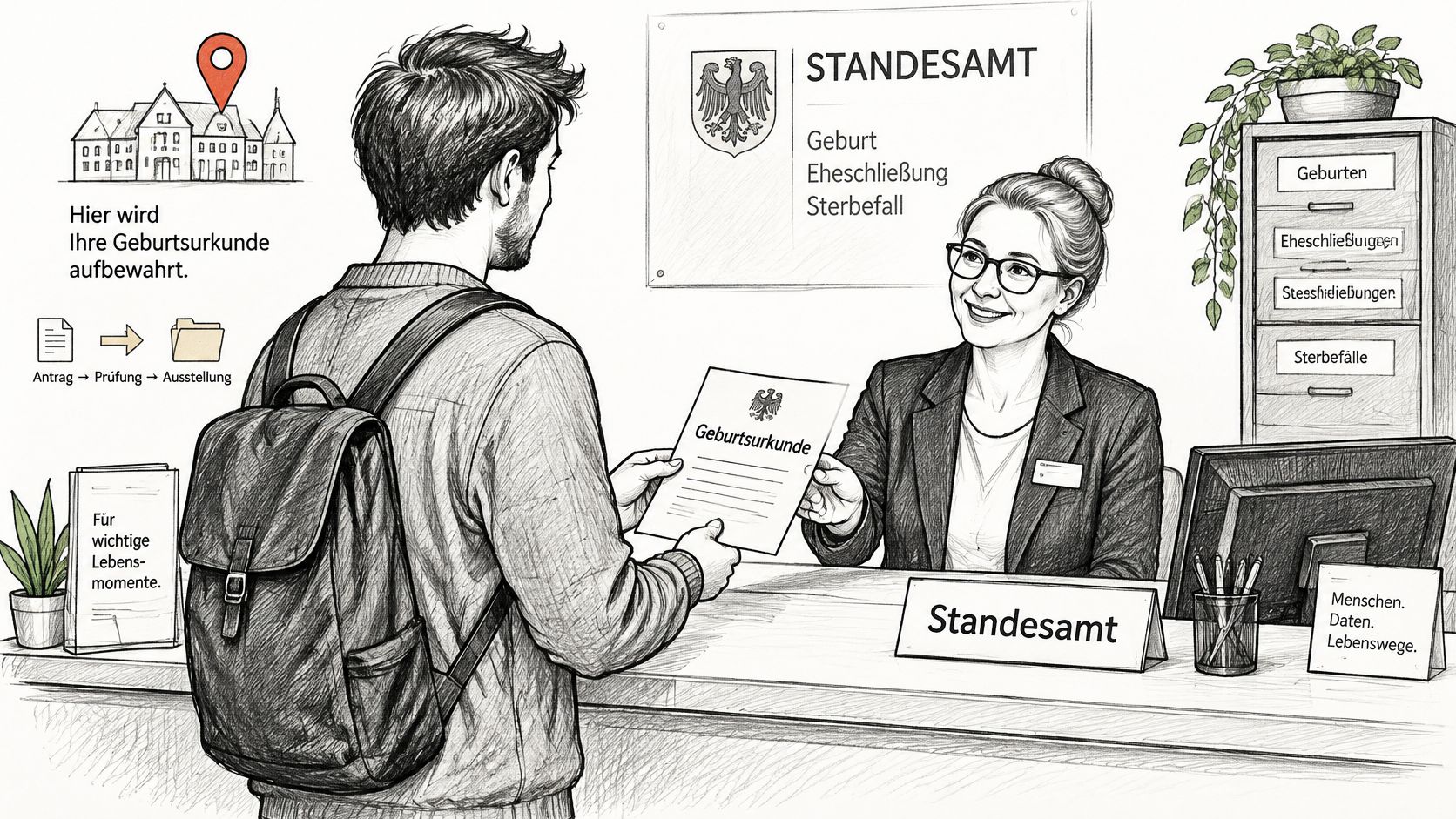
The application should begin with the office that holds the record. A current German address doesn’t necessarily identify the correct registry office.
Ordering a certificate is also a documentation decision, and it should already be settled before the request goes in. That prevents the office from issuing an accurate certificate that still doesn’t answer the receiving authority’s question.
The request procedure
Find the record holder. Usually, this is the Standesamt for the place of birth.A request mailed to the registry office covering the person’s current home often comes back unanswered. The record stays with the office that registered the birth.
Specify the document. The application should name the ordinary certificate, multilingual certificate, or certified register printout.If an annotation matters, the request should identify the purpose clearly. A common mistake is ordering the shorter certificate when the citizenship file needs the broader entry.
Prepare proof of entitlement. A grandchild ordering an ancestor’s record may need documents connecting each generation, not just a matching name.Identification comes first, followed by records establishing the relevant relationship or legal interest. Without that chain, the registry office cannot verify access, and the request stalls.
Use the office’s application channel. Applications may be possible in person, by post, or through an official online service where available.The applicant should follow that office’s payment and delivery instructions. A downloaded scan doesn’t satisfy an authority that requires a recently issued original.
Check the document on arrival. Names, birth details, and parent information should be compared against the passport and other civil-status records.Checking only the applicant’s surname misses problems. A parent’s different spelling or an unexplained birth-name difference can need attention before the filing.
Add only the required cross-border formalities. Apostilles, legalization, and accepted translations should follow the receiving authority’s requirements.A translation bought for the wrong extract gets paid for twice. Confirm the correct extract first, because replacing it means arranging another translation.
Check the filing, not just the envelope
The certificate should be reviewed as part of the full application package. A formally correct original can still leave a gap if the application needs another generation’s record or a separate marriage certificate.
For family applications, the family reunion visa document requirements provide a useful framework for organizing the broader file. Each document should have a defined purpose.
A correct, matching original is more useful than a fast extract that proves the wrong fact.
Applicants should keep a clear copy for their records before submission. They should also follow the authority’s instructions about whether originals are retained or returned.
Birth Certificates in Citizenship and Immigration Filings
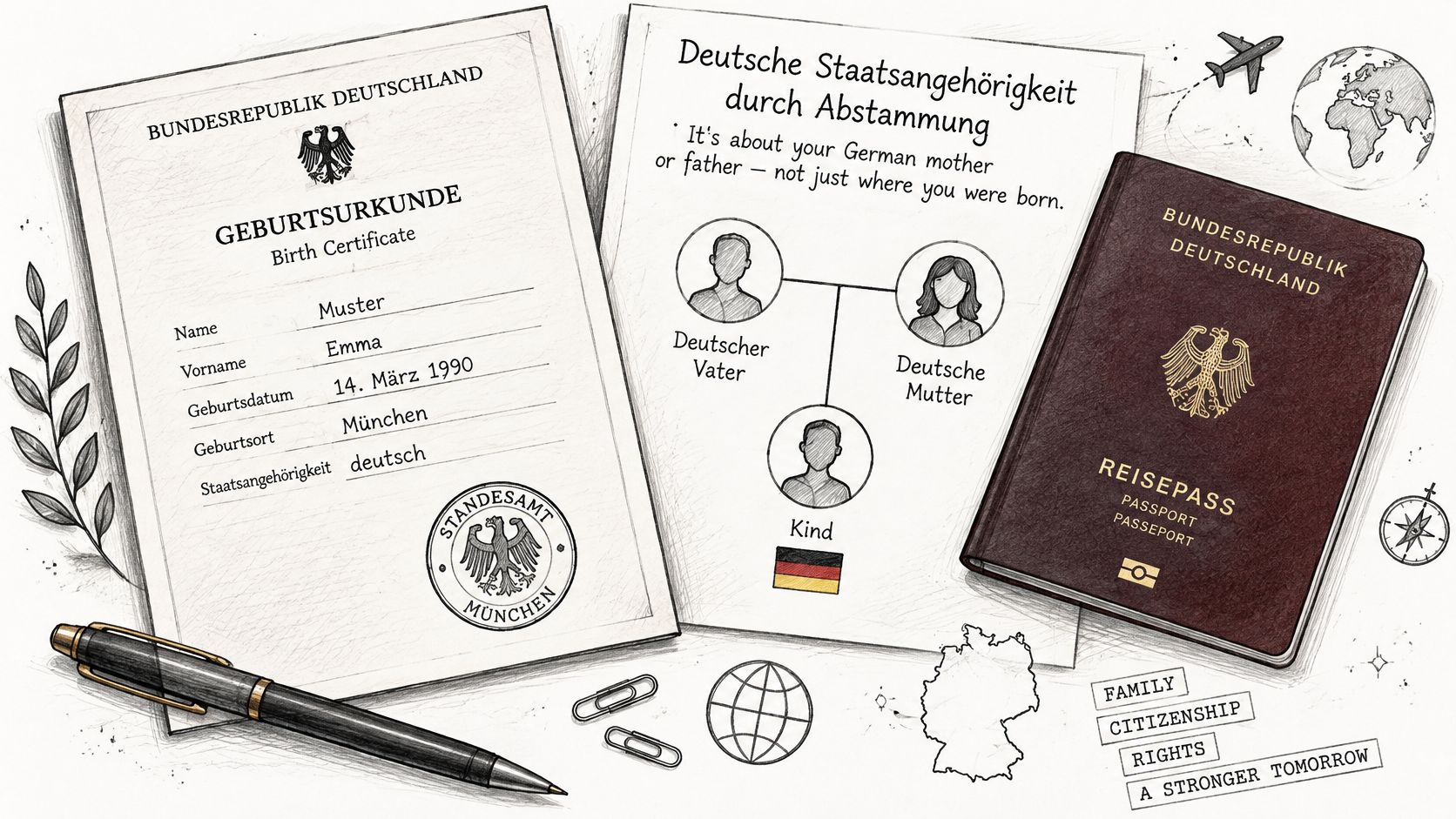
German citizenship generally passes by descent from a German legal mother or German legal father. The parent must have been German when the child was born, according to the Federal Foreign Office’s citizenship guidance.
Birth in Germany isn’t the general basis of acquisition, although statutory exceptions exist. In a descent inquiry, the applicant must distinguish the family connection from the ancestor’s nationality
An older certificate in a Berlin case
In a Berlin citizenship case, an ancestor’s old German birth certificate didn’t state nationality. The filing therefore treated it as supporting evidence rather than the main proof of citizenship.
The submission included other records that expressly described the ancestor as a German citizen. A reasoned letter explained why the documents, considered together, were sufficient.
About four weeks later, the authority invited the client to collect the citizenship certificate. That outcome belongs to the individual case and isn’t a general processing timetable.
A modern birth certificate expressly confirming German citizenship had been sufficient in similar cases. The important distinction was the document’s actual wording, not whether it was old or new.
The practical lesson isn’t that every old certificate needs a lengthy argument. It is that the applicant should identify the precise evidentiary gap and supply records that address it.
Building the documentary chain
The Federal Foreign Office’s citizenship inquiry questionnaire identifies documents that can be submitted together:
- The applicant’s birth certificate: Evidence of the applicant’s birth and family connection.
- A parent’s German passport: A passport from the applicant’s birth date.
- Relevant marriage certificates: Records needed to establish the family’s legal history.
- A grandparent’s German passport: A passport from the parent’s birth date.
- Ancestors’ naturalization certificates: Evidence relevant to nationality history.
- German citizenship certificates: Certificates belonging to relatives or ancestors.
These documents answer different questions. A marriage certificate may connect names, while a passport or citizenship certificate addresses nationality.
A clear covering letter should connect each record to the fact it supports. It shouldn’t claim that a German place of birth establishes citizenship when the certificate says nothing about nationality.
Someone preparing to apply for German citizenship should organize the evidence around the applicable legal route. A descent inquiry and an ordinary naturalization application don’t necessarily require the same family history.
Children abroad and family reunion
A child born abroad may need evidence of both parents’ identities and citizenship. Where citizenship is claimed through an unmarried German father, his paternity must be legally recognized for citizenship to arise through him.
Those issues require more than a name appearing casually in a family document. The file must establish the legally relevant relationship.
For family reunion, the birth certificate serves a different purpose: proving the parent-child link required by the visa application. It doesn’t replace the sponsor’s passport, residence permit, or other status evidence.
Keeping those functions separate makes the application easier to assess. It also helps applicants spot missing evidence before submission.
Apostilles, Translations, and Older German Records
A translation answers a language question. An apostille answers an authenticity question.
The Federal Foreign Office’s document-authentication guidance explains that a Hague apostille is issued by a designated authority in the country that issued the document. It authenticates the relevant signature or seal, not the truth of the birth details.
Language isn’t authenticity
An apostille doesn’t correct a misspelled name or inconsistent date. It also doesn’t replace a certified translation where the receiving authority requires one.
The practical sequence is:
- Obtain the right record: An original or accepted certified copy.
- Check consistency: Compare names and dates with the passport and related records.
- Confirm authentication: Arrange an apostille or legalization only where required.
- Arrange the accepted translation: Use the form and translator standard accepted by the receiver.
An authenticated document can still contain a discrepancy, and a translated document can still need authentication.
A multilingual certificate can reduce translation needs. It doesn’t universally remove authentication requirements.
Treaty forms and historical records
The Federal Foreign Office’s guidance on international civil-status documents identifies participants in the 1976 convention, including France, Italy, the Netherlands, Poland, Portugal, Spain, Switzerland, and Turkey. Certain International Commission on Civil Status forms are exempt from formalities in participating states.
The receiving authority should nevertheless confirm acceptance for the intended procedure. A court, embassy, immigration office, university, or civil registrar may apply different documentary requirements.
Some German offices accept international or English-language certificates without translation. A registry office may still require an apostille or translation for a foreign document.
Historical records require a separate location check. Registry Office I in Berlin is the request route for relevant births from former German territories and consular or colonial registers.
Those certificates can establish birth, names, and parents. Access remains restricted because the records contain personal data.
A citizenship inquiry involving Danzig, Gdańsk, and Jewish family history may also require careful separation of birthplace, historical borders, and nationality. None should be treated as interchangeable evidence.
Choose the Right Certificate Before You File
A sound application starts with the fact that needs proof, not the document easiest to order. Resolve the evidence question before paying for certificates or translations.
The final filing check
- Which fact matters? The birth itself, the parents named in the entry, or an annotation in the register.
- Which document establishes it? The ordinary certificate, the multilingual form, or a certified copy of the register entry.
- Which formalities apply? A recent original, authentication, or an accepted translation.
- What if something does not line up? If the registry office reports no entry, ask which office or archive holds the register before ordering again. If names or dates differ across documents, find out whether the receiving authority expects a correction, an additional record, or a written explanation.
That last question saves the most time. Applicants regularly order a fresh extract when the problem is a mismatch between the register and a passport, and no certificate can fix that.
The practical sequence is simple. Name the filing, list the facts it must establish, then order the extract that proves them. If the right document remains uncertain, a case assessment can identify the missing evidence before money goes to the wrong request.
Artjom Spirin is a licensed immigration lawyer specializing in German immigration law. LegalWeg answers questions about German immigration law and offers advice in English, German, and Russian. Applicants unsure which birth record belongs in their file can visit LegalWeg and request a free case assessment through the form on its contact page.