
Section 9 of the German Nationality Act (StAG) allows an application after three years of lawful ordinary residence if the marriage or registered partnership has lasted at least two years. Marriage alone doesn’t confer citizenship.
Popular advice says that a German spouse means a fast passport. That’s wrong, and it leads many couples to wait for the wrong date.
Marriage changes the residence clock. It doesn’t remove the language, test, income, or record checks.
German Citizenship After Marriage at a Glance
A German spouse can shorten the naturalization wait, but the three-year route has two clocks. The 2024 reform also made the standard route five years, so Section 9 is not always faster.
Section 9 of the Nationality Act, or StAG, covers spouses and registered civil partners. Under Section 9 of the German Nationality Act, the key thresholds are three years of lawful, ordinary residence in Germany and a marriage or registered partnership lasting at least two years. Both periods must be complete on the filing date.
The Two Clocks
The residence clock starts with lawful ordinary residence in Germany. The relationship clock starts with the marriage or registered partnership. Residence before the wedding can count toward the first clock; dating before the wedding does not count toward the second.
For example, someone who has lived lawfully in Germany for four years before marrying a German citizen must still wait until the marriage has lasted two years to meet Section 9’s thresholds. The five-year standard route may come sooner if only one year remains.
The reverse can happen too. A couple may have been married for two years before moving to Germany. The relationship threshold is met, but the residence clock still needs three years.
A marriage residence permit allows a person to live in Germany. Citizenship requires a separate naturalization application.
Routes Side by Side
Citizenship routes after marriage compared
| Route | Residence in Germany | Relationship rule | What else applies |
|---|---|---|---|
| Spouse or registered partner under Section 9 | 3 years of lawful ordinary residence | Marriage or partnership at least 2 years | Applicable naturalization conditions |
| Standard naturalization | 5 years since the 2024 reform, previously 8 | No German spouse required | Applicable naturalization conditions |
| Exceptional integration | 3 years | No spouse required | Special integration achievements |
| Public-interest shortening under Section 9 | May be under 3 years | Marriage has lasted 3 years | Requires a reason of public interest |
| Minor child naturalized with the foreign parent | Child need not have 3 years of lawful residence | Naturalized together with the parent | Other applicable conditions remain relevant |
Compare the dates in the relevant row before choosing a route. A person with strong integration achievements may qualify for the three-year exceptional route without a German spouse. Someone close to five years of residence may reach the standard threshold before completing two years of marriage.
The residence and relationship thresholds show when an application may be possible. The authority also needs documents for every other condition. Minor children may be naturalized with a foreign parent under Section 9 without meeting the three-year residence period themselves. A public-interest shortening is narrower: the marriage must have lasted three years, and a public-interest reason must apply.
Dual nationality is a separate question from the residence and marriage clocks. The guide to German dual citizenship rules explains that issue.
Need Help With Your German Citizenship Application?
We guide you from the first eligibility check to the final decision, and step in if the authority delays or refuses.
Tell us about your situation, and we can assess your case for free.
How Section 9 Shortens the Wait
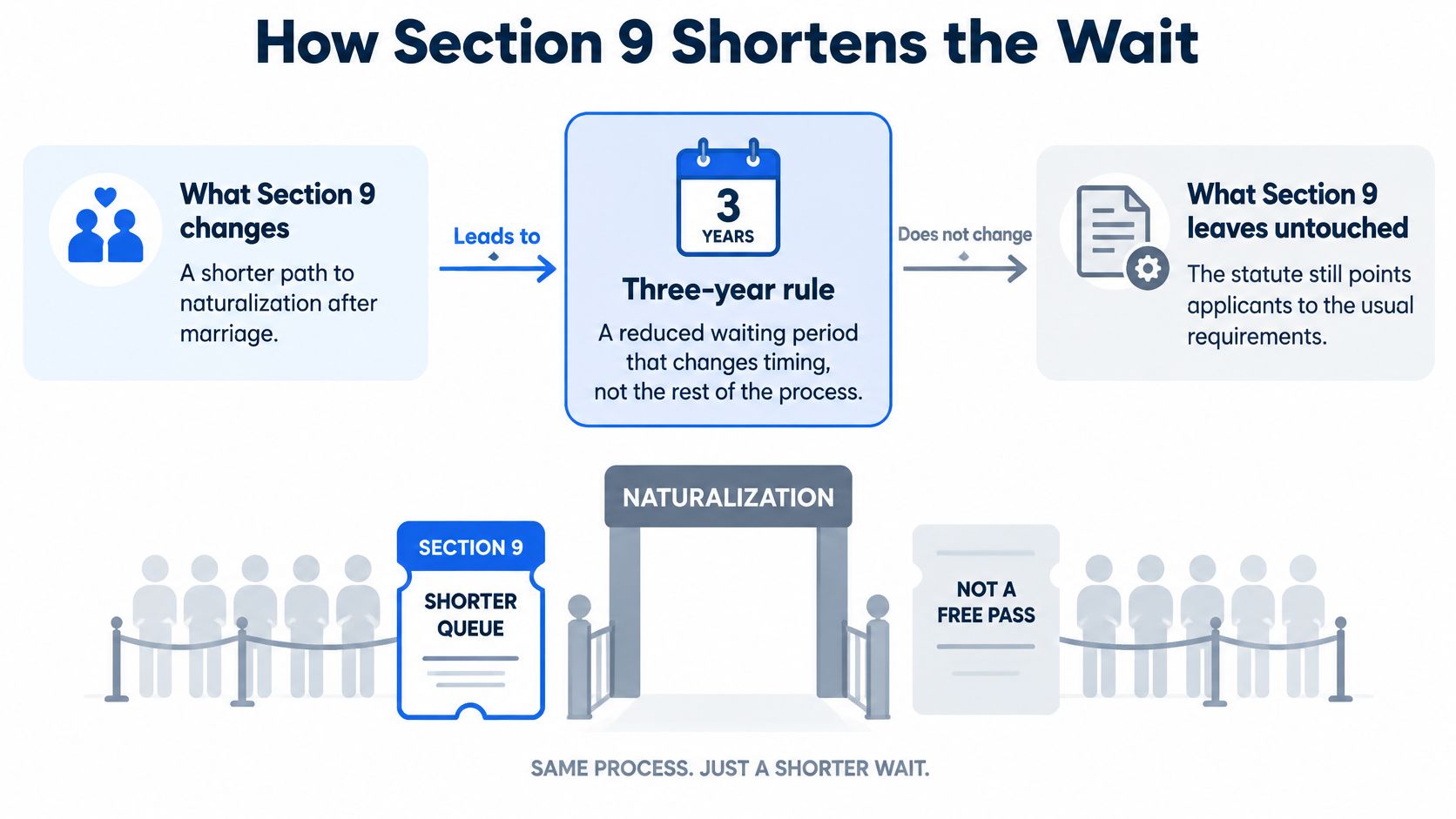
Section 9 offers a three-year residence route for a foreign spouse or registered civil partner of a German citizen, provided the marriage or partnership has lasted at least two years. The three years refer to residence in Germany; the two years refer to the relationship. Both clocks matter.
The English text of the Nationality Act sets out this route and refers to the other applicable naturalization requirements in Section 10(1). A marriage alone does not create an entitlement to citizenship.
How a Gap Affects the Residence Clock
Suppose an applicant has lived in Germany for three calendar years, but their residence history includes a gap in the second year. The authority must examine whether the applicant’s stay meets the lawful and ordinary residence requirement. Three years on a calendar do not, by themselves, prove three years of qualifying residence.
That is why the dates and documents matter. An applicant should check the residence record before relying on Section 9.
When the Standard Route May Be Just as Fast
A spouse who meets Section 9’s three-year residence and two-year marriage tests may apply earlier than someone relying on the standard five-year route. But the difference can be small if the applicant is already close to five years of residence.
The 2024 reform also introduced an exceptional three-year naturalization route for applicants with special integration achievements and advanced German. That route has different conditions. For a couple who does not meet Section 9’s two-year relationship test, it may be relevant to compare the available timelines rather than assume marriage makes Section 9 faster.
Partnership and Family Cases
Registered civil partners receive the same Section 9 timing treatment as spouses. Unmarried partners do not qualify under this route solely because they share a home, have children, or have been together for a long time.
A separation or divorce before the decision may also affect whether the spouse-based route still applies. The authority assesses the circumstances when it decides the application, so a filing date does not freeze the relationship status.
A minor child of the foreign spouse may be naturalized together with the parent even without three years of lawful residence. This exception concerns the child’s residence period; it does not make the family’s application automatic.
Language Test and Livelihood Gates
Meeting the residence and marriage timelines does not by itself make an application ready. Language proof, the naturalization test, and evidence of financial support are separate gates.
The Federal Ministry of the Interior’s guidance on naturalization sets German language ability at B1 level under the Common European Framework of Reference. It also lists alternatives, including a German school-leaving certificate, vocational training completed in Germany, or studies completed in Germany.
Applicants who qualify through one of these alternatives may not need a separate B1 exam. Others need accepted proof of passing the exam before filing.
Why B1 Sets the Calendar
A booked exam does not establish language ability. The result does. If an applicant needs the B1 certificate, the application must wait until that proof is available.
For example, someone may have passed the naturalization test but still be waiting for a B1 result. The tests cover different requirements, so passing one does not replace the other.
The Other Gates
The naturalization test covers Germany’s legal and social order. Applicants also need to show that they can support themselves and eligible dependants without disqualifying reliance on benefits.
Income records and insurance documents help explain the household’s financial situation. Identity and nationality records establish who is applying and may include a passport and civil-status documents.
Applicants must also make a declaration of commitment to the free democratic basic order. A criminal record check forms part of the review, and a disqualifying conviction may prevent naturalization.
Get support on your visa or citizenship application
Filing a visa or citizenship application alone can get overwhelming fast. You don’t have to go through it by yourself.
Get full support from an immigration lawyer, from finding the right forms to getting a final decision.
A Sensible Filing Order
Start by checking which language proof applies. If an exam is required, allow time to take it and receive the result. Then secure the naturalization test result and gather income, insurance, identity, and civil-status records.
Compare names, dates, and other details across documents. Inconsistent spellings or dates can prompt follow-up questions and slow preparation.
The step-by-step guide to applying for German citizenship explains how these proofs fit into the application. A couple can meet the time conditions and still need to wait for required evidence before filing.
When the Three-Year Clock Changes
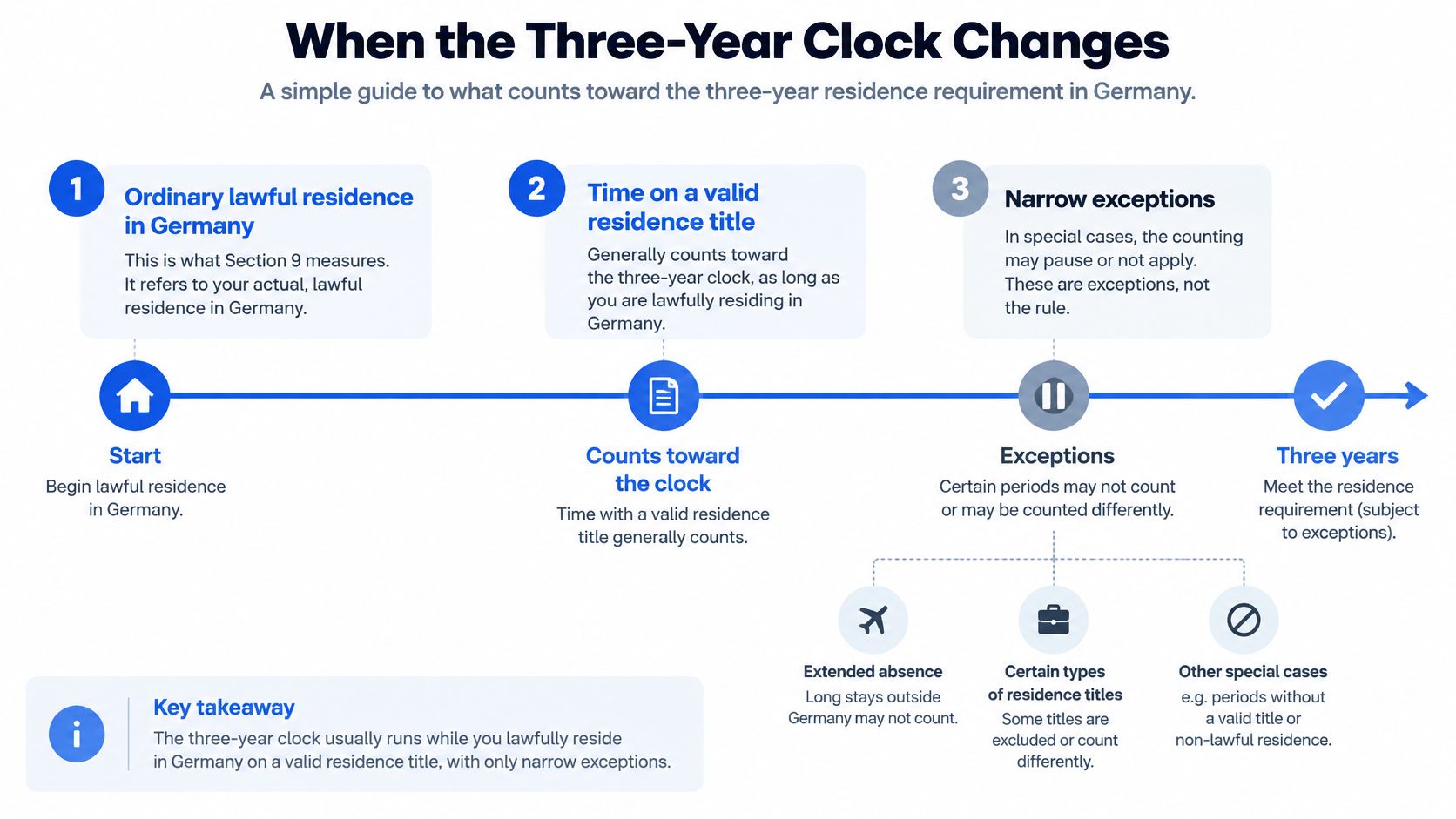
Section 9 measures ordinary lawful residence in Germany. That phrase does most of the work in clock disputes.
Time on a valid residence title generally counts. The title doesn’t need to be a marriage-based title.
Years lived in Germany before the wedding can therefore count. Residence and marriage length run as two separate clocks.
A student year, a work year, and a family year can sit in one history. The question is whether each period was lawful ordinary residence.
Two Clocks, Two Start Dates
The marriage clock starts at the legal wedding. It must reach at least two years.
A religious ceremony without legal effect doesn’t start that clock. Engagement and cohabitation don’t start it either.
Long processing times don’t allow early filing. An applicant can’t file at twenty months of marriage and rely on the queue to supply the rest.
The conditions need to fit the application that is filed. Hope about future dates isn’t a legal basis.
Couples at the earlier stage of planning a wedding and a move can read the background on how to marry a German. Marriage law and citizenship law answer different questions, so the steps shouldn’t be merged.
Narrow Exceptions
Public interest shortening can reduce the residence period below three years. The marriage must already have lasted three years for that door to open.
Public interest means an interest of the state or public, not private convenience. A wish to travel or change jobs doesn’t meet that idea on its own.
Most families never use this exception. Treating it as a routine family discount leads to bad planning.
Minor children follow a different small exception. A child may be naturalized with the foreign parent without a personal three-year residence record.
The child’s position depends on the parent’s file. A weak parent file doesn’t become strong because a child is included.
Moves and Separation
A move inside Germany can freeze a ready case. The foreigners file may need to transfer to the new local authority first.
That transfer explains a frustrating pattern. A family meets both clocks, yet no application is filed because the file sits between offices.
The delay is administrative, not substantive. Eligibility doesn’t disappear during the transfer, but filing can’t proceed cleanly.
Separation has a sharper effect. A person who separates before the decision may fall off the spouse row entirely.
The five-year standard row may then be the only realistic path. Planning should account for that risk before a couple relies solely on Section 9.
Exceptional integration offers a contrast. It can also lead to naturalization after three years without a German spouse.
The spouse row is therefore an option, not a duty. Some applicants qualify faster or more safely on an independent basis.
Four checks before filing: years of lawful stay, years of marriage, children’s ages, and any recent move.
Those four checks take minutes to write down. They prevent the most common clock mistakes.
Two Spouse Cases and What They Show
A couple can meet the legal time limits and still be unready to file. These two hypothetical cases show why the difference matters.
Hypothetical case one: Ready, but relocated
A foreign spouse has lived in Germany for close to five years and has been married for several years. Both the Section 9 time conditions and the standard five-year residence period are met.
The family moves shortly before applying. The foreigners file must be transferred to the new authority, so the couple needs to confirm which office is responsible before submitting the application. Keep the address-change confirmation with the application papers.
Hypothetical case two: The certificate is missing
Another spouse meets the residence and marriage time conditions and has passed the naturalization test. The B1 certificate is still pending, so the application cannot yet include proof of the language requirement.
The dates for eligibility and filing readiness can differ. A completed test and a completed application are separate milestones.
A Destatis table of marriages between German and foreign nationals recorded 18,122 marriages involving a German woman and a foreign man in 2024, and 21,542 marriages involving a German man and a foreign woman. Destatis also reported 291,955 naturalizations in 2024, with 86% conducted under the standard provision or as joint naturalization of spouses and children under Section 10(2).
These figures give context, but they do not determine an individual application. For a couple, the practical question is whether the file is ready to submit or whether a specific administrative step or certificate remains outstanding.
What to Do When the Office Goes Quiet
Eligibility is only half the practical problem. The other half is the queue.
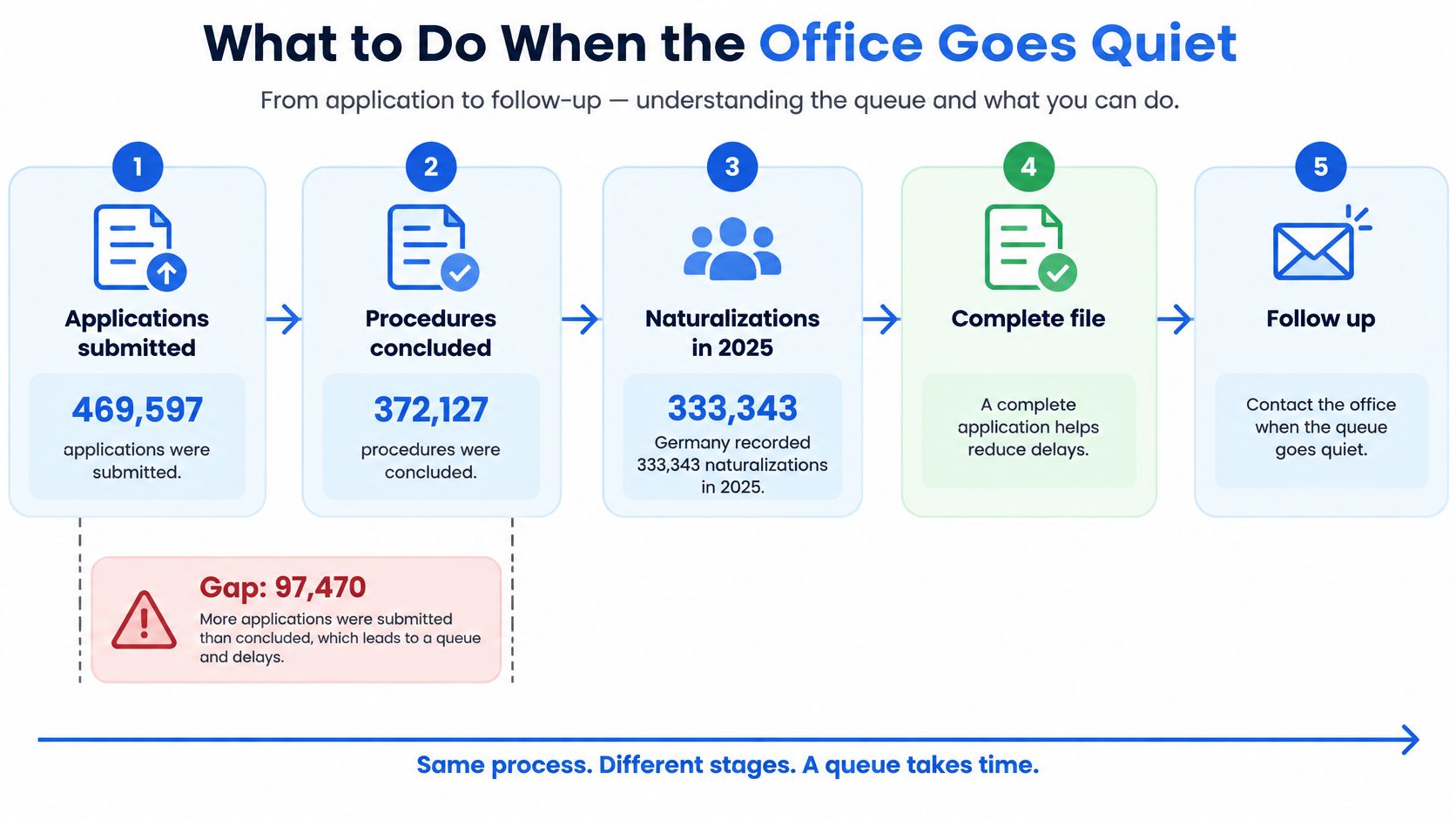
Destatis naturalisation statistics show Germany recorded 333,343 naturalisations in 2025, while 469,597 applications were submitted and 372,127 procedures were concluded. That gap explains why a complete spouse file can sit without news for months.
More applications entered the system than procedures left it. A backlog grows under those conditions even when staff work steadily.
Why the Reform Didn’t Shorten Every Wait
The 2024 reform widened eligibility. Retention of a prior citizenship and the cut from eight years to five brought many people into the system at once.
Broader eligibility can slow decisions in the short term. Offices receive more files before capacity grows.
Local practice also varies. One authority requests extra documents quickly, while another sends nothing for a long period.
Silence therefore carries little information by itself. It doesn’t prove approval, refusal, or a lost file.
Couples often read silence as a verdict on the marriage route. Queue pressure is a likelier explanation when the file was complete.
Build the Paper Trail From Day One
Every applicant should keep the submission date. The filing confirmation belongs in the same folder.
Every letter from the authority should be saved. Every reply to a document request should be saved with its sending date.
Useful records include the following items.
- Submission proof: Date, office, and method of filing.
- Confirmation: Any receipt or file number from the authority.
- Correspondence: Letters, emails, and notes of phone calls.
- Document replies: Copies of everything sent after a request.
- Change notices: Reports of a move, job change, or family change.
A tidy folder turns frustration into evidence. Dates matter more than recollections when delay is later disputed.
Follow Up, Then Escalate
Ordinary follow-up means a written status request. A short letter asks for the current status and any missing items.
That letter should quote the file number and submission date. It should also list documents already provided.
Formal escalation is different. An action for failure to act, the Untätigkeitsklage, asks a court to compel a decision.
The plan for such a step generally considers whether three months have passed without sufficient reason. Whether the lawsuit fits depends on the procedural facts of the file.
Frustration alone isn’t the test. Completeness of the file and the authority’s conduct both matter.
LegalWeg files a lawsuit (Untätigkeitsklage) when authorities don’t respond. The detailed process is explained in the guide on how to file Untätigkeitsklage.
Winning such a case means the authority must decide. The decision can still be a refusal on substance.
A delay lawsuit forces an answer. It doesn’t force a yes.
The two-track plan is therefore clear. Confirm the Section 9 conditions, and document silence from the day of filing.
Match Your Clocks Before You File
The marriage route depends on two timelines, and the dates must line up before you apply. A permit for residence based on marriage can support lawful residence, while citizenship requires a separate application and its own conditions.
| Example dates | Residence in Germany | Marriage or partnership | Practical next step |
|---|---|---|---|
| January 2023 | 2 years | 1 year | Wait. Neither timeline has reached the required period. |
| January 2023 | 3 years | 1 year | Wait. The relationship timeline is still short of two years. |
| January 2023 | 3 years | 2 years | If the other requirements and documents are ready, consider filing. |
These dates illustrate how the two clocks interact. Your own residence start date, relationship history, and supporting documents determine which row applies.
A couple comparing citizenship with a longer-term residence option can review the guide to getting permanent residence in Germany. The right filing order depends on eligibility and the couple’s circumstances.
LegalWeg offers a free case assessment to help clarify the appropriate route. Request one through the contact form.