
Germany issued about 56,300 EU Blue Cards in 2024, roughly 72% of the EU total, according to Eurostat’s 2024 figures. That concentration changes how skilled professionals should approach EU work visas: the EU provides some shared rules, but the right route and application process still depend on the country where the job is based.
For applicants considering Germany, the first task isn’t booking an appointment. It’s checking that the qualification, job, salary and documents fit a specific permit route, because the 90-day decision benchmark starts only after a complete application is submitted.
Table of Contents
- Which EU Work Visa Fits Your Situation
- How the EU Blue Card Works Across Member States
- Germany’s Salary Thresholds and Eligibility Routes
- Pre-Filing Eligibility Checklist
- How to Apply for a German Work Visa Step by Step
- What Employers Must Do Before the Offer
- How Long Decisions Take and What to Do When They Stall
- Family Rights, Permanent Residence and Long-Term Status
Which EU Work Visa Fits Your Situation
| Route | Best for | Core requirement |
|---|---|---|
| EU Blue Card | Degree-holding professionals | Contract or binding offer of at least six months and salary above the national threshold |
| German national skilled worker permit | Workers with a recognised vocational or academic qualification | Recognised qualification and a qualifying job offer |
| EU single permit | Non-EU workers needing a combined work and residence permit | Employer application checked by the national authority |
| Intra-corporate transfer permit | Staff moved from a group company abroad | Transfer within a multinational group for the assignment period |
Match each route to the qualification, the job and the employer before you look at the permit name. A degree holder with a qualifying contract usually starts with the EU Blue Card. A worker with vocational training usually needs a national skilled-worker route instead.
Match the route to the move
Every row in that table asks for the same three pieces of evidence: a credential, a job, and an employer relationship that fits the category. The rows differ in how those three are tested.
The EU Blue Card is designed for highly qualified non-EU workers whose job and salary meet the destination country’s requirements. It fits a degree-holding professional with a qualifying offer, and the salary test is set nationally, so the same contract can clear one country’s bar and fall short of another’s.
A German national skilled worker permit may suit someone whose recognised vocational or academic qualification matches the offered job. Read the qualification and the job description side by side. A job offer on its own does not establish that the route fits.
The EU single permit combines permission to reside and permission to work in one document. It is the broader option for non-EU workers who need both, with the employer’s application checked by the national authority.
An intra-corporate transfer permit covers staff moving from an overseas company to a related company in the destination country. The employer and applicant should confirm that the move is a genuine internal group transfer, not an ordinary new hire.
A worker who lacks either a recognised degree or a qualifying contract starts from a different point. The Opportunity Card for Germany moves the search for qualifying work ahead of the permit application, so entry to look for a job comes before the offer that would open a work route.
Four questions settle most of this: qualification, contract, salary and employer. The pre-filing eligibility checklist later in this article tests each one against the documents you will submit, and an incomplete answer there is what holds a file up before an authority ever opens it. Start with the route that matches the actual job and the evidence behind it, not the route with the most familiar name.
Applying for an EU Blue Card in Germany?
We handle your EU Blue Card from the first check to a lawsuit over any delay.
Tell us about your case, and we’ll get you through the next step.
How the EU Blue Card Works Across Member States
The Blue Card works like a shared template that each participating country fills in with its own salary line and filing desk. The legal framework is common; the application desk is national. Under the EU summary of Directive (EU) 2021/1883, the scheme applies in 25 participating EU Member States; Denmark and Ireland do not take part; and each country sets its threshold within a range of 1.0 to 1.6 times the relevant national average gross annual salary. That range explains why a salary offer can look strong in one capital and weak in another.
Directive (EU) 2021/1883 traces the scheme to Council Directive 2009/50/EC, adopted in 2009. The revised directive entered into force on 27 November 2021, replaced the original directive from 19 November 2023, and had a national transposition deadline of 18 November 2023 for participating Member States.

What the revised rules changed
The reform changed several admission and mobility rules that matter when comparing countries:
- Contract length: Applicants can generally qualify with a contract or binding offer lasting at least six months. The former minimum was 12 months.
- Salary test: Each country sets its threshold within the 1.0 to 1.6 range above, so the same gross salary can clear one country’s rule and fail another’s.
- Moving countries: After one year of legal employment in the first country, a holder can use facilitated mobility to move to another participating Member State.
If you are comparing a move to a second participating country, the EU Blue Card benefits overview explains what the card offers holders and which cross-border points to check before accepting an offer.
A professional who starts in one participating country and later receives an offer in another may have a facilitated mobility route. The destination country must still process the new job under its own rules, including salary checks and any notification or application steps. Mobility rules do not give free movement; the destination country’s procedures still apply. Family members may also face their own steps, so the worker’s move is not the whole family’s automatic transfer.
Before applying, confirm that the destination participates and check its national salary rule against the actual contract. A shared EU framework helps applicants read the route, but national rules determine how the application proceeds. Treat the shared rulebook as the map; the national authority controls the road, including paperwork, the salary test, and the timing. The processing clock becomes meaningful only once the file is complete, so confirm eligibility before you rely on any estimate.
Germany’s Salary Thresholds and Eligibility Routes
In 2026, Germany’s standard EU Blue Card route requires a gross annual salary of €50,700, and the reduced threshold is €45,934.20 for shortage occupations and for applicants whose last degree or equivalent qualification was obtained less than three years before applying, according to the German government’s Blue Card guidance. Under the regular route, approval from the Federal Employment Agency is generally not required, but the job offer or employment contract must last at least six months.
The reduced threshold splits into two practical paths. A shortage-occupation application needs Federal Employment Agency approval of the employment. A newer-graduate application uses that same reduced figure when the applicant’s last degree or equivalent qualification was obtained less than three years before applying, and it can cover entry-level jobs in all professions.
| Route | Agency approval | Main eligibility evidence | Common confusion |
|---|---|---|---|
| Regular route | Generally not required | Salary at the standard threshold; contract of at least six months | A strong degree does not lower the standard salary test |
| Shortage occupation route | Required | Occupation on the shortage list plus agency approval of the employment | The reduced salary does not remove the agency check |
| New graduate route | Required | Last degree or equivalent obtained less than three years before applying | Entry-level jobs in all professions can fit |
| IT specialist route | Sometimes required | At least three years of comparable academic-level IT experience | The degree route is not the only evidence path |
Test the job, degree and salary together
Consider a software engineer with a master’s degree obtained two years ago and a German offer paying €48,000 gross annually. That salary falls below the regular threshold, so the standard route does not fit. The applicant may qualify through the reduced new-graduate route because the degree was obtained less than three years before applying. The employment then needs Federal Employment Agency approval. The salary gate and the qualification gate are separate.
The IT specialist route addresses a different case. An applicant without the standard degree route may qualify through at least three years of comparable professional experience at an academic level. The German government’s employer guidance on Blue Card questions notes that these cases may involve agency assessment, especially when the reduced salary threshold is used.
Practical rule: A qualifying degree does not replace the salary test. Check the route that supports the offered salary first, then confirm the job and approval requirements for that route.
An otherwise qualified applicant can still fail the salary test. Confirm the route before signing the contract or filing. The decision clock starts only when the file is complete, so settle eligibility before any step in the application.
Pre-Filing Eligibility Checklist
This list assumes the route is already settled. Its job is to test whether the documents prove that route to the immigration office. An officer decides from paper alone, so every claim in the application needs evidence behind it.
| Check | What the file must show |
|---|---|
| Route fit | The permit named in the application matches the qualification and the job described in the contract. |
| Salary | Gross annual pay, as written in the contract, meets the threshold for that route. |
| Contract length | A start date and duration that meet the route’s minimum. |
| Qualification | The degree or vocational certificate, plus recognition or comparability evidence where it was earned abroad. |
| Foreign certificates | Legalisation and German translations where the authority requires them. |
| Employer statement | Written confirmation of the role, the salary and the employing entity. |
Catch common blockers early
Four problems repay a deliberate check. Pay below the regular threshold may still qualify under a reduced route, which brings its own approval step. A file with missing translations or certificates is incomplete, even when the application form has been submitted. Blue Card conditions differ between member states, so documents assembled for one country’s requirements may not satisfy another’s. Family members need their own eligibility check, because a spouse’s or child’s right to join depends on the permit type and on the evidence filed with it.
The decision clock is the practical reason for all of this. Authorities treat a file as complete only when every required document has arrived, and the statutory processing window runs from that date. A certificate that lands in week six can push the start of the review weeks past what the applicant expected.
Keep dated copies of the checklist and of everything submitted. If a dispute later turns on whether the application was complete on a particular date, that record shows what was sent and when.
Where the route or the evidence is unclear, LegalWeg’s legal experts assess the situation and confirm the next steps through a free case assessment.
How to Apply for a German Work Visa Step by Step
A sound application starts with eligibility, not paperwork. The applicant should complete the route check first, then assemble a file that lets the authority assess the job, qualification, and supporting evidence together.
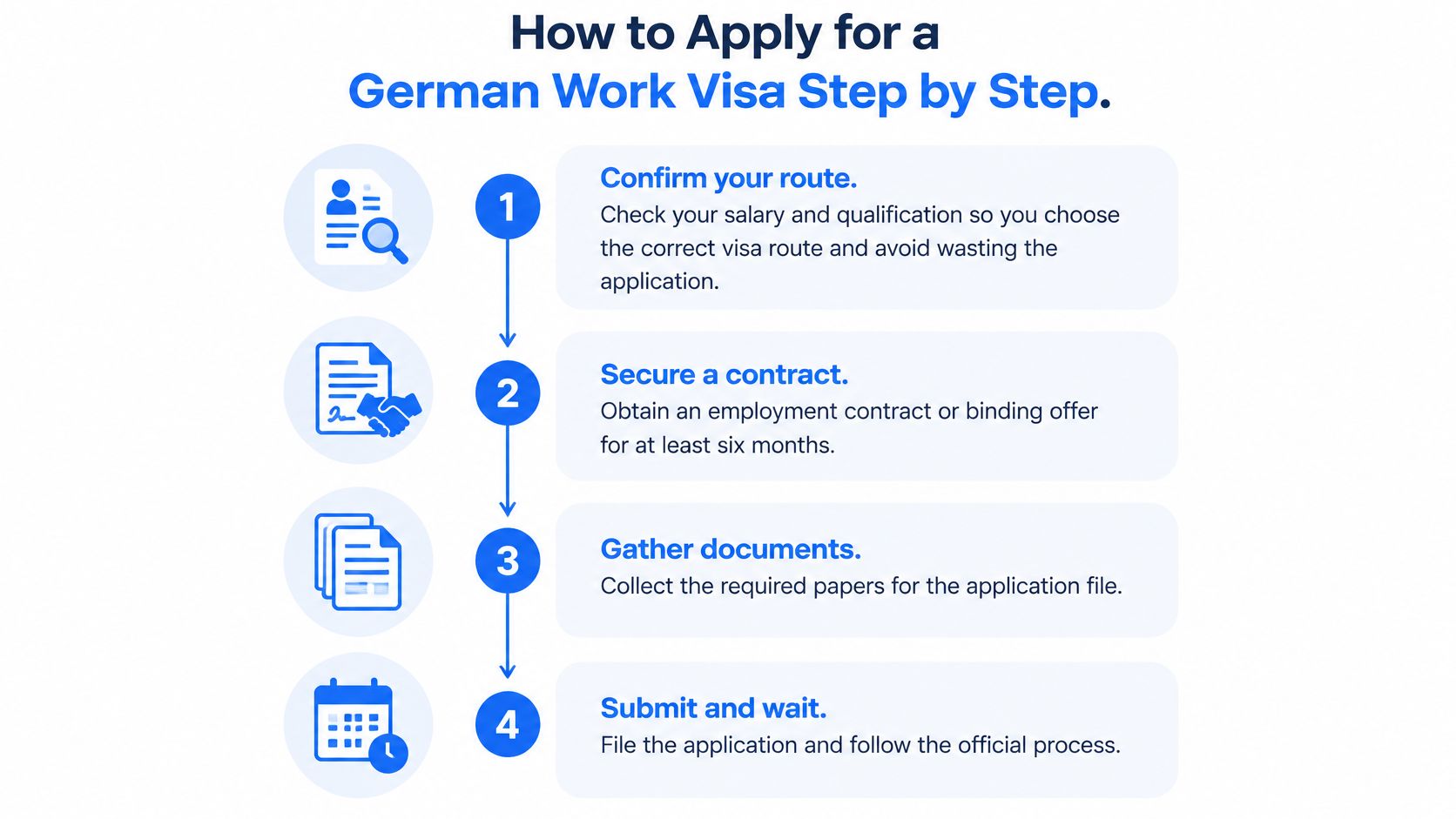
Confirm the route. Match the qualification and job to the permit, then test salary against the applicable route. A frequent mistake is choosing a route by job title alone and discovering later that the salary or qualification doesn’t fit.
Secure a written offer. Obtain an employment contract or binding offer that meets the route’s minimum duration. Check that the role, salary and employer details are consistent across the offer and any application forms.
Gather the core documents. Prepare the passport, degree or qualification evidence, CV, contract and proof of health insurance. A missing document can prompt an evidence request and delay the point at which the file is treated as complete.
Prepare foreign certificates. Arrange legalisation and German translations where needed. Don’t assume that an English-language document or an informal translation will satisfy the authority.
Book an appointment. Contact the relevant German embassy or consulate early to learn its filing procedure and available appointments. An appointment gap can extend the overall process even before the file reaches the decision stage.
Attend with originals. Bring the required originals and copies, complete fingerprinting if requested, and pay the applicable visa fee. A common slip is arriving with scans when the appointment instructions require original documents.
Respond to review requests. The authority may consult the local immigration office or the employment agency, depending on the route. If it asks for more evidence, submit the requested material promptly and keep a dated copy of the response.
Collect the visa and enter Germany. Check the visa’s validity dates and travel within that period. Keep the visa and application records accessible for the next residence step.
Register and apply for the residence permit. After arrival, register the German address and apply to the local immigration office for the residence permit. The process is complete only when the applicant has a registered address and the residence permit card has been issued.
LegalWeg prepares and files visa applications for clients after they submit their documents. That can help applicants who need support organizing the application file and communicating with the relevant authorities.
What Employers Must Do Before the Offer
An employer can spend weeks choosing the right visa route and still lose that time at the document stage. The 90-day decision benchmark starts only when the file is complete, and missing employer papers keep the file incomplete.
Consider a candidate whose salary sits just under the applicable threshold. The employer can raise the gross salary to clear it or confirm whether the role fits a reduced-threshold route before the offer is issued. That decision belongs in the offer approval, not in a later appeal after a refusal.
Pre-offer checklist
Describe the role in writing. State the job title, duties and location, and check that the role makes sense alongside the candidate’s qualification. A mismatch can obstruct an application even when the salary is sufficient.
Confirm salary and contract duration. Check the proposed gross salary against the route threshold and make the contract duration meet the route minimum. Treat this as a final consistency check against the thresholds covered earlier, not a new analysis.
Assemble employer evidence. Prepare the documents the authority will request, and keep dated copies of everything sent. Both sides then have a record of what was submitted.
Name a responder. Assign one person to monitor authority requests and reply without avoidable delay. A missing employer paper can hold up completion of the file.
If the employer needs a template or wording for a supporting letter, this guidance on an employer support letter for immigration explains what the letter should cover.
This week, put one name and one backup on the offer approval record for employer document requests, so the file does not stall before it reaches the authority.
How Long Decisions Take and What to Do When They Stall
The EU Blue Card’s 90-day decision benchmark starts when the file is complete, according to the EU Blue Card information page. The clock works like a service timer that begins only once every required item is on the counter. Missing translations, legalisation problems, absent employer documents, appointment delays or requests for more evidence can postpone that moment. National authorities apply their own processing rules. The benchmark is a decision target for a complete file, not a guaranteed relocation timeline.
Ask three questions before filing
- What proves completeness? Keep the appointment confirmation, document checklist, submission receipt, and any authority message confirming completeness in one file.
- When does the clock restart? Ask how the authority treats supplementary documents and whether it considers the file complete only after those documents arrive. Record the date each item is sent and acknowledged.
- What happens if the office stays silent? Send a short written reminder that identifies the application, its submission date and any prior correspondence. Keep proof of delivery.
If the authority still does not decide, a German lawyer can assess whether an Untätigkeitsklage under § 75 VwGO, an action for failure to act, is appropriate. Such an action can generally be filed after three months without a decision, but the legal conditions and exceptions matter. Check the current wording of § 75 VwGO with a German lawyer. An elapsed waiting period alone does not prove that the legal requirements are met.
A person considering a failure-to-act lawsuit should gather the full timeline first. The application and employer sections explain how to keep dated records of each submission and response. Those records help establish what happened and when.
Family Rights, Permanent Residence and Long-Term Status
A German Blue Card can lead to a settlement permit, a permanent residence status. The standard facilitated route requires at least 27 months of qualified employment and contributions to statutory pension insurance. With German at level B1, the period can be reduced to 21 months, according to Germany’s settlement permit guidance.
Consider a Blue Card holder who has completed 21 months of qualified employment, paid statutory pension contributions, and reached B1 German. If the other statutory requirements are also satisfied, that person may qualify for the settlement permit rather than continuing to renew the temporary Blue Card.
Plan the family’s status separately
Spouses and minor children may join a Blue Card holder, but the family’s steps need to be checked alongside the worker’s application. When the family already lived with the holder in another EU Member State, Germany provides privileged treatment in qualifying cases.
- Entry: In qualifying cases, family members can enter Germany without first obtaining a new visa.
- Housing and support: Germany doesn’t apply the usual adequate-housing or livelihood-security requirements when issuing the residence permit in these cases.
- Insurance: Health-insurance coverage is still required.
- Separate procedures: The family’s residence status is an administrative pathway of its own, not an automatic extension of the main applicant’s permission.
The German skilled-immigration guidance on family and mobility describes the relevant privileged treatment. Families should confirm that their circumstances qualify and prepare the required evidence for each member.
Changing employer or country can affect how residence time counts toward long-term status. Keep employment contracts, pension contribution records and residence documents together, and get advice before a move if it could interrupt the qualifying period. Applicants planning ahead can also review the steps for permanent residence in Germany.
LegalWeg offers a free initial case assessment to help identify the German work-visa route and the documents needed for a Blue Card or related permit. Applicants can ask LegalWeg to prepare and file the application after submitting their documents, and can visit LegalWeg to get started.