
Yes, since 27 June 2024 Germany generally no longer requires applicants to give up their existing nationality, but the other country’s law can still decide the outcome.
That’s the surprise for many readers. Germany can say yes, and the home country can still say no.
So the question isn’t only can Germany have dual citizenship. It’s whether both countries let the same person keep both citizenships at once.
Table of Contents
- Yes, Germany Allows Dual Citizenship Since 2024
- Who Can Keep Two Citizenships by Applicant Type
- Naturalization Requirements That Still Decide Eligibility
- Check Your Home Country Law Before You Apply
- Residence Permits and Steps to Apply for Citizenship
- Confirm Your Dual Citizenship Position Before You Apply
Yes, Germany Allows Dual Citizenship Since 2024
Under the old rules, naturalizing as German normally meant giving up the nationality you already held. The reform that took effect on 27 June 2024 reversed that default.
Two separate laws now decide the outcome of every application: German eligibility rules on one side, and your home country’s rules on keeping its citizenship on the other. Germany controls only the first side.
What German Law Says Now
The Federal Government summary of the modernised citizenship law states that naturalisation generally no longer requires applicants to renounce their existing nationality, and that Germany permits multiple citizenship as a matter of German law.
An applicant who naturalizes successfully can become German and keep the original citizenship. Dual citizenship is the outcome of that successful application rather than a separate right claimed in advance. Qualify first, keep both after.
What the Rule Was Before
Before the reform, the default ran the other way. Applicants were normally expected to renounce their previous nationality as part of the process.
Exceptions existed. They covered four situations:
- EU citizenship: The applicant held citizenship of another EU country.
- Renunciation impossible: The home country didn’t allow release from citizenship.
- Renunciation unreasonable: The home country made release possible only on harsh terms.
- Particular hardship: Giving up citizenship would cause serious personal harm.
An applicant who fit none of them still had to give up the first citizenship. That was the practical effect for everyone outside the exception list, whatever their reasons for wanting to keep both ties.
What Changed in 2024
The reform entered into force on 27 June 2024. From that date, keeping your existing citizenship became the normal starting point under German law.
Two changes matter most for dual citizenship:
- Renunciation removed as the default: Applicants are no longer generally required to give up their first nationality in order to naturalize.
- Shorter standard residence period: The usual wait fell from eight years to five, according to the Federal Government explanation of the citizenship reform.
The government framed the reform around integration. A naturalized citizen takes on full legal membership in Germany while keeping family, cultural, and legal ties to the country of origin.
What Didn’t Change
Every other naturalization condition stayed in place. Residence, language, livelihood, and the constitutional commitment still decide each file, and the eligibility section sets out each check in detail. Fail one, and the application fails, however clearly German law permits two citizenships.
Two Quick Examples
Take an American applicant who meets every German condition. She can usually become German and keep US citizenship, because US law allows dual citizenship.
Now take an Indian applicant who meets the same German conditions. He must check first, because India doesn’t recognize dual citizenship.
Same German answer. Different final result.
Which Date Counts
The reform law entered into force on 27 June 2024. What counts is the date of your naturalization, not the date you filed: applications still pending on that day are decided under the new rules, so those applicants also no longer have to give up their first nationality.
If you were naturalized before that date, the older renunciation rules applied to your file.
Germany permits multiple citizenship as a matter of German law, but that is only half of the answer.
Start with one action before anything else. Write down your current nationality and look up its rules on losing citizenship when you naturalize elsewhere. Germany has opened its side of the door. Confirm the other side is open too, before you file.
Who Can Keep Two Citizenships by Applicant Type
Six applicant types reach two citizenships by different roads. Your road decides which German conditions you still have to meet and which questions your home country answers for you. Find your type in the table, then read the notes that follow it.
| Applicant | Route to German citizenship | Keep original citizenship under German law | Main condition |
|---|---|---|---|
| Non-EU national naturalizing | Naturalization | Yes, since 27 June 2024 | Five years lawful residence, language, livelihood, loyalty |
| EU citizen living in Germany | Free movement, or naturalization by choice | Yes | Naturalization is optional; residence rules still apply |
| Swiss citizen | Naturalization | Yes | Standard naturalization conditions |
| German citizen acquiring another nationality | No naturalization needed | Yes, under German law | Rules of the new country decide other effects |
| Child born in Germany to foreign parents | Citizenship at birth in Germany | Generally yes | One parent has lived lawfully in Germany for five years and holds a permanent right of residence; the parents' country decides the rest |
| Applicant naturalized before 27 June 2024 | Earlier naturalization rules | Generally no at the time, unless an exception applied | Older renunciation rules may still apply to the file |
The Federal Government guidance on the naturalisation reform sets the five year residence requirement behind that first row.
Find Your Row First
A non-EU national naturalizing is the main group affected. German law now lets that person keep the original citizenship, but residence, language, and livelihood still decide the case.
An EU citizen sits in a different position. Free movement already allows living and working in Germany, so naturalization is a choice rather than a necessity. The choice still has value: voting rights and long term security can matter even when a residence right already exists.
Spouses often ask a related question. The guide on German citizenship after marriage covers that family route in detail.
A Swiss citizen naturalizes under the same conditions as other applicants. Even before the reform, Swiss nationals could keep their citizenship, just like EU citizens.
A German citizen who takes another nationality keeps German citizenship under German law. The new country then decides issues like military duty, tax filing, or passport use.
Children and Older Cases
A child born in Germany to foreign parents acquires German citizenship at birth if one parent has lived lawfully in Germany for at least five years and holds a permanent right of residence (§ 4(3) StAG). Whether the child also keeps the parents’ citizenship depends on the other country’s rules, and some countries require consular registration within a set period.
People naturalized before the reform need separate care. Their files were decided under older rules, so a past renunciation may still shape their position today.
The main condition column tells you what Germany still asks. Your home country’s rules tell you what you might lose.
Get support on your visa or citizenship application
Filing a visa or citizenship application alone can get overwhelming fast. You don’t have to go through it by yourself.
Get full support from an immigration lawyer, from finding the right forms to getting a final decision.
Naturalization Requirements That Still Decide Eligibility
A complete residence period gets an application accepted. Whether it gets approved depends on checks that fail in specific, predictable ways.
| Route | Residence period | Status |
|---|---|---|
| Standard naturalization before 27 June 2024 | 8 years | Replaced by the 2024 reform |
| Standard naturalization from 27 June 2024 | 5 years | Applies to all applicants, subject to other conditions |
| Accelerated route for exceptional integration | 3 years | No longer available |
The 2024 reform moved the standard requirement from eight years to five. The three-year fast track it introduced for exceptional integration was abolished again with effect from 30 October 2025, so five years is now the standard minimum. What decides files now is where applications break.
How Each Check Fails in Practice
Residence. A gap you can’t explain may not count toward the five years. Time spent under a status the citizenship rules don’t recognize leaves the total short, even if you lived in Germany the whole time.
Language. A certificate below the required level fails the check outright. Fluent spoken German at work won’t replace the missing document. Preparation for the German citizenship test sits alongside the language proof, so treat both as documents to finish early rather than tasks for the last month.
Livelihood. Income that depends on welfare benefits can block approval even when your residence period is complete. The office looks at whether you support yourself.
Loyalty. The commitment to Germany’s constitutional order is a stated requirement. An applicant who won’t give it has no file to decide.
A temporary visa alone creates no entitlement. Holding a visa and meeting the citizenship conditions are two different things, and the office treats them that way.
A second passport is never the first requirement; it is what remains once every condition is met.
A dual citizenship outcome needs German approval first, and these checks are where that approval is won or lost.
Do one practical task now. List your residence dates, income proof, and certificate dates for the five years before you plan to apply. Anything missing on that list is a point your file can lose.
Need Help With Your German Citizenship Application?
We guide you from the first eligibility check to the final decision, and step in if the authority delays or refuses.
Tell us about your situation, and we can assess your case for free.
Check Your Home Country Law Before You Apply
German approval doesn’t settle the whole question. Germany can’t override your home country’s nationality law.
The German missions guidance on dual citizenship supports checking how the other country treats a second nationality. That check should happen before naturalization, not after.
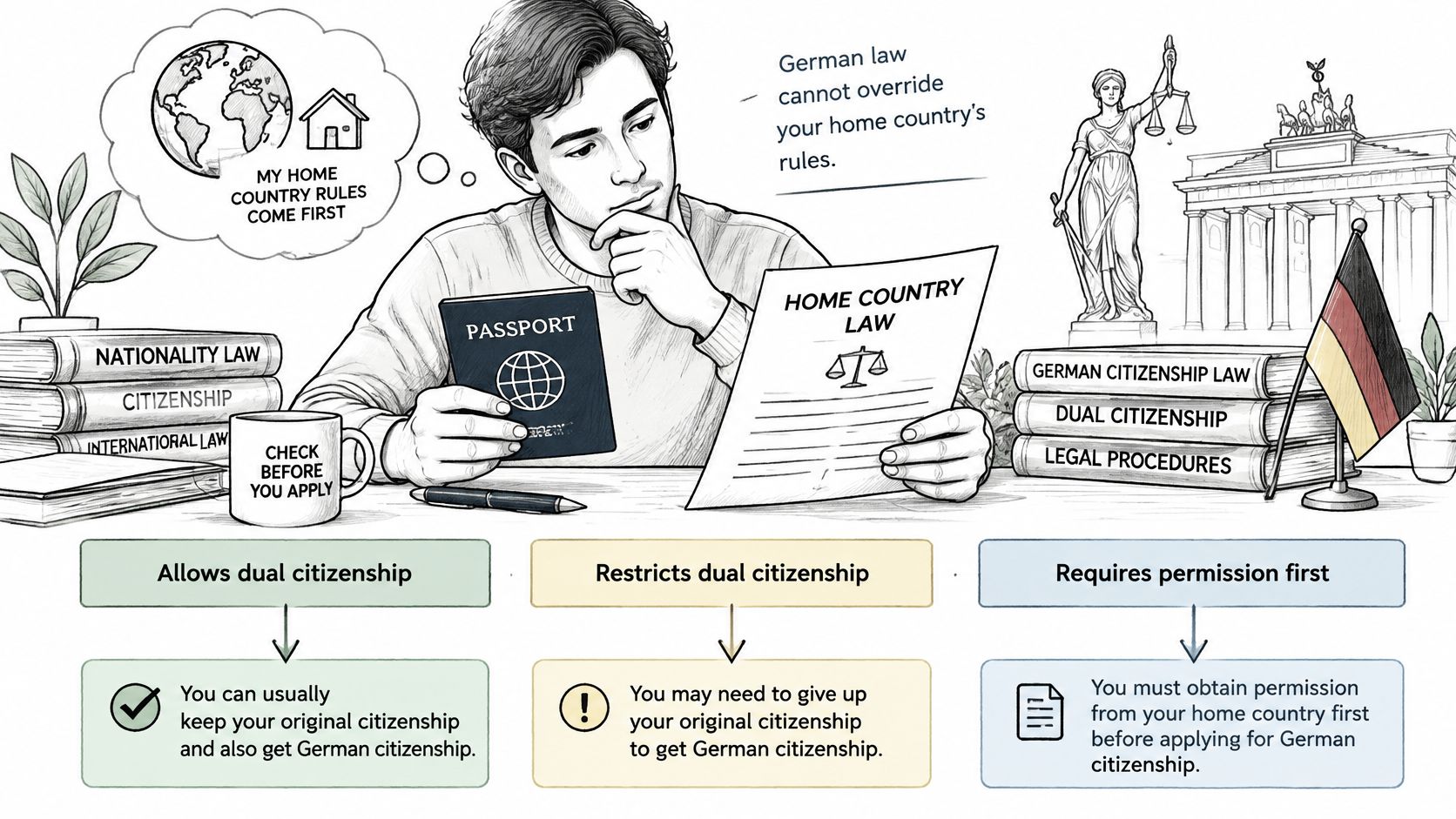
| Home-country rule | What happens to your citizenship | Action before applying |
|---|---|---|
| Dual citizenship allowed | Both citizenships kept | Confirm passport, consular and property rights |
| Permission required to keep citizenship | Must request approval before naturalization | Get written approval from the consulate or authority |
| Automatic loss on acquiring another nationality | Original citizenship ends when German citizenship is granted | Decide whether that loss is acceptable; get written confirmation |
| India: dual citizenship not recognized | Indian citizenship ends on acquiring foreign citizenship | Ask the Indian mission in writing; check Overseas Citizen of India status |
| United States: dual citizenship allowed | US citizenship kept | Check tax reporting and filing obligations |
Read the Table as a Checklist
Some countries allow dual citizenship. Both citizenships survive, but you should still confirm passport use, consular help, and property rights.
Some countries require permission first. Ask before you naturalize, because approval after the event may come too late.
Some countries apply automatic loss. Your original citizenship ends the moment German citizenship is granted, even if nobody warns you.
That loss can affect more than a passport. Inheritance, land ownership, and the right to live in your home country can all change.
Specific national rules can add extra steps. The page on German citizenship for Israelis shows how one nationality raises its own questions.
India and the United States
India doesn’t recognize dual citizenship. An Indian applicant should ask the Indian mission in writing and check Overseas Citizen of India status as an alternative.
That status isn’t citizenship. It can still preserve long term entry and residence rights, so compare it carefully before deciding.
The United States allows dual citizenship. A US applicant keeps US citizenship, but also keeps US filing duties, including tax reporting wherever they live.
Don’t treat a phone call as proof. Get written confirmation from your consulate or nationality authority and keep a copy in your application file.
Residence Permits and Steps to Apply for Citizenship
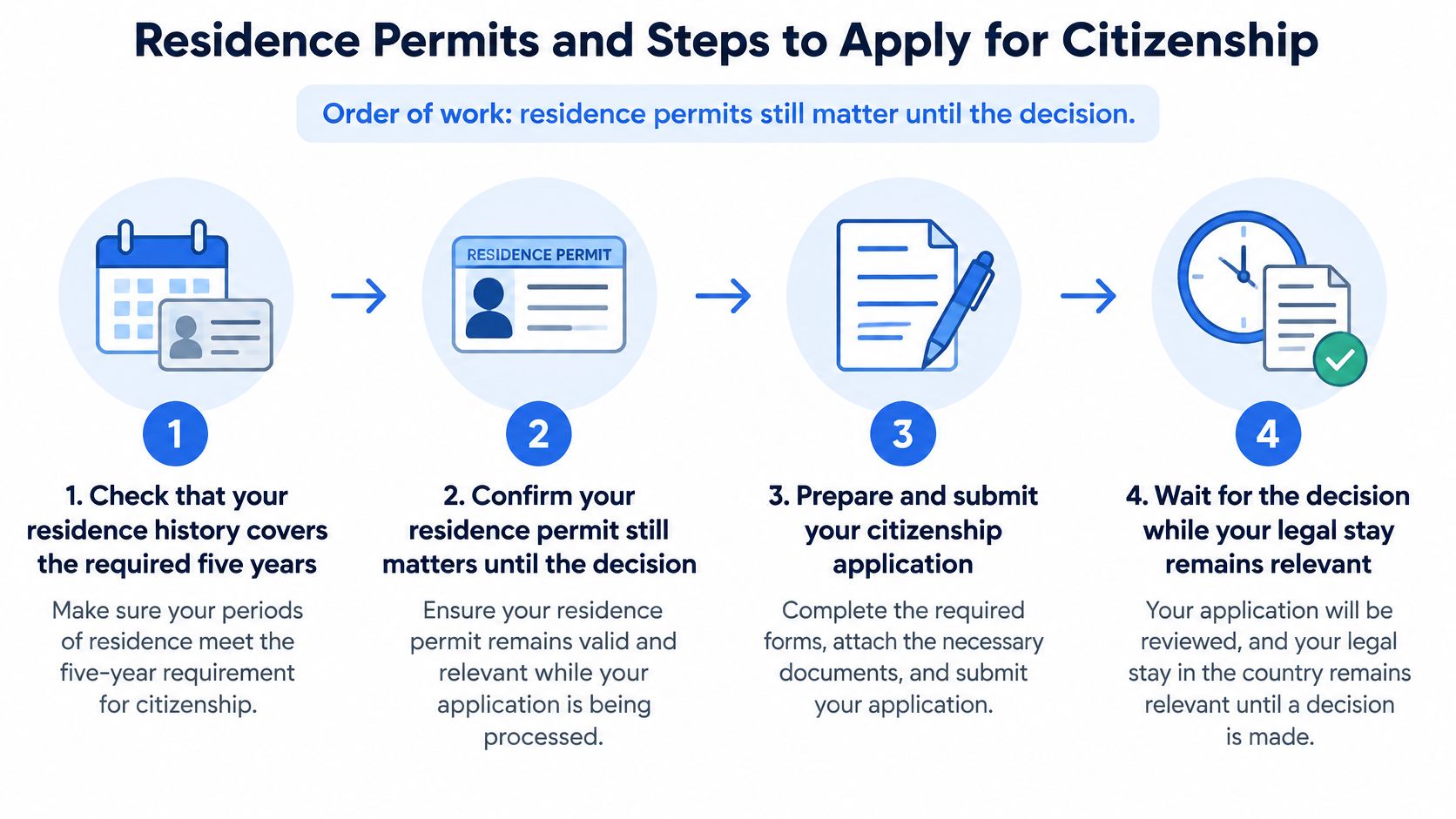
Order matters here. Your residence permit still governs your legal stay until the citizenship decision arrives.
Work through the steps in sequence. Skipping ahead usually creates the delay people blame on the office. For the full document list, filing office and timeline when you want to keep your existing nationality, follow the step-by-step process in how to get dual citizenship in Germany.
The Seven Steps in Order
- Check your residence history: Confirm it covers the required five years and your current permit stays valid. A gap between permits can break the record.
- Get the home country answer: Request written confirmation on whether you keep your citizenship. Filing before you have that answer puts the whole application at risk.
- Gather your documents: Collect your passport, residence permit, civil status records, income proof, health insurance proof, and language certificate. Watch for civil records that need a certified translation.
- File the application: Submit it to the local naturalization office for your place of residence. The guide on how to apply for German citizenship sets out the filing process in full.
- Attend appointments: Go to any interview or language test the office requests. Expect questions about your income and residence history, so bring records that match your application.
- Complete the final step: After approval, make the citizenship declaration and receive your certificate of naturalization. The passport application is a separate step and doesn’t happen on its own.
- Update home country records: Follow whatever notification or registration your first country requires. Skipping this can cause problems on your next trip home.
Why the Permit Still Matters
An application doesn’t replace your permit. Until the certificate is in your hand, your lawful stay still rests on your residence status.
Renew on time, every time. An expired permit can stall the file or end it.
Keep copies of every permit you’ve held. The office may ask you to prove continuity across several cards.
What a Complete File Looks Like
A complete file tells one clear story. Dates, addresses, permits, and income records all agree with each other.
Check these points before submission:
- Identity documents: Passport and civil records match in name and date of birth.
- Residence proof: Registration records cover the full period without gaps.
- Income proof: Payslips or tax records show you support yourself.
- Language proof: The certificate shows the required level.
- Translations: Foreign documents carry certified translations where required.
A passport may spell your name differently from your birth record. Explain the difference in a short note attached to the file instead of hoping nobody notices.
Small mismatches cause long questions. Resolve them before you submit, while you still control the timing.
A tidy file won’t guarantee approval. It does remove the avoidable reasons for delay, and that’s within your control.
Confirm Your Dual Citizenship Position Before You Apply
Make one decision before filing. Confirm your position with a written home country answer.
Bring these items to a first consultation:
- Passport: Your current passport.
- Residence permit: Your valid permit card.
- Residence summary: A dated list of your stay in Germany.
- Home country rule: The text on losing citizenship.
A German citizenship lawyer can test that material against the naturalization conditions. LegalWeg supports visa applications for German citizenship, Blue Card, permanent residence, and family reunion cases, and its legal team supports clients all over Germany.
Advice is available in English, German, and Russian. An assessment shows which route fits and what to fix first, such as a residence gap or an expiring permit.
Request the home country letter first. Its answer decides whether the rest of the file can proceed.
LegalWeg helps applicants prepare German citizenship and naturalization files, check residence and document problems early, and act when authorities don’t decide. If your home country answer is unclear, or your residence history has a gap, get that point assessed before you file. Visit LegalWeg to start with a clear view of your route.