
This article was written with the help of AI and has not yet been reviewed by our team.
Key Takeaways
- German family reunion law protects marriage and family. An unmarried partner of a German citizen or of a non-EU resident cannot get a family reunion visa, however long the relationship has lasted (§ 27 AufenthG).
- A registered partnership counts like a marriage (§ 27(2) AufenthG). Germany stopped registering new partnerships after 30 September 2017. A partnership registered abroad must be state-recognised and comparable to the German one.
- The main exception is the EU route. The unmarried partner (Lebensgefährte) of an EU or EEA citizen who habitually resides in Germany can apply for a right of residence. This applies if the couple has a durable relationship and will live together in Germany (§ 3a FreizügG/EU). It is a discretionary decision, not an automatic right.
- For that EU route, proof means objective documents: a joint lease or property, shared finances, joint loans or powers of attorney. Photos, chat histories and letters from friends are not enough on their own. Federal guidance names two years of living together as a guide.
- Everyone else has three practical options: marry (abroad, or in Germany with a marriage visa), get your own residence permit (work, study, Opportunity Card), or, if you have a German child together, apply as the parent of a German child (§ 28(1) AufenthG).
Table of contents
You have been together for years, and maybe you already live together. But you are not married.
Now one of you lives in Germany, or is about to move there. Can the other follow as family?
The answer depends on one thing more than anything else: the citizenship of the partner who lives in Germany.
This guide explains when German law treats a partner like a spouse and how the EU route for partners of EU citizens works.
It also shows which evidence works and what to do if you are not covered.
It is general information based on the law as of 15 November 2026, not legal advice for your individual case.
Need help with your family reunion visa?
From completing the documents to filing a lawsuit over the delay in results, our team can help.
Reach out to our team, and we’ll get back to you directly.
Can an Unmarried Partner Get a Family Reunion Visa for Germany?
Family reunion under the Residence Act (Aufenthaltsgesetz) is granted to protect marriage and family under Article 6 of the German Basic Law (§ 27(1) AufenthG).
The spouse rules for joining a German citizen (§ 28) or a foreign resident (§§ 29 to 31) apply to married couples.
The law extends those rules to registered life partners (Lebenspartner). For a registered partnership, §§ 28 to 31 apply in the same way (§ 27(2) AufenthG).
An unmarried couple without a registered partnership is not covered, even if the relationship is long and serious. German missions say this directly.
The German mission in Brazil, for example, states that opposite-sex partners in a marriage-like relationship (união estável) have no claim to a visa or residence permit.
A marriage valid under German law is needed (Auswärtiges Amt).
This applies whether the partner in Germany is a German citizen, a Blue Card holder, a skilled worker or holds a settlement permit.
For the general rules on who can join whom, see our guide to family reunification in Germany.
Registered Partnerships Abroad: Do They Count for a Partner Visa?
Since 1 October 2017, couples of the same sex marry in Germany. New registered partnerships can no longer be created.
Partnerships registered in Germany before that date continue (§ 1 LPartG).
A partnership registered under foreign law can count as a registered partnership for family reunion.
It must have been recognised by the state and, in its legal effects, correspond to the German registered partnership (Nr. 27.2.1 of the Allgemeine Verwaltungsvorschrift zum Aufenthaltsgesetz of 26 October 2009, GMBl 2009 S. 878; also summarised by Informationsverbund Asyl & Migration).
Lighter forms of partnership may not meet that test.
For EU free movement, federal guidance gives the French PACS as an example of a registered partnership that corresponds neither to marriage nor to the German registered partnership (BMI application notes, 22 January 2021).
If your partnership is a lighter form like this, do not assume the spouse rules apply. Ask the German mission before you apply.
EU Route for Unmarried Partners: How § 3a FreizügG/EU Works
The picture changes if the partner who habitually resides in Germany is a citizen of another EU country or of an EEA country (Iceland, Liechtenstein, Norway).
Their family is covered by the Freedom of Movement Act/EU (Freizügigkeitsgesetz/EU), not by the Residence Act.
That law has a separate category for “persons close to” an EU citizen (nahestehende Personen). It includes an unmarried partner.
Who Counts as an Unmarried Partner Under EU Free Movement Law?
The law defines the partner (Lebensgefährtin or Lebensgefährte) as a person with whom the EU citizen has entered into a credibly shown, lasting relationship.
That relationship excludes any other relationship of the same kind, and neither of the two is married or in a registered partnership (§ 1(2) no. 4(c) FreizügG/EU).
How the Authority Decides on an EU Partner Application
Such a partner can be granted the right to enter and live in Germany, on application.
The condition is that the EU citizen will live together with them in Germany not only temporarily (§ 3a(1) no. 3 FreizügG/EU).
The authority decides after a thorough examination of the personal circumstances (§ 3a(2)). This is discretion, not an automatic right like the one a spouse of an EU citizen has.
When the authority decides on that application, the general conditions in § 5(1), (2) and (4) of the Residence Act apply correspondingly (§ 11(5) FreizügG/EU).
In particular, the livelihood must usually be secure.
Our guide to family reunification requirements in Germany explains the income, housing and insurance conditions in general.
Unmarried Partner Residence Card: Validity and Work
If the right is granted, the partner receives a residence card for close persons.
As a rule, it is valid for five years, and the partner may work (§ 5(7) FreizügG/EU).
Applying for the EU Partner Visa at the German Mission
A partner from a country that needs a visa for Germany usually applies for the visa at the German mission first.
Missions ask “persons close to” an EU citizen for detailed evidence of the relationship (Auswärtiges Amt).
The German mission in Argentina sums up the difference. If your partner is an EU citizen, a partnership can be enough.
If your partner is German or of another nationality, a marriage certificate is required (Auswärtiges Amt, Buenos Aires).
Can the Unmarried Partner of a German Use the EU Route?
Usually not. A German citizen living in Germany is not covered by the EU route.
There is one exception.
The Freedom of Movement Act also applies to family members and close persons of Germans who have made lasting use of their EU free-movement rights (§ 1(1) no. 6 FreizügG/EU).
Federal guidance explains that this covers, for example, a partner who acquired a right of residence while living with the German citizen in another EU country.
The partner then moves to Germany with them (BMI application notes, 22 January 2021).
Whether your stay abroad was “lasting” enough is a question for an individual check.
How to Prove a Durable Relationship for an Unmarried Partner Visa
The Federal Ministry of the Interior has set out how authorities should assess a partner under the EU route (BMI application notes on the Freedom of Movement Act/EU, 22 January 2021).
The key points:
- Case-by-case assessment. The authority must look at the whole picture. Missing one piece of evidence does not automatically mean you are not partners.
- Two years of living together is a guide for a long-term shared household. A shorter period can be enough if other circumstances point to a lasting relationship.
- An official certificate is not required, and usually cannot be obtained. What counts is documentation that, taken together, makes the relationship credible.
Unmarried Partner Proof Checklist: Which Documents Help?
The guidance lists the kinds of documents that can help:
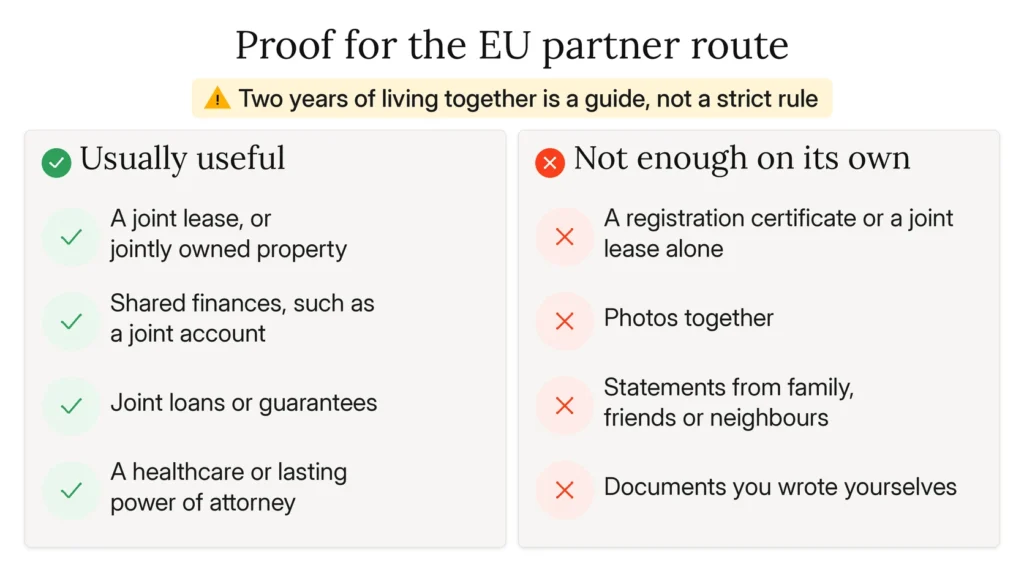
| Usually useful | Not enough on its own |
|---|---|
| A registered partnership abroad, such as a PACS | A registration certificate (Meldebescheinigung) or a joint lease alone |
| A joint lease, or jointly owned property | Photos together, for example from holidays or celebrations |
| Birth certificates or school documents showing you care for a child together | Statements from family, friends or neighbours |
| Bank statements, bills or contracts showing shared finances, such as a joint account | Documents you wrote yourselves, such as a self-made sublease signed only by the two of you |
| Joint loans or guarantees | Proof that you only run a business together |
| A healthcare or lasting power of attorney (Patienten- or Vorsorgevollmacht) naming the other partner | Evidence of an emotional or intimate relationship |
The same guidance says the authority should not ask for evidence of an emotional or intimate relationship. Questions about how you met or about your partner’s preferences are legally irrelevant.
Practical rule: Build your file on objective documents that show you share a household and stand in for each other financially and personally.
3 Options for Unmarried Partners of Germans and Non-EU Residents
Without a marriage or a registered partnership, there is no family reunion visa. You still have options:
Option 1: Marry, Then Apply for a Spouse Visa
You can marry abroad and then apply for a spouse visa. Or the partner abroad can apply for a visa to marry in Germany (Visum zur Eheschließung).
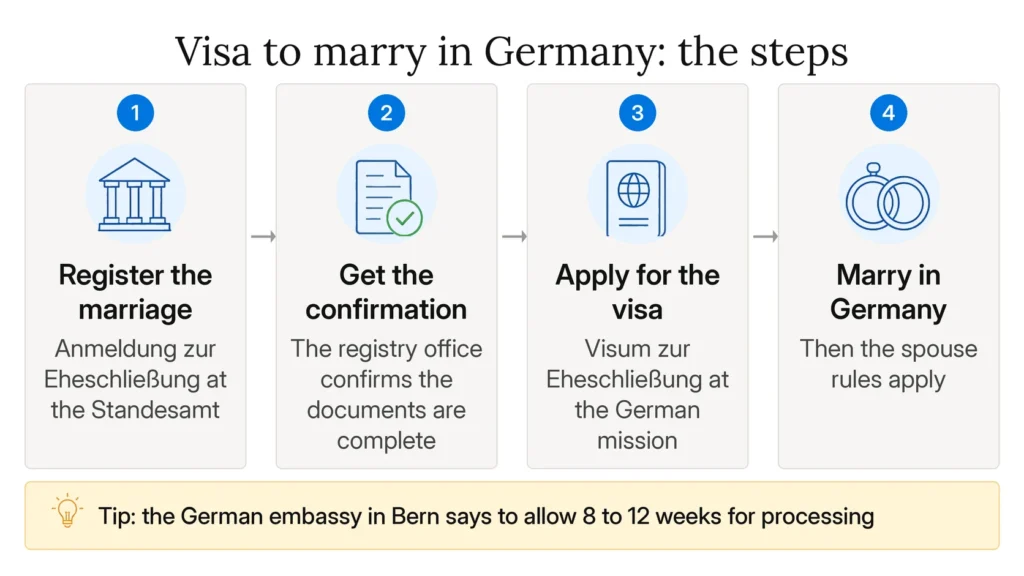
For a wedding in Germany, the couple first registers the intended marriage (Anmeldung zur Eheschließung) at the German registry office (Standesamt).
Once the registry office confirms that the documents are complete, the partner can apply for the marriage visa at the German mission (Auswärtiges Amt).
Because the couple will then live in Germany as spouses, the spouse rules apply. The German embassy in Bern, for example, asks for:
- the registry office’s confirmation
- proof of A1 German
- health insurance until the wedding
- copies of the partner’s passport, registration and, if applicable, residence permit in Germany
It says to allow 8 to 12 weeks for processing (Auswärtiges Amt, Bern). Each mission publishes its own list, so check the one responsible for you.
Simple German (A1) is generally required for spouses of Germans and of foreign residents.
There are exceptions, for example for spouses of Blue Card holders and skilled workers (§ 30(1) AufenthG; § 28(1) AufenthG).
The full requirements by sponsor are in our spouse visa checklist and our guide to spousal reunification.
If you are marrying a German citizen, see also how to marry a German.
For the paperwork, see our list of documents required for a family reunion visa.
A marriage entered into only to obtain a residence right does not give a right to family reunion (§ 27(1a) AufenthG).
Authorities may question both partners separately if they have doubts. A genuine relationship with a real history is the best protection.
Option 2: Get Your Own Residence Permit Instead of a Partner Visa
A partner who does not want to marry yet needs a permit on their own basis.
Common routes are a work permit (for example as a skilled worker), a student permit, or the Opportunity Card (Chancenkarte).
Each has its own requirements, and the relationship plays no role in the decision.
Our overview of the types of visas for Germany and our guide on how to get a residence permit in Germany explain the main routes.
Option 3: Residence Permit as the Parent of a German Child
An unmarried couple with a child who is a German citizen has a separate route.
The foreign parent of a minor, unmarried German child gets a residence permit to exercise parental custody (Personensorge) if the child lives in Germany (§ 28(1) sentence 1 no. 3 AufenthG).
A parent without custody can be granted one if the family already lives together in Germany (§ 28(1) sentence 4). Here, it does not matter whether the parents are married.
Can an Unmarried Partner Apply From Inside Germany?
Where your partner applies depends on the residence status they have now:
- On a national visa or residence permit (for example as a student or worker): they can stay on that permit. If you marry in Germany, they can usually apply to the foreigners authority (Ausländerbehörde) for a spouse permit without leaving the country (§ 39 no. 1 AufenthV).
- Visa-free or on a Schengen visa: applying from inside Germany is only possible in narrow cases, namely if the legal entitlement to a residence permit arose after entry (§ 39 no. 3 AufenthV). The entitlement must be complete, including any language requirement. Do not rely on this without checking your case first, because a wrong move can mean leaving and applying for a visa from abroad.
- Partner of an EU citizen: they apply to the local foreigners authority for the right of residence under § 3a FreizügG/EU, with the evidence described above.
Practical rule: Whatever the route, apply before the current permit or permitted stay ends. Late applications can leave a gap in lawful stay.
Unmarried Partner Visa Routes Compared: EU Route vs German Law
Find your situation in the left column. The table shows whether family reunion is possible and what to do.
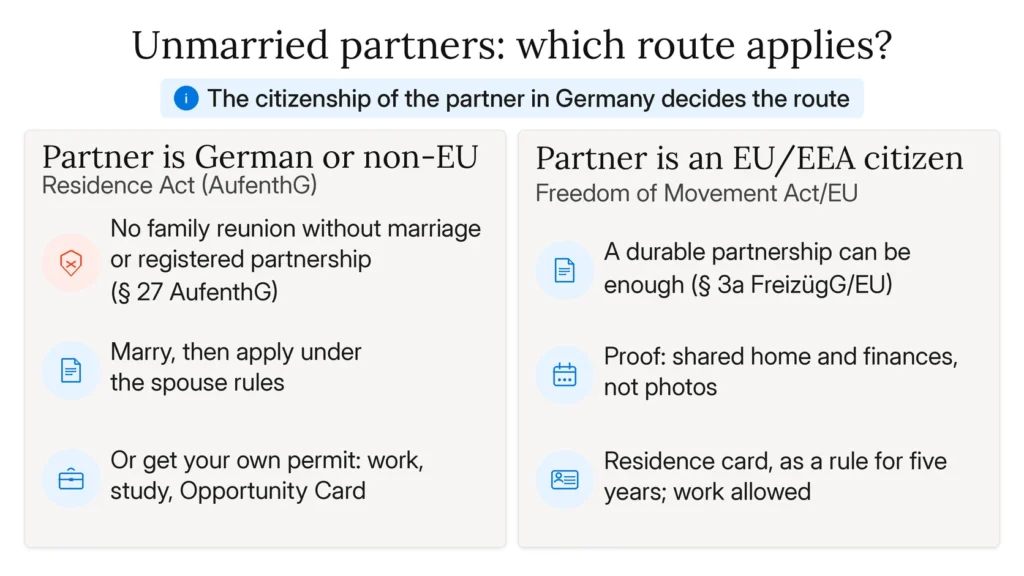
| Your partner living in Germany is… | Unmarried partner can join through family reunion? | What to do |
|---|---|---|
| A German citizen | No | Marry; get your own permit; or apply as the parent of a German child (§ 28) |
| A non-EU national with a permit (e.g. Blue Card, skilled worker, settlement permit) | No | Marry, then spouse rules (§§ 29 to 31); or own permit |
| An EU or EEA citizen who habitually resides in Germany | Possibly, as a close person | Apply under § 3a FreizügG/EU with proof of a durable relationship |
| A German who lived with you in another EU country | Possibly | Check whether § 1(1) no. 6 FreizügG/EU applies |
When to Get Legal Advice on a Partner Visa
Partner cases often turn on details:
- whether a foreign partnership is recognised
- whether your evidence is strong enough for the EU route
- whether an application from inside Germany is allowed
A refusal costs time, and some mistakes (such as entering on the wrong visa) are hard to undo.
If your situation is not clear-cut, have it checked before you book a wedding date or file an application. Our guide to immigration lawyer costs in Germany helps you plan.
If a visa application is pending for too long, see our guide on family reunion visa delays and on the failure to act lawsuit (Untätigkeitsklage) for a family reunion visa.
FAQ: Unmarried Partner Visa Germany
Is there a fiancé visa for Germany?
Germany has no visa just for being engaged. What exists is a national visa to marry in Germany and then stay.
You apply for it after the registry office has confirmed your registration of the marriage.
Do unmarried partners need two years of living together?
No. Under the EU route, federal guidance uses two years of living together as a guide.
A shorter period can be enough if other circumstances, such as a child together or shared finances, show a lasting relationship.
Do same-sex couples have different partner visa rules?
No. Married same-sex couples follow the spouse rules, and registered partners are treated like spouses. An unmarried same-sex couple is in the same position as any other unmarried couple.
Can an unmarried partner work in Germany under the EU route?
Yes, once the right of residence is granted. The partner receives a residence card for close persons, as a rule valid for five years, and may work (§ 5(7) FreizügG/EU).
Sources
- § 27 AufenthG: principle of family reunion; registered partners (para. 2); sham and forced marriages (para. 1a)
- § 28 AufenthG: family reunion with Germans, including the parent of a minor German child
- § 30 AufenthG: spouses of foreign residents, including the German-language requirement and exceptions
- § 39 AufenthV: obtaining a residence title from inside Germany
- § 1 LPartG: no new registered partnerships after 30 September 2017
- § 1 FreizügG/EU: scope, including Germans who used free movement (para. 1 no. 6), and the definition of a partner (para. 2 no. 4(c))
- § 3a FreizügG/EU: residence of persons close to an EU citizen
- § 5 FreizügG/EU: residence card for close persons, five years, work allowed (para. 7)
- § 11 FreizügG/EU: corresponding application of the Residence Act, including the general conditions in § 5(1), (2) and (4) AufenthG in cases under § 3a (para. 5)
- Federal Ministry of the Interior, application notes on the amended Freedom of Movement Act/EU, 22 January 2021, Version 1.0 (official BMI PDF), section 3.1.5.3 on partners
- Auswärtiges Amt: FAQ on marriage, including the visa to marry in Germany
- German Embassy Bern: visa to marry in Germany (documents and processing time)
- German Embassy Buenos Aires: visa FAQ on civil unions and family reunion
- German Missions in Brazil: spouse visa and marriage-like relationships (união estável)
- Allgemeine Verwaltungsvorschrift zum Aufenthaltsgesetz of 26 October 2009 (GMBl 2009 S. 878), Nr. 27.2.1: a foreign registered partnership must be state-recognised and correspond in its legal effects to the German registered partnership
- Informationsverbund Asyl & Migration: spouse reunion, including registered partnerships formed abroad (Nr. 27.2.1 AVwV-AufenthG) (readable summary)