
The usual advice about a visa application form starts too late: fill every box carefully, then sign. For Germany, the first question is whether the applicant has opened the right system at all.
A perfectly typed form can still belong to the wrong kind of stay. The safer approach is process control: choose the route, assemble the evidence, and complete the handoff that makes the application ready for review.
Table of Contents
- The Right German Visa Application Form
- Fields and Documents to Check Before You Sign
- How to Complete VIDEX for a Short Stay
- How National Visas Move Through the Portal
- Mistakes That Delay or Return a File
- When to File Yourself or Ask for Help
The Right German Visa Application Form
A traveller prints a completed form for a move to Germany, then discovers that it belongs to a short visit. The problem isn’t handwriting or missing information, but the filing route.
Germany doesn’t use a single visa application form for every purpose. The Federal Foreign Office’s visa forms guidance distinguishes printed Schengen applications from national category D forms and directs applicants to follow the responsible mission’s requirements.
Which German form matches your stay
| Purpose | Maximum stay | Form or system | Still required in person |
|---|---|---|---|
| Tourism, business, or a private visit | Up to 90 days | VIDEX Schengen form, then print | Signed form, passport, evidence, and fingerprints |
| Employment, study, or training | More than 90 days | Consular Services Portal, national category D | Originals and biometrics after online filing |
| Family reunification | More than 90 days | Portal category, with group applications from November 2025 | Relationship evidence and biometrics |
| EU Blue Card | More than 90 days | National employment category on the portal | Contract, qualification evidence, and biometrics |
| Family member of an EU, EEA, or Swiss citizen, short stay | Up to 90 days | Harmonised form with several starred fields excluded | Proof of the family link and the travel document |
The long-stay entries describe the route for the intended stay, not a guaranteed maximum validity printed on a visa. The permission granted must be checked separately from the form selected.
Contact us for immigration support
Have a question about your visa, citizenship, or immigration case?
Contact our team, and we’ll get back to you directly.
Purpose comes before the questionnaire
A professional visiting a business meeting isn’t necessarily applying through the same route as a professional moving to take up employment. An invitation from a company doesn’t make those purposes interchangeable.
The same distinction matters for families. Visiting a spouse temporarily and relocating to live with that spouse require different preparation.
Applicants comparing types of visas for Germany should identify the actual activity first. A familiar category name isn’t enough if the intended activity belongs elsewhere.
- Temporary visit: The file explains the visit and the planned departure.
- Relocation: The file establishes the legal purpose of living in Germany.
- Special family status: The applicant checks whether the harmonised form excludes particular starred fields.
The mission determines the usable route
National forms are available in several language versions, including German-English. Availability doesn’t mean that every downloadable version is the correct starting point for every mission.
Applicants should distinguish a form-preparation screen from an application-submission system. Completing questions online doesn’t, by itself, establish that the supporting file has reached the authority responsible for deciding it.
Before typing, the applicant should confirm which German mission covers the place of residence. That mission’s current category instructions should determine the next step.
Fields and Documents to Check Before You Sign
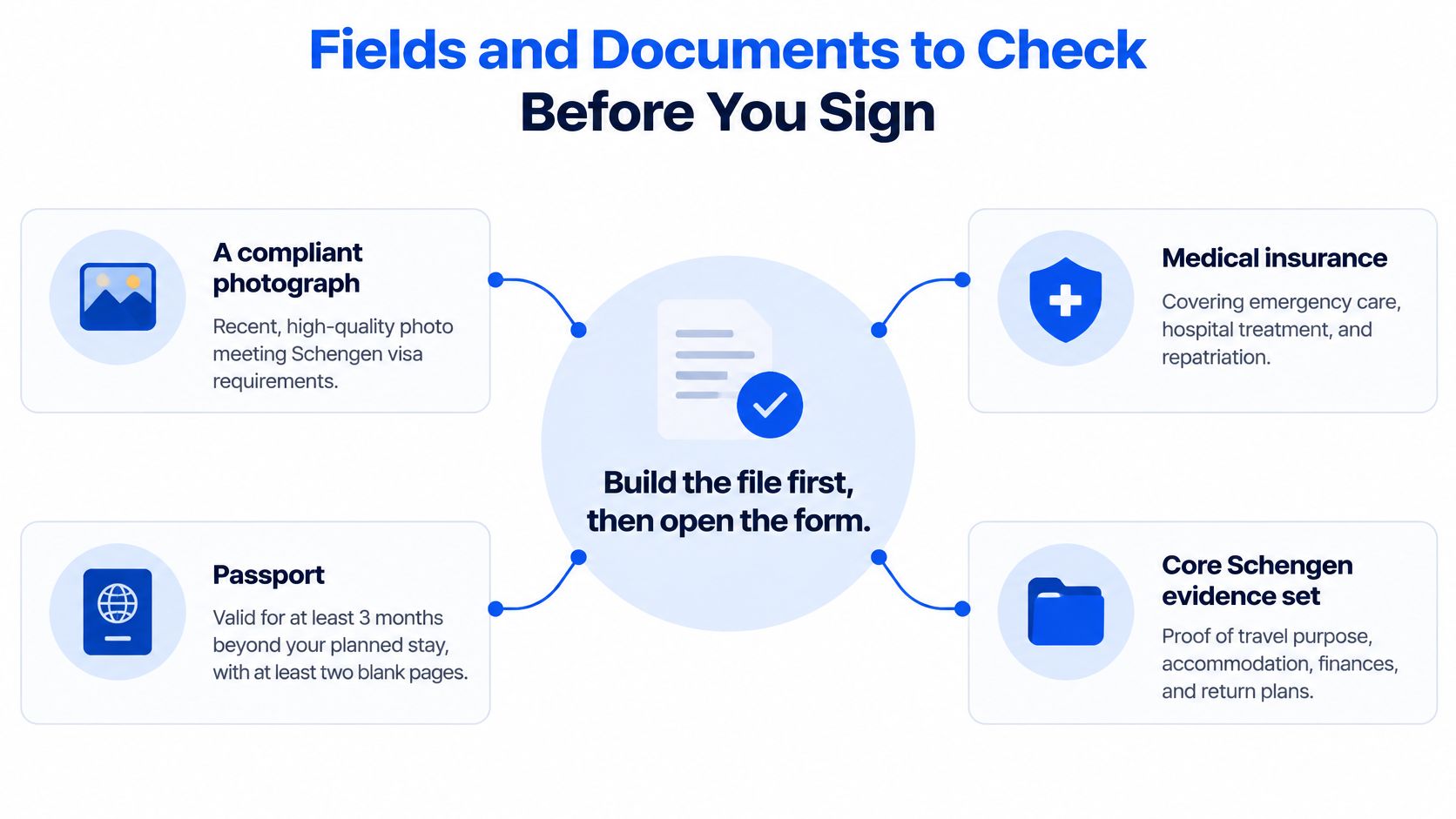
Build the file first, then open the form. Otherwise, applicants can end up answering from memory and later discovering that the documents describe a different trip.
The harmonised EU application form and guidance require fields 1–3 to match the travel document exactly. The form also records the information needed to connect identity with the proposed journey and supporting evidence.
Assemble the evidence before entering answers
For an ordinary Schengen application, the core preparation set includes the following items. The mission’s purpose-specific checklist determines what evidence is acceptable.
- Compliant photograph: The image must meet the applicable application requirements.
- Medical insurance: The cover must include emergency care, hospital treatment, and repatriation.
- Purpose evidence: An invitation or a documented business reason should explain why the journey is taking place.
- Proof of funds: The financial evidence should support the stated source of payment.
- Accommodation evidence: The file should establish where the traveller will stay.
- Return intention: Supporting documents should explain the intended return after the visit.
- Fingerprints: These form part of the process in ordinary cases, rather than a document uploaded from home.
National applications need evidence matched to the intended residence purpose. Applicants shouldn’t copy a tourist checklist and add a job title.
An employment file needs the contract and relevant qualification evidence. A study file needs admission evidence and proof of the means to live in Germany.
For family reunification, the central documents establish the relationship and the sponsor’s status. The family reunion visa document guide helps applicants organise that purpose-specific file.
Need help with your family reunion visa?
From completing the documents to filing a lawsuit over the delay in results, our team can help.
Reach out to our team, and we’ll get back to you directly.
Identity and passport details
The passport is the master record. Names shouldn’t be copied from an old flight booking if that booking uses a shortened or different spelling.
Identity checking should cover:
- Names: Compare every character with the travel document.
- Passport number: Distinguish similar-looking letters and digits.
- Document details: Check the document type and issuing country.
- Nationality: Separate current nationality from any former nationality requested.
- Dates: Verify birth, issue, and expiry dates in the format the form requests.
Applicants whose names were originally written in another alphabet should follow the passport’s recorded spelling. An independently chosen transliteration can create a mismatch even when it sounds the same.
A translation also needs to identify the same person consistently. If an underlying document uses a different name, the applicant should establish the connection through appropriate evidence rather than rewriting it.
Travel dates and destination
The itinerary should be settled enough to support the dates entered. A booking saved during early planning shouldn’t remain the source for a later, revised application.
The main destination and the first-entry state are separate questions. Arriving through another country doesn’t automatically make that country the destination of the trip.
For example, a traveller may enter through an airport outside Germany before continuing to a German host. The form should reflect the actual route without disguising where the visit will take place.
A simple comparison sheet can prevent date errors:
| Form entry | Document to compare |
|---|---|
| Intended arrival | Travel schedule and first accommodation |
| Intended departure | Return plan and final accommodation |
| Destination | Purpose evidence and itinerary |
| Accommodation dates | Reservations or host confirmation |
Purpose, employment, and payment
The stated purpose should agree with what the applicant will do. A business invitation shouldn’t be used to conceal a plan to start employment.
Employment answers also need careful separation. The applicant’s present employer isn’t automatically the organisation inviting the applicant to Germany.
For payment questions, the file should make the funding arrangement understandable. If a host pays for accommodation while the applicant pays for travel, the answers should reflect that division.
Bank documents shouldn’t contradict the explanation of who bears the costs. A sponsor’s support should be documented where the mission requires it.
Accommodation and inviter information
A hotel reservation and a private invitation identify different kinds of accommodation. Applicants shouldn’t force a host’s details into hotel fields merely because that screen appears familiar.
The following details deserve a direct comparison with the final supporting document:
- Name: The hotel, host, or inviting organisation.
- Address: The actual location associated with the stay.
- Contact details: A usable contact matching the evidence.
- Dates: The period covered by the reservation or invitation.
Scans must be complete and readable. Cropped edges, missing reverse pages, or blurred stamps can prevent a reviewer from checking the document.
Foreign documents should follow the mission’s translation or legalisation requirements. A clear scan doesn’t replace a required translation or authentication.
Before signature: The passport, bookings, insurance, and financial or employment evidence should describe the same application.
The signature turns the entries into a declaration. Applicants should hold the signature and final upload until discrepancies have been resolved.
How to Complete VIDEX for a Short Stay
VIDEX prepares the data; the mission receives the legally effective file. The German Missions’ VIDEX instructions describe its use for Schengen stays of up to 90 days.
Prepare the screen inputs
Check passport eligibility before starting. The passport must generally remain valid for at least three months after the planned trip and have been issued within the preceding ten years, not merely extended.
Gather the source documents. The working set should contain the travel document, travel schedule, German address, hotel reservation, and invitation information.
Enter identity from the passport. An old booking may contain an abbreviated name that shouldn’t be carried into the application.
Set the route and travel dates from the current reservations. Draft dates from an earlier plan can create conflicts with the evidence submitted later.
A technically correct screen can’t repair an ineligible passport. Passport replacement should therefore be resolved before applicants build the application around its number.
The full evidence set belongs alongside the screen inputs, not in a separate last-minute search. The document checks above provide the preparation framework without turning data entry into guesswork.
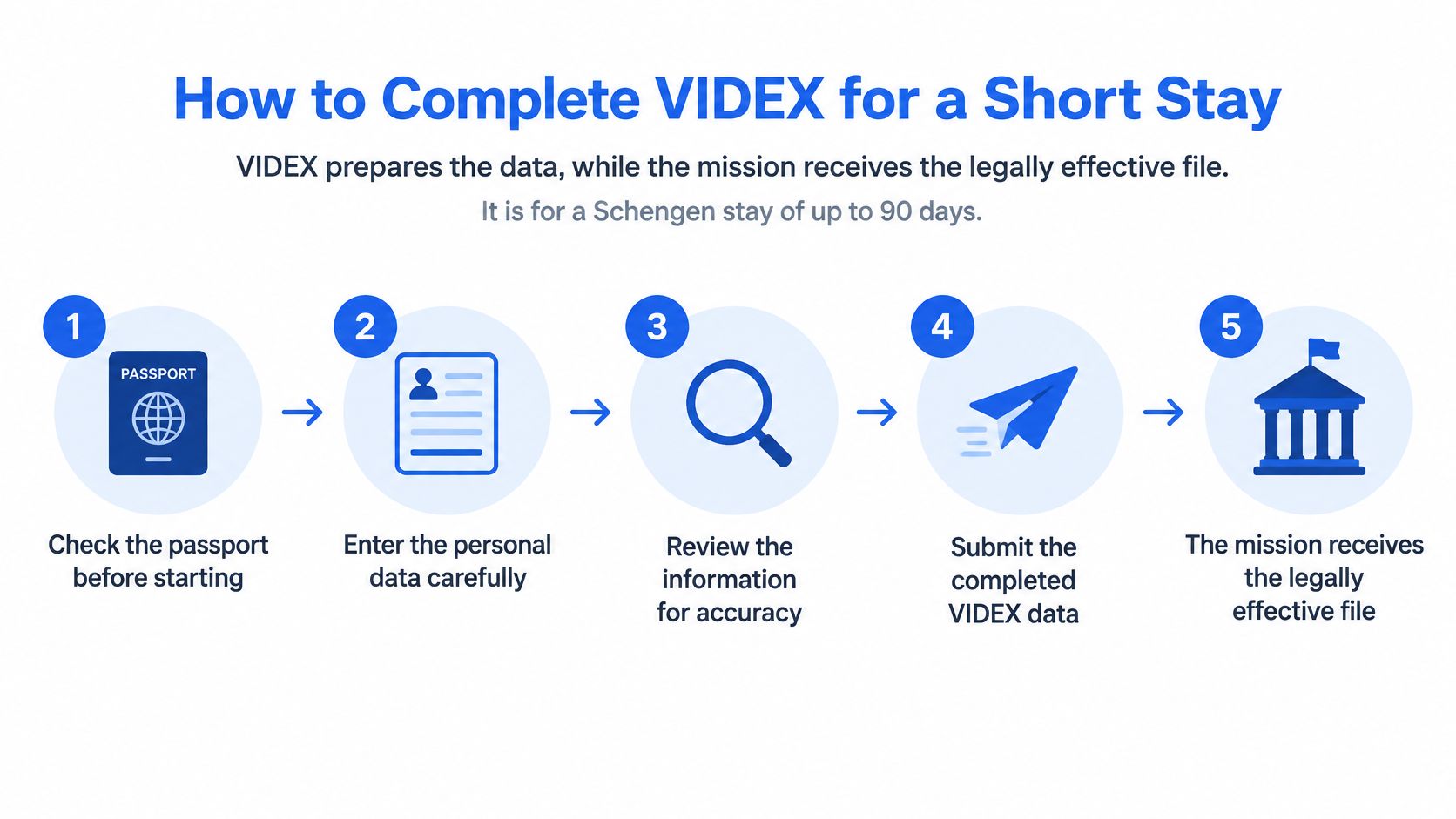
Review the generated application
Check the special family-member instructions. Several starred fields don’t apply to qualifying family members of EU, EEA, or Swiss citizens.
Print the generated application and barcode output. The printed record should come from the final reviewed version, not an earlier saved draft.
Sign every required declaration. Applicants should inspect the complete output rather than assuming that signing the main page covers every declaration.
Present the signed application with the complete file to the competent German mission. The appointment brings together the printout, original documents, and ordinary fingerprint collection.
A flight change after printing deserves another comparison. The concern isn’t just whether the paper remains neat, but whether the encoded information and supporting itinerary still agree.
Applicants should retain a copy of the version prepared for submission. That gives a reliable reference if the mission later asks about an entry.
A printed barcode is a handoff tool, not confirmation that the visa has been granted or that every document has been accepted.
Before the appointment, the applicant should compare the printout against the passport once more. The final check should also confirm that no page or declaration was lost during printing.
The appointment instructions determine how the file is presented. An applicant shouldn’t substitute a screenshot or an unfinished online record for the required printed output.
How National Visas Move Through the Portal
Unlike VIDEX’s print-and-present workflow, the Consular Services Portal supports online national-visa filing. The Federal Foreign Office’s digital visa announcement describes the rollout of 28 national-visa categories across all 167 overseas missions on 1 January 2025.
The categories cover employment, study, training, and family reunification. More than 100,000 applicants used the platform in its first year, and group applications became possible from November 2025.
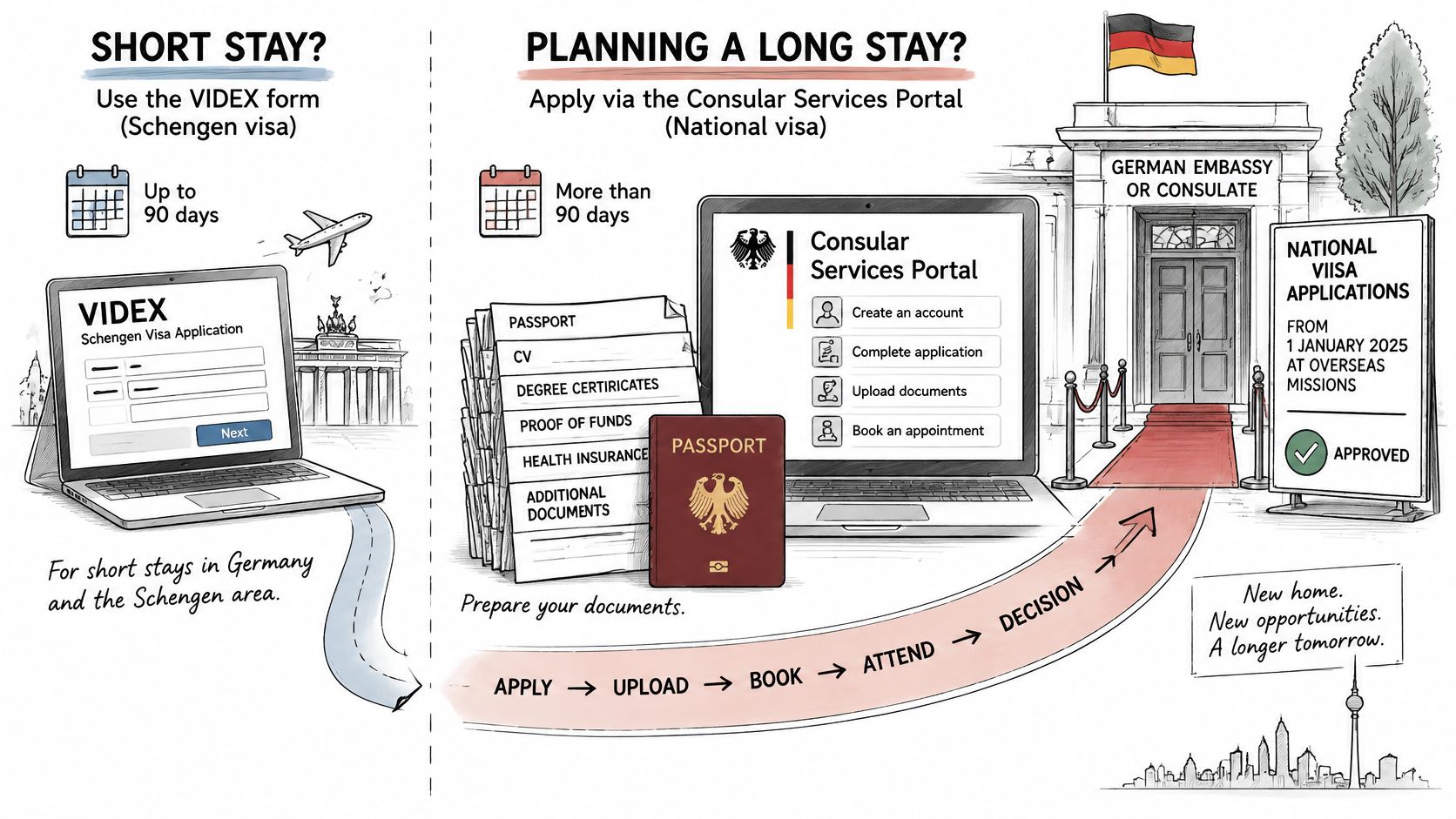
Category selection is a legal decision
A qualified professional may see several employment-related labels. The right choice follows the actual eligibility route, not whichever label appears closest to the job title.
An applicant considering the Blue Card should establish the applicable EU Blue Card requirements in Germany before building the online file. Selecting a category doesn’t establish eligibility for it.
A complete set of fields can still be the wrong application.
Digitisation shifts the work rather than removing it. Applicants still need to control the relationship between the selected category and the documents uploaded.
Family filing adds another decision. Where the portal supports linked or group records, a spouse or child should be connected through the appropriate workflow rather than treated as an unrelated application.
Applying for an EU Blue Card in Germany?
We handle your EU Blue Card from the first check to a lawsuit over any delay.
Tell us about your case, and we’ll get you through the next step.
Online submission leaves a physical handoff
Readable uploads matter because the reviewer must be able to inspect the evidence. Applicants should open each uploaded file and check its contents, not rely on the filename alone.
- Document quality: Every relevant page should be visible and correctly oriented.
- Originals: Original documents should remain available for the mission’s checks.
- Biometrics: Online filing doesn’t cancel the personal biometric stage.
- Representation: Applicants should confirm the mission’s representative procedure before assuming another person can operate the case.
An uploaded file isn’t necessarily an accepted document. A submission confirmation also shouldn’t be read as confirmation that the mission needs nothing further.
If a name or date is wrong after submission, the applicant should use the correction route supplied by the mission. Starting another application without explaining the existing record can make case management harder.
Schengen applications aren’t accepted through this same national online process. Online completion of a short-stay form shouldn’t be mistaken for portal filing.
The expected handoff remains concrete: online submission, followed by the required originals and biometrics. The mission then reviews the case, with involvement from the relevant authority in Germany where needed.
Mistakes That Delay or Return a File
German missions process an enormous volume of visa applications each year. At that scale, applicants benefit from identifying the kind of error before deciding how to correct it. Whatever the mission, the same fields cause most returns: names, passport numbers, travel dates, mandatory answers, and document clarity.
Classify the problem before acting
The severity of an error decides the fix. A one-letter typo in a surname can often be corrected before signing. A passport issued too long ago cannot be fixed by any amount of typing, and filing a long stay on a short-stay form sends the file down the wrong route entirely.
What to do with each kind of form error
| Severity | Example | Safest next action |
|---|---|---|
| Clerical | One letter or digit differs from the passport | Correct it before signing, or ask the mission how to amend it |
| Documentary | Form date differs from the contract, invitation, or appointment | Rebuild the form from the final documents |
| Eligibility | Passport was issued more than ten years ago or expires too soon | Replace the passport before filing |
| Jurisdictional or category | Long stay entered on a Schengen form, or filed at the wrong mission | Stop and use the competent mission and category |
Timing changes the response. Entries in a working file can still be edited before signing; once the mission holds the record, changes go through its own procedure.
A documentary conflict adds a second step: deciding which document is authoritative. Changing the form to match an outdated invitation only moves the inconsistency somewhere else, so the form should always be rebuilt from the final, current evidence.
A blank field needs a reason, not a guess
Form systems generally separate required fields from optional ones. A required answer left missing typically triggers a correction request, while an unanswered optional field does not usually invalidate the application on its own.
The exact rules vary by mission and visa type, so the first question remains the same: is this field required, excluded, or inapplicable?
- Mandatory answer unavailable: The applicant should obtain the information or seek procedural clarification.
- Field not applicable: The applicant should follow the form’s instructions for recording that position.
- Document not yet issued: The applicant shouldn’t invent its date or reference number.
- Conflicting records: The applicant should reconcile the evidence and explain any unavoidable discrepancy.
If the mission allows an explanatory attachment, it should identify the missing item clearly. An explanation doesn’t guarantee that the application can proceed without the document.
Where filing requires evidence that doesn’t yet exist, waiting for it may be safer than submitting an unsupported answer. A fabricated date creates a more serious problem than an openly explained gap.
Applicants who run into recurring immigration issues in Germany benefit from separating mechanical corrections from questions about the legal route. A revised entry fixes the first; only the right category and mission fix the second.
When to File Yourself or Ask for Help
Self-filing is reasonable when the stay type is clear, and the evidence is consistent. The applicant should also be able to identify the competent mission without guessing.
A practical self-filing test
- Purpose: Is the proposed activity clearly a short visit or a longer residence purpose?
- Passport: Does the travel document pass the applicable validity and issue-date checks?
- Consistency: Do the form and final supporting documents agree?
- Responsibility: Does the chosen mission cover the applicant’s place of residence?
An uncertain answer is a reason to pause. The applicant shouldn’t use successful screen completion as a substitute for resolving the uncertainty.
Extra care is warranted when family records need linking or a previous file came back with inconsistent entries. A category dispute also needs more than proofreading.
Get support on your visa or citizenship application
Filing a visa or citizenship application alone can get overwhelming fast. You don’t have to go through it by yourself.
Get full support from an immigration lawyer, from finding the right forms to getting a final decision.
Help should resolve a specific obstacle
Applicants can prepare focused questions for an immigration lawyer by identifying the disputed category or conflicting documents. A useful question explains what prevents filing, rather than asking only whether a form looks complete.
LegalWeg offers a free case assessment, requested through the form on its contact page. After clients submit their documents, LegalWeg prepares and files the visa application and handles the process through the final decision.
Before signing, the applicant should confirm the matching filing route and assemble the final evidence. If the form and file still disagree, an assessment should come before another application.
LegalWeg helps applicants turn their documents into a prepared and filed German visa application, with handling through the final decision. Applicants uncertain about the correct form or supporting evidence can visit LegalWeg and request a free case assessment through the contact-page form.