
A multiple-entry visa lets a traveler seek entry again during its printed validity, but it doesn’t raise the stay limit. For a Schengen visa, that limit stays at 90 days in any 180-day period.
A traveler opens a passport and sees a visa valid for several years. The natural next step is to book a long stay in Germany.
That step is where trouble often starts. The visa has three separate clocks, and they don’t move together.
One clock covers validity, which is the calendar window for travel. Another covers the number of entries, and the third covers days of stay.
Reading only the longest date creates a false plan. Reading all three clocks shows what is allowed.
Table of Contents
- What Multiple Entry Visas Actually Allow
- How the 90 Day Rule Counts Your Stay
- Who Gets a Longer Multiple Entry Visa
- Choosing Between a Schengen Visa and a German National Visa
- Documents You Need Before You Apply
- Travel Patterns That Raise Questions
What Multiple Entry Visas Actually Allow
Say a traveler sees multiple entries on a Schengen visa and plans a six-month stay. That plan should stop at once.
Multiple entry visas give permission to seek entry more than once during the printed validity. They don’t give permission to reside.
Read the Sticker in Order
The German Federal Foreign Office guide on length of stay explains that a German Schengen visa can authorize one entry, two entries, or multiple entries. The sticker also specifies the visa’s validity period and the number of days allowed during that period, with a maximum short-stay allowance of 90 days in any rolling 180-day period.
The entries field answers one narrow question. It tells the traveler how many times entry may be sought.
- Single entry: One entry, then the visa is used up for entry purposes
- Two entries: Two entries within the printed dates
- Multiple entries: Repeated entries within the printed dates
The validity field answers a different question. It shows the first and last date when travel may happen.
The duration field answers the third question. It shows how many days the traveler may stay.
Those fields must be read together. A long validity window doesn’t cancel a short day limit.
Practical rule: Multiple means the door may be approached again. It doesn’t mean the room may be occupied without limit.
Compare the Common Visas
A German national visa belongs in the same comparison for one reason. It is the route meant for a stay longer than 90 days, usually followed by a residence permit.
| Visa | Validity | Entries | Stay limit |
|---|---|---|---|
| Schengen single-entry C | Dates printed on the sticker | 1 | Up to 90 days in any 180-day period |
| Schengen two-entry C | Dates printed on the sticker | 2 | Up to 90 days in any 180-day period, combined |
| Schengen multiple-entry C | Up to 5 years | Multiple | Up to 90 days in any 180-day period |
| Cascade one-year multiple-entry | 1 year | Multiple | Up to 90 days in any 180-day period |
| Cascade two-year multiple-entry | 2 years | Multiple | Up to 90 days in any 180-day period |
| Cascade five-year multiple-entry | 5 years | Multiple | Up to 90 days in any 180-day period |
| German national visa D | Set by the mission, often months | Often one entry to take up residence | Longer than 90 days, then a residence permit |
Every Schengen row carries the same stay ceiling. Only the entry count and the calendar window change.
A border officer still decides each admission. An unexpired visa doesn’t force the officer to admit the traveler.
The officer can check the purpose of the trip. The officer can also check funds, accommodation, and onward plans.
That check matters on the tenth trip as much as on the first. Earlier smooth entries don’t guarantee the next one.
Before booking, the traveler should write down three items. The list below keeps them separate.
- Entries: The number printed on the sticker
- Validity: The first and last travel dates
- Days: The stay allowance printed on the sticker
If one item is unclear, booking should wait. A flight date can’t fix a visa that doesn’t cover it.
A five-year visa therefore offers flexibility, not residence. It suits repeated short trips spread across a long calendar window.
Contact us for immigration support
Have a question about your visa, citizenship, or immigration case?
Contact our team, and we’ll get back to you directly.
How the 90 Day Rule Counts Your Stay
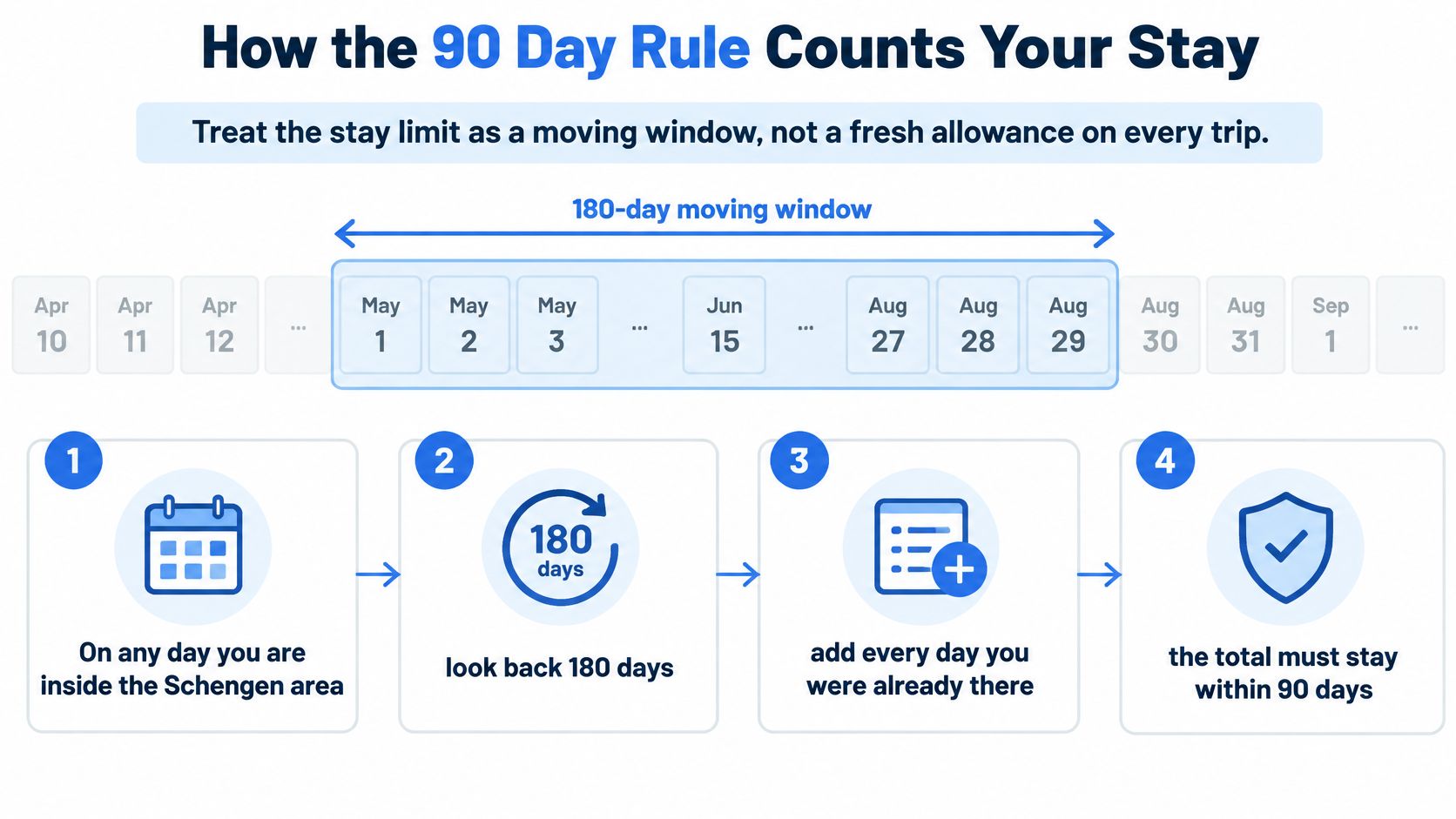
Treat the stay limit as a moving window, not a fresh allowance on every trip. That single shift prevents most counting errors.
Count Backwards From Today
On any day inside the Schengen area, the traveler looks back 180 days. Every day already spent inside during that window is added up.
The total can’t pass 90 days. If it does, the stay is too long.
The German Federal Foreign Office guidance on long-valid Schengen visas states that each visit remains subject to the combined limit of 90 days in any 180-day period. It also states that the calculation applies across the entire Schengen area, not separately to Germany and each other Schengen country, and that longer validity does not increase the total short-stay allowance.
Days in different Schengen countries share one balance. They aren’t separate national allowances.
- Germany: Counts toward the shared balance
- France: Counts toward the same balance
- Spain: Counts toward the same balance
- Every other Schengen country: Counts toward the same balance
Crossing an internal border doesn’t reset anything. The traveler is still inside the same counting zone.
| Pattern | Days counted | What still applies | Result |
|---|---|---|---|
| One continuous stay | 90 | Must leave when the balance is used | No days left until older days fall outside 180 |
| Two or more short trips | Every day in the look-back window | Gaps do not erase recent days | Combined days cannot pass 90 |
| Days split across Schengen countries | France, Germany, Spain, and the rest together | One shared balance | Changing country does not reset the count |
| Repeat entry after leaving | Days from the earlier trip still in the window | Length of the gap does not erase them | Next trip must fit the remaining balance |
Work Through One Example
Say a traveler spends 60 days in Germany from 1 March to 29 April. Those dates create a clear starting balance.
On 1 June, those 60 days are still inside the 180-day look-back window. That leaves 30 days.
A stay from 1 June to 30 June uses those 30 days. The total inside the window then reaches 90 days.
A longer June stay would break the limit. Leaving for a few days in between wouldn’t erase the March and April days.
The window must be counted from the planned entry day. Counting from the booking day gives the wrong answer.
A five-year visa widens the calendar for trips. It doesn’t add a single day to the 90-day balance.
Older days only stop counting when they fall outside the window. That happens gradually, day by day, not all at once.
Staying past the balance carries real risk. An overstay can affect the next border check and later visa applications.
A traveler who entered without a visa faces the same counting discipline. The rules for a residence permit after visa-free entry to Germany depend on staying inside the lawful short-stay window first.
The safe habit is simple. Entry and exit dates go on one calendar before the return flight is booked.
That calendar should cover the whole Schengen area. A Germany-only calendar hides days spent elsewhere.
Who Gets a Longer Multiple Entry Visa
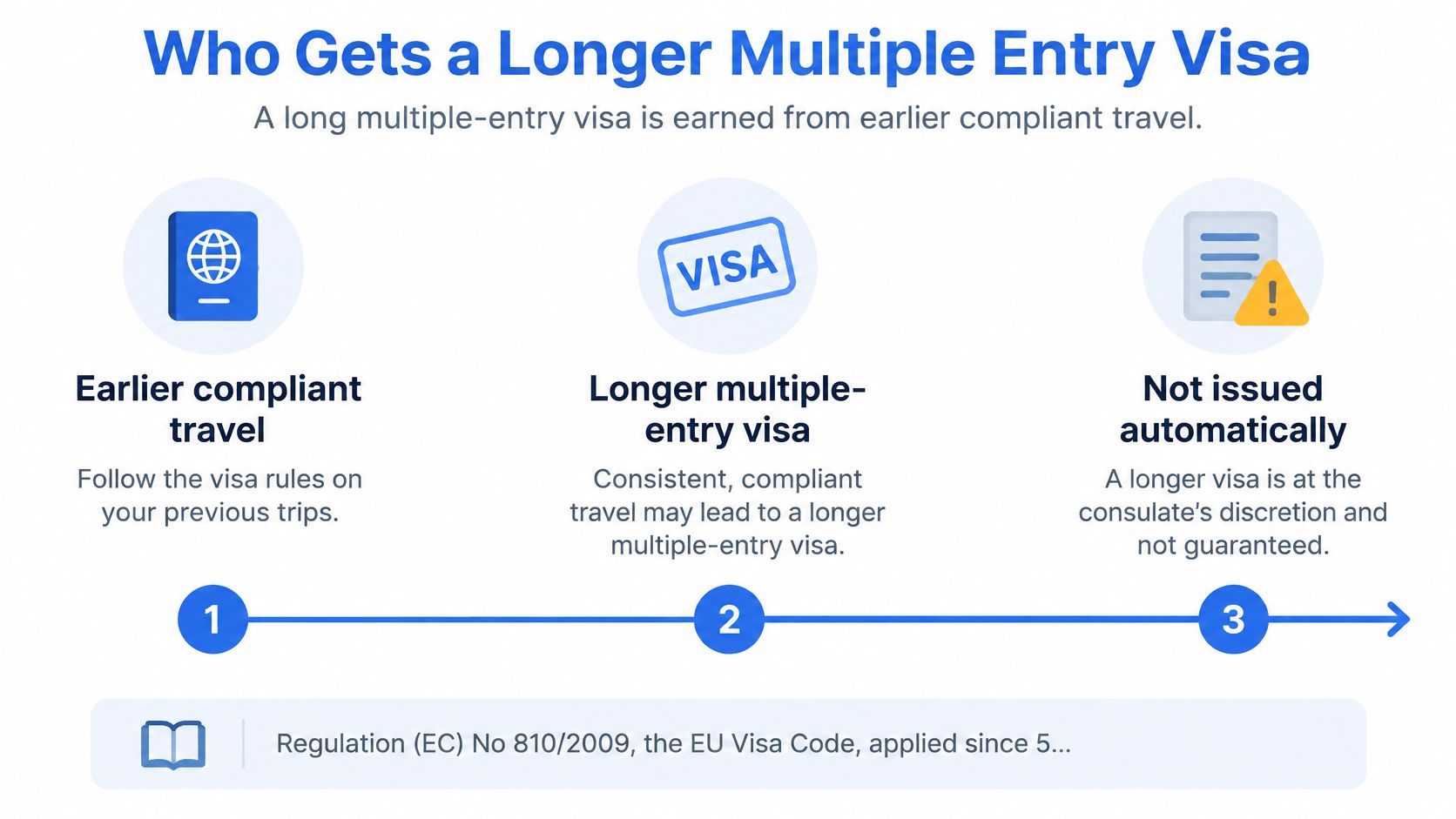
A traveler with several Schengen visas used correctly has a stronger case for a longer multiple-entry visa. The EU Visa Code sets out a step-by-step route, though the issuing mission still assesses each application.
The Cascade in the EU Visa Code
The EU Visa Code describes how an applicant’s record can support progressively longer visas. The table shows the typical cascade:
| Visa granted | Prior record needed | Look-back window | Maximum validity |
|---|---|---|---|
| One-year multiple-entry | Three visas used | Previous 2 years | 1 year |
| Two-year multiple-entry | One-year multiple-entry used lawfully | Previous 2 years | 2 years |
| Five-year multiple-entry | Two-year multiple-entry used lawfully | Previous 3 years | 5 years |
Each step builds on the previous one. Lawful use means following the visa’s purpose and staying within the permitted duration.
For example, business travel should remain business travel. Using repeated visits to live in Germany would not show that the visa was used as intended.
The German Mission Test
The German Federal Foreign Office FAQ on annual and multi-annual visas says these visas are generally issued to people who have visited Germany or other Schengen countries several times and are considered particularly trustworthy.
The mission looks at the applicant’s travel history and circumstances in their country of residence. Earlier Schengen visas and entry or exit stamps can show compliant travel, while evidence of work, housing, or other ties can help demonstrate a stable home base.
Prepare copies of:
- Earlier Schengen visas
- Entry and exit stamps showing when previous trips ended
- Documents showing work, housing, or other ties in the country of residence
Meeting a cascade condition does not guarantee a particular visa length. The mission decides the visa type and validity period after reviewing the application.
A request for a five-year visa can result in a shorter visa instead. Gather the travel records before renewing or replacing a passport, so the earlier visa history is easier to document.
Choosing Between a Schengen Visa and a German National Visa
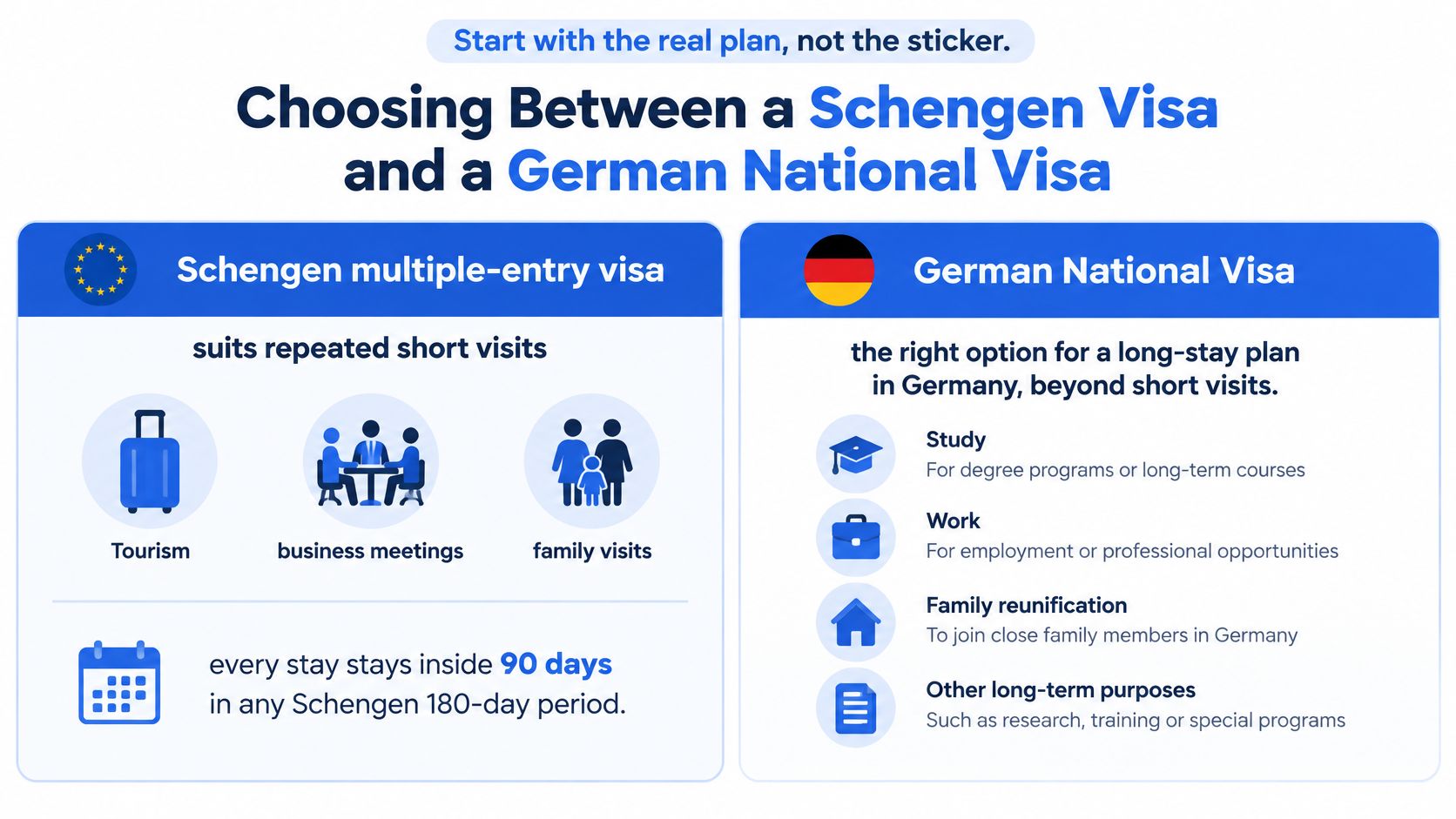
A traveler planning several short visits to Germany needs a different route from someone preparing to work, study, or join family there. Choose the visa that matches the purpose you can document.
When the Schengen Visa Fits
A Schengen multiple-entry visa can suit repeated short visits. Each trip must fit the permitted stay, and the traveler should return home between visits.
Common short-visit purposes include:
- Tourism: Leisure trips with a return home
- Business meetings: Meetings, conferences, and negotiations, rather than taking a job in Germany
- Family visits: Visits that fit within the available stay
The 90-days-in-any-180-day period limits time spent in the Schengen area. A multiple-entry visa may remain valid longer, but that validity does not increase the number of days a traveler may stay.
When the National Visa Fits
A German national visa is the route to consider for a planned stay longer than 90 days for a specific purpose. The application needs to support that purpose, such as:
- Work: Qualified employment in Germany, for example with a skilled worker visa
- Study: Admission to a course in Germany
- Family reunion: Joining an eligible family member in Germany
After arriving, the visa holder registers an address and applies for the corresponding residence permit at the local immigration office. The visa covers entry for the stated purpose; the residence permit governs the longer stay.
| Decision point | Schengen multiple-entry visa | German national visa |
|---|---|---|
| Best fit | Repeated short visits | A planned stay longer than 90 days for a specific purpose |
| Scope | Travel within the Schengen area | Entry to Germany for the stated purpose |
| Stay limit | 90 days in any 180-day period | A longer stay under the national visa and subsequent residence permit |
| After arrival | Leave within the permitted stay | Register an address and apply for the residence permit |
| Work or residence | Does not itself grant permission to work or reside long term | Rights depend on the purpose and the residence permit |
A national visa does not add tourist days, and a Schengen visa does not provide a work or family residence route. Choose the category that fits what you will actually do in Germany.
The overview of visa types for Germany can help identify the relevant category before applying.
The Verdict in Two Lines
Use a Schengen visa for short visits that fit the 90-in-180-day limit. For a planned move to Germany, assess the national visa route tied to the purpose.
That route may involve an EU Blue Card for qualified employment, family reunion, or, later, an application for permanent residence or citizenship if the requirements are met. LegalWeg supports applications for German citizenship, Blue Card, permanent residence, and family reunion, and takes care of the process from submission to the final decision.
If the intended stay has changed from visiting to living in Germany, assess the appropriate route before making another short visit.
Documents You Need Before You Apply
A document belongs in the file only if it supports the visa and purpose being requested. For example, an employment contract supports a work application, while travel bookings support a short visit.
The Seven Step File Check
Work through the file in order. Each step helps make the application complete and consistent.
- Check the passport: Confirm it is valid for the trip and has blank pages.
- Complete the form and photo: Follow the mission’s current specifications. LegalWeg’s guide to the visa application form can help with form fields.
- Arrange travel medical insurance: For a Schengen short stay, choose cover for the planned trips.
- Prove the purpose: Include an invitation, employer letter, or bookings that match the dates.
- Show funds and reasons to return: Document how the stay will be paid for and why the traveler will leave.
- Attach earlier visas and stamps: Include them when applying for multiple entries, so the travel history is clear.
- Use the right purpose documents for a national visa: Include an employment contract, university admission, or family documents, as relevant.
Why Each Document Exists
Each document answers a different question.
- Insurance shows that medical expenses during the trip are covered.
- Purpose documents show what the traveler plans to do and when. Dates across bookings, invitations, and letters should agree.
- Funds and return evidence help show that the traveler can pay for the visit and intends to leave.
- Earlier visas and stamps show how previous permissions were used.
For a national visa, the file must support the long-stay purpose. An employment contract can document work, university admission can document study, and family documents can support a reunion application.
After arrival, a residence permit application may follow the national visa. Allow time for that step when planning the move.
File discipline: A hotel booking does not support a job application. A work contract does not belong in a visitor file.
Fees and processing times vary by mission. Check the competent mission’s current instructions for local requirements, including document format and copies.
Make every copy complete and legible. Missing pages from an earlier visa can weaken the travel history the file is meant to show.
Travel Patterns That Raise Questions
Three short patterns show where the line sits. Many travelers will recognize their own calendar in one of them.

A specialist flies in for five-day meetings each quarter, then goes home. That pattern fits a multiple-entry visitor visa well.
A parent stays about 85 days, leaves for two weeks, and tries to return at once. The Schengen balance may already be used up.
A freelancer spends most of the year in Germany on a visitor visa. That pattern is no longer a series of short visits.
The wider picture explains why officers know these patterns. The European Commission statistical overview on migration to Europe reports that in 2024 more than 9.7 million Schengen visas were issued and 52% of visas were issued for multiple entries.
What Officers Look At
Officers look at the purpose of each trip. They also look at gaps between trips and the length of earlier stays.
- Purpose: Whether the stated reason matches the actual activity
- Gaps: Whether time at home looks like real residence elsewhere
- Stay length: Whether visits keep stretching toward the maximum
Frequent long stays with short absences can look like residence. That impression can form even when each entry stamp was valid.
Later visa officers read the same pattern. A stretched record can weaken the next application.
The switch has a clear name. A plan to live or work in Germany belongs on the national visa route, not on repeated visitor entries.
Stopping early protects the record. A clean visitor history stays useful evidence for whatever application comes next.
Travelers whose short trips have turned into a plan to live, work, or reunite with family in Germany can have the correct route assessed before the next entry puts their record at risk. LegalWeg handles German visa and residence cases, including EU Blue Card, family reunion, permanent residence, and citizenship applications, from submission to the final decision. Start with a case assessment at LegalWeg.